


Concrete pile integrity and steel pile integrity differ primarily in the types of defects that occur, the physical properties that testing must account for, and the methods best suited to detecting problems. Concrete piles are vulnerable to cracking, voids, and cross-section irregularities, while steel piles face corrosion, wall thinning, and weld failures. The material differences mean that no single testing approach works equally well for both pile types, and choosing the wrong method can leave serious defects undetected. The sections below work through the most important questions engineers and project teams face when assessing foundation integrity across both materials.
What makes concrete and steel piles structurally different?
Concrete and steel piles differ in material stiffness, cross-section consistency, and how they transfer load to the surrounding soil. Steel piles have a well-defined, uniform cross-section and a predictable elastic modulus, making their structural behavior relatively straightforward to model. Concrete piles, particularly cast-in-situ types, have variable cross-sections and a stiffness that depends on mix quality, curing conditions, and reinforcement placement.
These differences have direct consequences for integrity assessment. Steel piles behave predictably under stress wave analysis because their material properties are constant along the pile length. A stress wave traveling through a steel tube encounters a consistent medium, and any deviation in the wave signal points clearly to a structural anomaly.
Concrete piles present a more complex picture. Cast-in-situ concrete piles are formed in the ground, meaning the pile shaft takes on the shape of the borehole rather than a controlled factory mold. Cross-section area can vary along the pile length, and the concrete stiffness may differ between sections depending on how the pour was executed. This variability is not a defect in itself, but it makes interpreting test signals considerably harder, because natural variation and genuine damage can produce similar responses.
Precast concrete piles occupy a middle ground. They are manufactured under controlled conditions, giving them more consistent properties than cast-in-situ piles, but they remain more variable than steel and are susceptible to cracking during handling, transport, and driving.
What types of defects occur in concrete piles versus steel piles?
Concrete piles are most commonly affected by cracks, voids, soil inclusions, necking (a reduction in cross-section area), and bulging. Steel piles are primarily vulnerable to corrosion, wall thinning, weld defects, and buckling. The defect types reflect the fundamentally different failure mechanisms of each material.
Common defects in concrete piles
Cast-in-situ concrete piles can develop defects during installation if the concrete mix segregates, if groundwater infiltrates the fresh concrete, or if the casing is withdrawn too quickly. The result can be voids, soil pockets, or sections where the concrete is weak or missing entirely. Necking occurs when the borehole collapses inward before the concrete sets, reducing the effective pile diameter at that point.
Precast and driven concrete piles face a different set of risks. Horizontal cracks can form during driving if tensile stresses in the pile exceed the concrete’s tensile strength. Early refusal, where a pile stops penetrating before reaching the design depth, can also indicate a broken pile rather than a competent bearing layer. Cracks can also develop during handling and transportation before the pile ever reaches the ground.
Common defects in steel piles
Steel piles are structurally robust during installation but degrade over time through corrosion, particularly in marine and coastal environments where the pile passes through the splash zone. Wall thinning reduces the pile’s cross-sectional area and load-carrying capacity gradually, making it a long-term integrity concern rather than an installation risk. Weld defects at splices are another important failure point, especially in driven steel tube piles where sections are joined on site under time pressure. Buckling can occur if a pile encounters an unexpected obstruction during driving or if lateral loads exceed the pile’s slenderness capacity.
How does pile integrity testing work differently for concrete and steel?
Pile integrity testing works by analyzing how stress waves or other signals travel through a pile and reflect back from changes in material properties or geometry. For steel piles, the consistent material properties make signal interpretation more straightforward. For concrete piles, variable cross-sections and stiffness introduce ambiguity that requires more careful analysis and, in many cases, supplementary testing methods.
In dynamic-based methods, a hammer impact at the pile head generates a stress wave that travels down the pile. When the wave encounters a change in impedance, which is a function of cross-section area and material stiffness, part of the wave reflects back to the surface. Engineers analyze the timing and magnitude of these reflections to locate anomalies.
For steel piles, this process is relatively clean. The pile’s impedance is well-defined and constant, so a reflection signals a genuine change in the pile, whether a defect, a splice, or the pile toe. Signal matching using software such as AllWave-DLT can produce reliable results when the pile geometry is known and consistent.
For concrete piles, the same wave-based approach is more difficult to apply with confidence. Natural variation in cross-section area along a cast-in-situ pile produces impedance changes that can mimic defect signals. The concrete’s elastic modulus also depends on mix quality and curing, and these values are not always precisely known. This means that interpreting a reflection as a defect versus natural variation requires significant engineering judgment, and the risk of both false positives and missed defects is higher than for steel.
Which integrity testing methods are best suited to each pile type?
Sonic Integrity Testing (SIT) is the primary method for concrete piles, particularly cast-in-situ types, offering a fast and cost-effective first check on pile quality. Dynamic Load Testing (DLT) is well-suited to driven steel piles in granular soils, where material consistency supports accurate signal matching. For large-diameter bored concrete piles, Sonic Logging provides more detailed cross-sectional information than surface-based methods alone.
- Sonic Integrity Testing (SIT): Developed specifically for concrete piles, SIT applies a low-strain impact at the pile head and records the returning wave. It detects cracks, changes in cross-section, soil inclusions, and voids. The method is fast enough to test every pile on a site, making it a practical quality control tool for cast-in-situ and precast concrete piles alike.
- Sonic Logging: For large-diameter bored piles and diaphragm walls, sensors are lowered into pre-installed tubes cast into the concrete. A sonic signal passes between a transmitter and receiver, and variations in signal travel time and amplitude reveal defects and concrete quality across the pile cross-section. Sonic Logging provides more spatial resolution than SIT and is particularly useful where pile diameter makes surface-based methods less reliable.
- Dynamic Load Testing (DLT): Best suited to driven steel piles with a constant cross-section and the toe in granular soil. Under these conditions, bearing capacity estimates from DLT can fall within 10 to 20 percent of static load test results. For cast-in-situ concrete piles, DLT accuracy drops considerably, with estimates falling at best within 20 to 40 percent of static results, because variable cross-section and stiffness undermine signal matching quality.
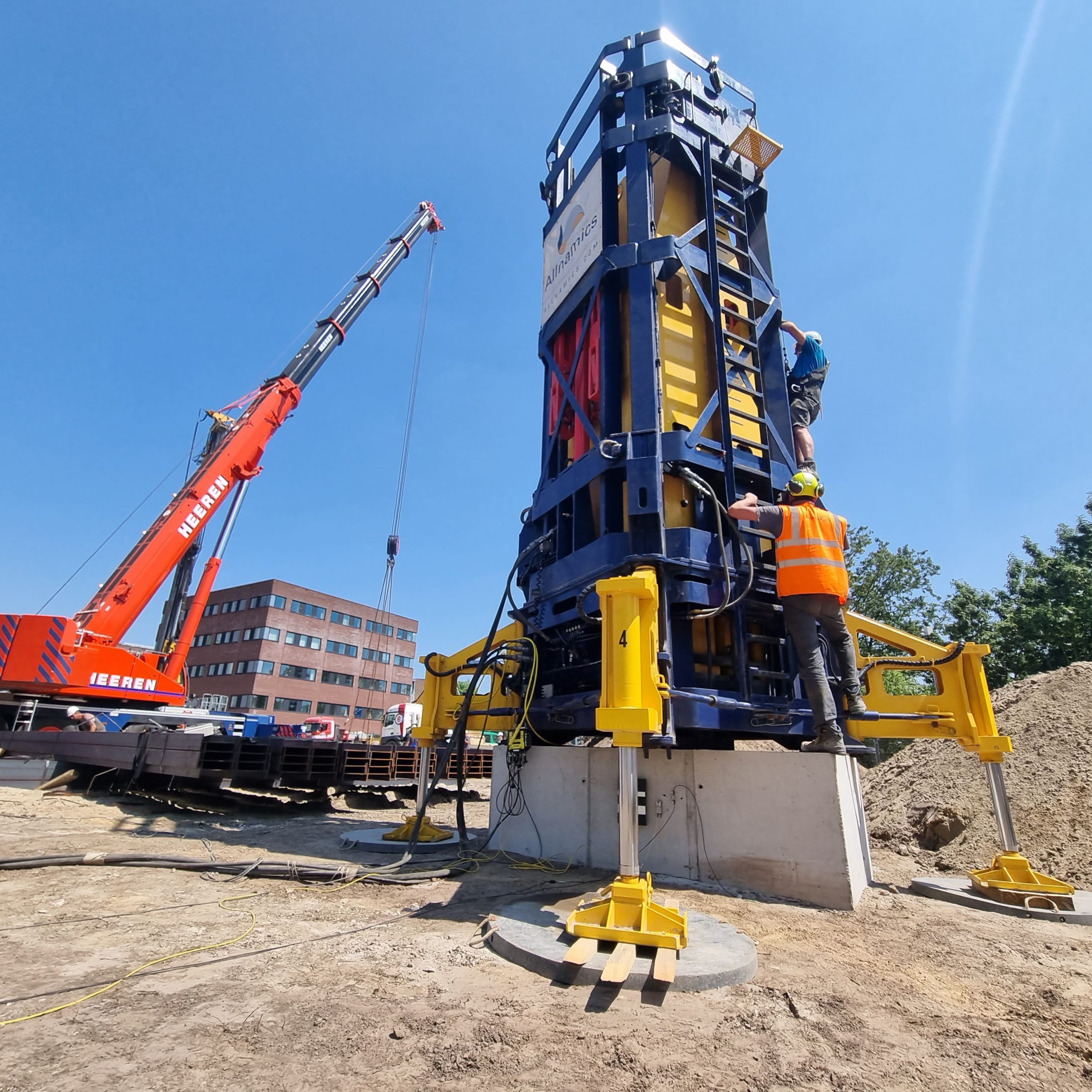
- Static Load Testing (SLT) and Rapid Load Testing (RLT): These methods measure force and displacement directly and independently, making them the most reliable option for large-diameter bored concrete piles where load-settlement behavior governs design. They are not affected by the material variability that limits dynamic methods on concrete piles.
For a pile load testing program on mixed pile types, the most effective approach typically combines SIT for broad quality control across all concrete piles, supplemented by Sonic Logging on selected large-diameter piles, and DLT or static testing for capacity verification on steel or precast driven piles.
Why is corrosion a unique integrity concern for steel piles?
Corrosion is a unique integrity concern for steel piles because it degrades the pile gradually and invisibly, reducing wall thickness and load-carrying capacity over years or decades without any visible surface indication. Unlike a crack in a concrete pile, which forms at a specific moment and remains relatively stable, corrosion is an ongoing process that continues as long as the pile is exposed to aggressive conditions.
The rate of corrosion depends heavily on the environment. Steel piles in marine environments face the most aggressive conditions, particularly in the splash zone where the pile alternates between wet and dry exposure, and in the tidal zone where oxygen availability accelerates electrochemical reactions. Piles in contaminated soils or near industrial sites can also experience accelerated corrosion from chemical attack.
Wall thinning from corrosion reduces the pile’s cross-sectional area, which directly reduces both its axial load capacity and its resistance to lateral forces. In tubular steel piles, significant wall loss can also compromise the pile’s ability to resist buckling under combined loading. Because this process is gradual, a pile that passed inspection at installation may have lost meaningful structural capacity years later without any obvious external sign.
Assessing corrosion in existing steel piles requires methods that can measure wall thickness directly, such as ultrasonic thickness gauging, or that can detect section loss through electromagnetic or eddy current techniques. Visual inspection alone is insufficient, particularly for submerged or buried sections where the most aggressive corrosion often occurs out of sight.
When should existing concrete or steel pile foundations be retested?
Existing concrete or steel pile foundations should be retested when the structure above shows signs of settlement or distress, when the foundation has been exposed to an event that could have caused damage, when the pile type or environment makes long-term degradation likely, or when a change in building use increases the loads the foundation must carry.
Specific triggers for retesting include:
- Visible structural distress: Cracking in walls, floors, or structural elements, differential settlement, or doors and windows that no longer close correctly can all indicate foundation movement or capacity loss.
- Damage events: Nearby construction, vibrations from pile driving or demolition, flooding, scour, or seismic activity can all affect foundation integrity and warrant reassessment.
- Age and environment: Steel piles in marine or chemically aggressive environments should be inspected and tested periodically, as corrosion progresses over time. Concrete piles in aggressive groundwater conditions may also deteriorate.
- Change of use or increased loading: If a building is being redeveloped, extended, or converted to a heavier use, the existing foundation must be assessed to confirm it can carry the new loads before work proceeds.
- Foundation reuse studies: When an existing structure is being demolished and the site redeveloped, retesting the existing piles can determine whether they can be reused in the new foundation, reducing construction waste and carbon emissions.
For concrete piles, retesting typically begins with SIT to screen for structural anomalies, followed by Sonic Logging or static testing where SIT results raise concerns. For steel piles, wall thickness measurements and visual or remotely operated vehicle (ROV) inspection of submerged sections are the starting point, with dynamic or static load testing used to verify residual capacity where section loss has been identified.
How We Help with Pile Integrity Assessment
We work with engineers, contractors, asset owners, and developers across the full range of pile integrity challenges, from quality control during installation to forensic assessment of existing foundations. Our approach combines decades of experience in both concrete and steel pile testing with in-house developed equipment and software that gives you reliable, defensible results.
Here is what we provide for pile integrity projects:
- Sonic Integrity Testing (SIT): Fast, site-wide quality control for concrete piles, developed by our founders and refined over decades of application on projects worldwide.
- Sonic Logging: Detailed cross-section assessment for large-diameter bored piles and diaphragm walls, using sensors lowered into pre-installed tubes to map concrete quality across the full pile diameter.
- Dynamic Load Testing with AllWave-DLT signal matching: Capacity verification for driven steel piles, interpreted by experienced engineers using our own software to minimize user dependency and deliver the most reliable results the method can provide.
- Static Load Testing and Rapid Load Testing: Direct, unambiguous load-settlement data for concrete piles where dynamic methods are insufficient, including our proprietary StatRapid system for high-capacity applications.
- Pile damage analysis and forensic investigation: When piles are broken, cracked, or behaving unexpectedly, we analyze installation records and test data to identify the cause and propose remedial actions.
- Foundation reuse assessments: We test and evaluate existing concrete and steel pile foundations to determine whether they can be reused in redevelopment projects, supporting your sustainability and carbon-reduction objectives.
If your project involves concrete piles, steel piles, or a combination of both, and you need independent integrity testing, capacity verification, or condition assessment, contact us to discuss your pile testing requirements for your specific pile types, soil conditions, and project requirements.