


Rapid Load Testing is significantly more accurate than its speed and cost might suggest when properly interpreted, results correlate well with Static Load Testing, typically within 10 to 15 percent for most soil and pile conditions. The key lies in applying the right analysis method to separate pile inertia and rate-dependent soil behavior from the measured response. The sections below unpack how that works, what affects accuracy, and when a rapid load test is the right choice for your project.
How does Rapid Load Testing measure pile bearing capacity?
Rapid Load Testing measures pile bearing capacity by applying a controlled axial compressive force to the pile head over a duration that is much longer than a Dynamic Load Test but far shorter than a Static Load Test. During the test, force and displacement at the pile head are recorded continuously. Because the load duration is long enough to suppress stress wave propagation through the pile, the pile can be treated as a single moving mass, which simplifies the analysis considerably.
The force in a Rapid Load Test is measured directly at the pile head using calibrated load cells. This is an important distinction from Dynamic Load Testing, where force is derived indirectly from measured strain combined with assumed pile material properties. Direct force measurement makes the result less sensitive to uncertainty about pile cross-section or concrete quality, a practical advantage for cast-in-place concrete piles where material properties can vary.
The raw measured force, however, does not equal the static bearing capacity. The recorded response includes two additional components that must be removed before the result is meaningful:
- Pile inertia: the force required to accelerate the pile mass itself
- Rate-dependent soil resistance: additional resistance generated by the high loading velocity, which would not be present under static conditions
Stripping out these components through an appropriate analysis method is what converts the raw rapid load test signal into an estimate of static pile resistance. Rapid Load Testing is governed by standards including ISO 22477-10:2016 and, in the Netherlands, NEN 7201:2025, both of which define the load duration criteria that distinguish it from conventional impact testing.
How well does Rapid Load Testing correlate with Static Load Testing results?
When correctly analyzed, Rapid Load Testing results correlate closely with Static Load Testing. Research programs and comparative studies carried out since the early development of Statnamic, the best-known form of Rapid Load Testing, consistently show that interpreted RLT capacity estimates fall within approximately 10 to 15 percent of static test results for a wide range of pile types and soil conditions. This level of agreement is generally considered acceptable for foundation design verification.
The correlation is strongest when the test conditions meet the load duration criteria defined in the applicable standard, when the pile behaves as a rigid body during the relevant part of the test, and when the analysis method accounts correctly for soil damping. Correlation tends to be tighter for piles in predominantly frictional soils than for piles with significant end bearing in very stiff or hard materials, where rate effects on soil resistance can be more pronounced and harder to quantify.
Early comparative studies in the Netherlands, including work carried out in Rotterdam and Arnhem, and subsequent international research programs provided the empirical foundation for the current standards. The Japanese Geotechnical Society published the first formal standard for Rapid Load Testing in 2002, followed by ASTM D7383 and ISO 22477-10, all of which reflect accumulated evidence of reliable correlation with static results when the method is applied correctly.
What factors affect the accuracy of Rapid Load Testing?
Several factors influence how accurately a rapid load test reflects static pile bearing capacity. The most important are load duration, soil type, pile geometry, and the quality of the analysis method applied to the results.
Load duration relative to pile and soil properties
The load must last long enough to suppress stress wave effects in the pile. This is determined by pile length, pile cross-section, and the speed at which stress waves travel through the pile material. If the load duration is too short, the pile does not behave as a single moving mass and the analysis becomes more complex. ISO 22477-10 and NEN 7201:2025 both define minimum load duration criteria based on this relationship. For large-diameter piles or piles in soft soils, wave effects in the surrounding ground can also influence the required duration.
Rate-dependent soil behavior
Soil resistance measured during a rapid load test is higher than under static conditions because of viscous damping: the soil resists faster movement more strongly. The magnitude of this rate effect depends on soil type, pore water pressure response, and the velocity of pile movement during the test. Typical pile velocities during a Rapid Load Test range from roughly 0.1 to 2 meters per second. Correctly estimating and removing the velocity-dependent component is one of the main sources of uncertainty in RLT interpretation, and it requires careful selection of damping parameters.
Pile type and material properties
For precast concrete piles and steel piles, material properties are well defined and introduce little uncertainty. For cast-in-place concrete piles, actual cross-section and concrete quality may vary along the pile length. Since force in a rapid load test is measured directly via load cells rather than derived from strain, this uncertainty has less impact on RLT than on Dynamic Load Testing, but it still affects displacement measurement and inertia correction.
What is the Unloading Point Method and how does it improve RLT accuracy?
The Unloading Point Method is the most widely used analysis technique for interpreting Rapid Load Test results. It improves accuracy by isolating the static soil resistance from the total measured force, which also contains contributions from pile inertia and rate-dependent damping. The method uses the point in the test where pile velocity returns to zero, the unloading point, as a reference to estimate the static resistance component.
At the unloading point, pile velocity is zero, which means the velocity-dependent damping force is also zero. This allows the static resistance to be calculated directly from the measured force minus the inertia correction at that specific moment. The method then uses a damping model to reconstruct the full static load-displacement curve from the test record.
The Unloading Point Method was developed alongside the Statnamic method and has been refined through decades of comparative research. Its main advantage is that it provides a full load-settlement curve rather than just a single capacity value, which makes the result directly comparable to a static load test output. More advanced variants, including the Segmental Unloading Point Method, extend the approach to piles where the rigid body assumption is less straightforward, improving accuracy for longer or more flexible piles.
Selecting appropriate damping parameters remains the most judgment-sensitive step. Experienced interpretation, combined with knowledge of the soil profile and pile behavior, is what separates a reliable result from an uncertain one.
When should Rapid Load Testing be used instead of Static Load Testing?
Rapid Load Testing is the better choice when a Static Load Test would require a large, costly reaction system, when the project timeline does not allow for the extended load application periods of a static test, or when the pile diameter or load level makes conventional static testing impractical. RLT delivers comparable accuracy at significantly lower cost and with much faster mobilization.
Specific situations where Rapid Load Testing is particularly well suited include:
- Large-diameter bored or cast-in-place piles where Dynamic Load Testing would require impact energies that risk damaging the pile head
- High-capacity piles where the reaction structure for a static test would be disproportionately expensive
- Offshore or marine projects where mobilizing static test equipment is logistically complex
- Supplementary verification after a bi-directional or static test has not fully mobilized pile resistance
- Projects with multiple piles to test where the speed of RLT allows more piles to be tested within the same budget
A practical example: in a Barcelona project involving large-diameter in-situ concrete piles with working loads between 6 and 8 MN, Rapid Load Testing with the StatRapid system was selected after a bi-directional static test did not fully mobilize resistance. Dynamic Load Testing was considered less suitable because the required impact energy posed a risk of excessive pile head stresses. The spring-based loading system of the StatRapid reduced peak stresses at the pile head while still generating the required force level.
Static Load Testing remains the reference method and is preferred when the full load-settlement behavior must be observed directly, when regulatory requirements specify it, or when the soil and pile conditions make rate-effect corrections particularly uncertain.
Can Rapid Load Testing results be used directly for foundation design?
No, raw Rapid Load Test results cannot be used directly for foundation design without further processing. The maximum force measured during a rapid load test includes pile inertia and rate-dependent soil resistance, both of which must be removed through analysis before the result represents static bearing capacity. Once correctly interpreted, however, the output can be used for design in the same way as a Static Load Test result.
The interpreted load-displacement curve from a Rapid Load Test, produced using the Unloading Point Method or an equivalent approach, provides the equivalent of a static load-settlement relationship. This can be used to verify pile capacity, confirm design assumptions, or calibrate pile design models. Most national and international standards that govern pile design accept interpreted RLT results as a valid basis for capacity verification, provided the test and analysis comply with the relevant standard, such as ISO 22477-10 or NEN 7201:2025.
One important consideration is that the interpreted static capacity from an RLT represents the resistance mobilized at the displacement achieved during the test. If the pile was not loaded to its ultimate capacity, the result reflects a lower-bound estimate rather than the full available resistance. Your design team should confirm that the test displacement is sufficient to mobilize the resistance level relevant to the design limit state.
How Allnamics Supports Your Rapid Load Testing Program
We combine decades of experience in pile testing with in-house-developed equipment and analysis tools to deliver Rapid Load Testing programs that produce reliable, design-ready results. Our involvement in the development of Statnamic and the StatRapid system means we understand the method from the ground up, not just how to run the test, but how to interpret it correctly for your specific pile and soil conditions.
When you work with us on a rapid load test program, we provide:
- Test design and planning: selecting the right load level, load duration, and instrumentation setup based on your pile geometry, soil profile, and design requirements
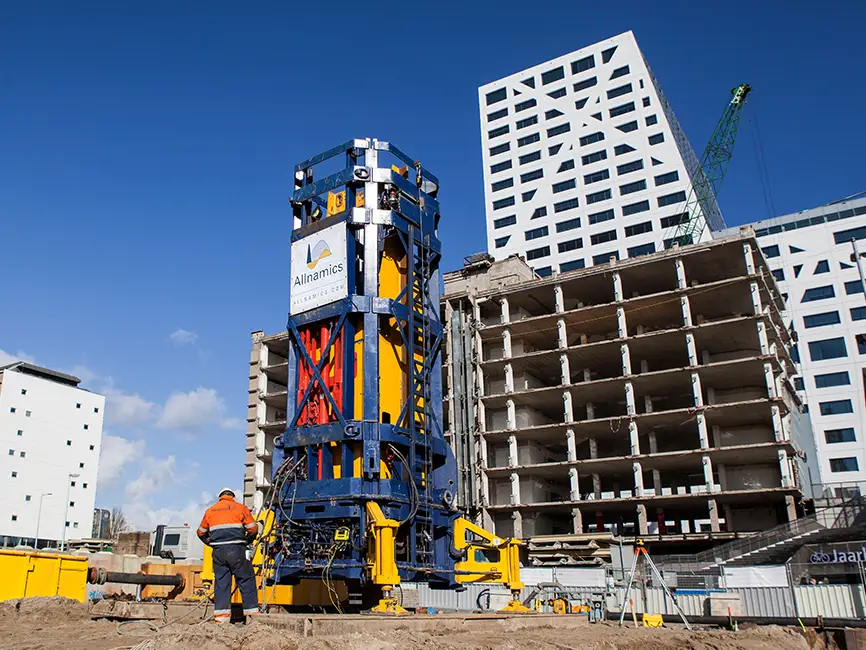
- StatRapid execution: using our spring-based drop mass system, which generates controlled load durations and reduces peak stresses at the pile head, particularly relevant for large-diameter cast-in-place concrete piles
- Expert signal interpretation: applying the Unloading Point Method and, where needed, more advanced analysis approaches to produce a full static load-displacement curve
- Compliance with standards: ensuring the test and analysis meet ISO 22477-10, NEN 7201:2025, or other applicable national standards relevant to your project
- Independent technical review: providing a second opinion on RLT results from other parties, or integrating RLT results with Dynamic Load Testing or Static Load Testing data from the same project
Whether you need a single verification test or a full testing program across multiple piles, we tailor the approach to your project’s technical and commercial constraints. Contact us to discuss your pile testing requirements and find out how Rapid Load Testing can work for your foundation design.