


Pile load testing delivers direct, measurable benefits for offshore foundations by verifying that piles achieve the required bearing capacity, structural integrity, and performance under real loading conditions before full construction proceeds. For offshore wind farms, oil and gas platforms, and marine infrastructure, this verification reduces the risk of foundation failure in environments where remediation is costly and technically complex. The sections below address the most common questions about offshore pile load testing in detail.
How does pile load testing verify offshore foundation performance?
Pile load testing verifies offshore foundation performance by applying controlled loads to installed piles and measuring their response in terms of displacement, capacity, and structural behavior. The results confirm whether a pile performs as designed under the actual soil and loading conditions at the specific offshore site, rather than relying solely on predictive models.
Offshore soil conditions are highly variable and often difficult to characterize fully from soil investigation data alone. Factors such as layered seabed geology, scour, cyclic wave loading, and lateral forces from currents all influence how a pile behaves in service. Load testing captures this real-world behavior directly, giving engineers reliable data to validate or refine their design assumptions.
The test results also provide a benchmark for comparing pile performance across a foundation group. Where individual piles show variation in measured capacity, engineers can identify whether that variation falls within acceptable tolerances or signals a problem requiring attention before the topside is installed.
What types of pile load tests are used for offshore foundations?
Dynamic Load Testing (DLT) and Rapid Load Testing (RLT) are the most commonly applied methods for offshore pile load testing, with Static Load Testing (SLT) used where site conditions and project requirements allow. Each method suits different pile types, installation methods, and project constraints.
- Dynamic Load Testing (DLT): Sensors attached to the pile measure force and velocity (indirectly from strain and acceleration data) during a hammer impact. Indirect signal matching analysis then derives a soil model that is used to estimate bearing capacity, soil resistance distribution, and pile integrity. DLT is well-suited to driven piles and can be performed during and direct after installation, making it efficient for large offshore programs.
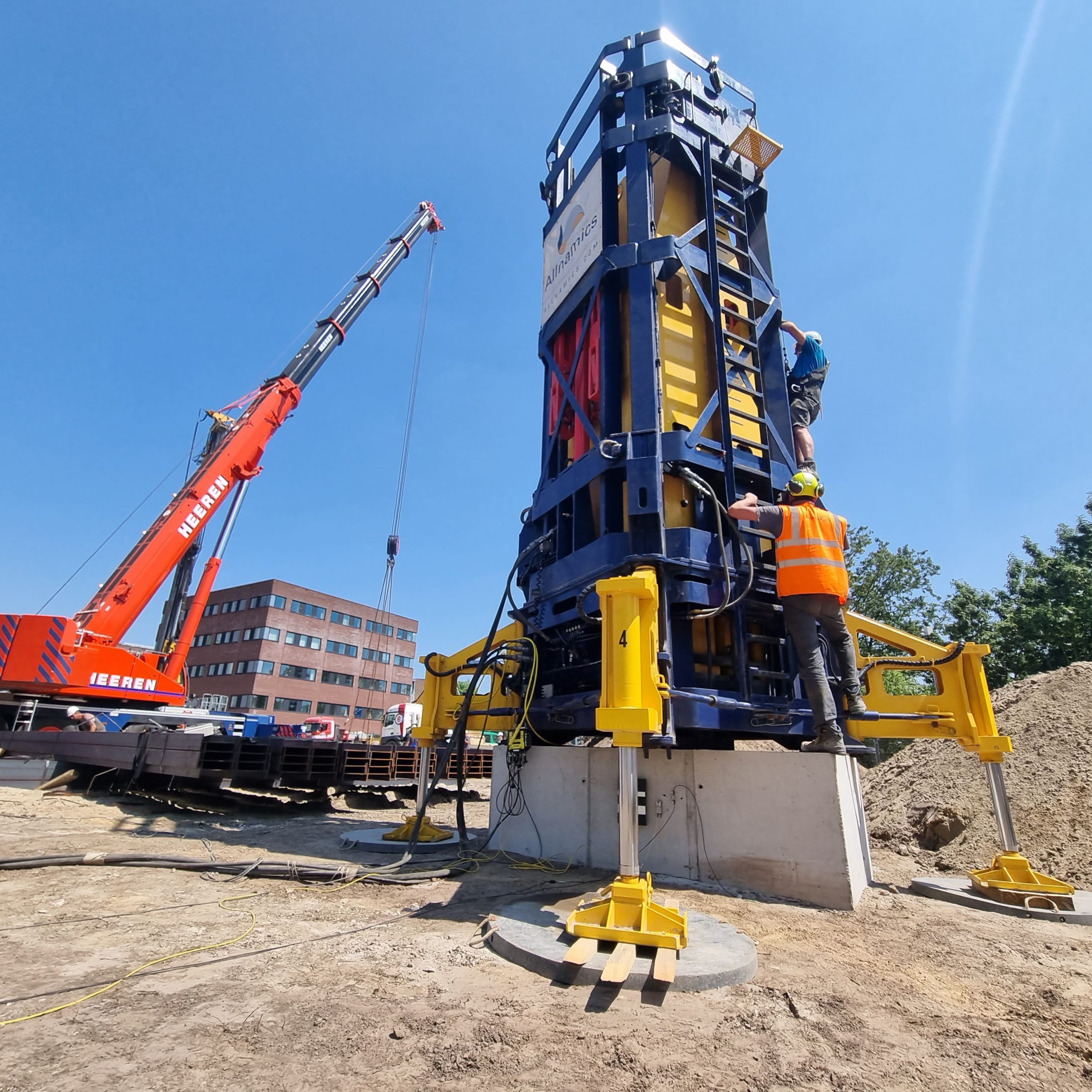
- Rapid Load Testing (RLT): StatRapid, Statnamic: RLT is a direct method that measures load and settlement during a controlled impulse load applied over a significantly longer duration than a DLT. As a result, stress wave effects are eliminated, and the accuracy of the capacity determination is significantly increased. RLT is useful where dynamic testing alone may not capture the full soil response.
- Static Load Testing (SLT): A direct, sustained load is applied and pile head displacement is measured. SLT provides the most straightforward interpretation of pile capacity but requires a reaction system, either by tensile anchors or a kentledge setup, which adds logistical complexity offshore.
The choice of method depends on pile dimensions, installation technique, water depth, vessel availability, and the level of certainty in capacity required by the project. On large offshore wind foundation programs, DLT during driving is often the most practical approach for testing a statistically meaningful number of piles within schedule and budget.
How does pile testing reduce risk during offshore construction?
Pile testing reduces offshore construction risk by identifying underperforming piles early, before the superstructure is installed and remediation becomes prohibitively expensive. Catching a capacity shortfall or structural defect at the piling stage is far more manageable than discovering a foundation problem after a jacket, monopile transition piece, or platform deck is in place.
Beyond individual pile performance, testing data supports better decision-making across the full foundation program. If early test results show that piles are consistently achieving higher capacity than the design predicted, it may be possible to reduce pile length or adjust installation criteria for the remaining piles, generating cost savings at scale (as well as reduction of material use, carbon emissions, and project time). Conversely, if results fall short of predictions, the installation program can be adjusted before the issue compounds.
Testing during installation also provides real-time monitoring of driving stresses. Excessive tensile or compressive stresses during driving can damage piles before they ever carry a structural load. Monitoring these stresses with instrumentation allows the installation team to adjust hammer energy or driving sequence to stay within safe limits.
Why is pile integrity testing critical for offshore structures?
Pile integrity testing is important for offshore structures because it detects structural damage or defects that visual inspection cannot reveal. Offshore piles are subject to aggressive installation conditions, corrosive marine environments, and cyclic loading throughout their service life, all of which can compromise pile continuity without any visible external sign.
During installation, driven piles can develop cracks or local damage from excessive driving stresses, particularly in hard driving conditions or when obstructions are encountered. Dynamic Load Testing during or after installation confirms whether the pile shaft is structurally sound before the foundation is loaded.
For offshore wind foundations in particular, where turbines are designed for operational lifespans of 25 years or more, confirming pile integrity at installation supports long-term asset reliability and informs maintenance planning.
When should offshore pile load testing be carried out?
Offshore pile load testing should be carried out at three key stages: during the design phase using preliminary test piles, during the main installation program as production testing, and after installation for establishing set-up factors. The timing at each stage serves a different purpose.
- Pre-production test piles: Installed and tested before the main foundation program begins, these piles validate design assumptions and installation criteria under actual site conditions. Results can be used to refine pile design, adjust installation specifications, or confirm that the chosen method is appropriate.
- Production testing during installation: A defined proportion of production piles are tested as they are installed. This provides ongoing quality assurance and flags any piles that deviate from expected performance before the program advances.
- Post-installation testing: After installation, piles can be re-tested (prior to installation of topside) to verify and quantify the increase in capacity due to set-up.
The number of piles tested at each stage is typically governed by project specifications, applicable standards, and risk-based decisions made during the design phase. Testing a higher proportion of piles in variable or challenging ground conditions is generally advisable.
How do pile load test results support offshore project compliance and reporting?
Pile load test results support compliance by providing documented evidence that installed foundations meet the performance criteria specified in the design, contract, and applicable standards. For offshore projects subject to regulatory oversight, certification requirements, or lender technical due diligence, this documented evidence is a formal project deliverable.
Test reports typically include derived capacity values, driving records, signal matching analyses, and integrity assessment outcomes. These records demonstrate that the foundation system was installed and verified in accordance with the approved design and relevant standards such as ISO, DNV, or API guidelines, depending on the project type and jurisdiction.
For offshore wind projects in particular, certification bodies and grid connection authorities often require foundation verification data as part of the approval process. Load test results also feed directly into structural analyses and fatigue assessments, improving the accuracy of the models used to predict long-term performance. Well-documented test data strengthens the overall technical file for the project and supports insurance, financing, and operational handover requirements.
How Allnamics Supports Offshore Pile Load Testing
We provide the full range of pile load testing services for offshore foundations, from pre-production test programs through to production monitoring and in-service condition assessments. Our team combines decades of experience in offshore foundation engineering with in-house developed instrumentation and software that deliver accurate, reliable results in demanding marine environments.
Here is what working with us on an offshore pile testing program typically includes:
- Test program design: We help you define the scope, testing method, and acceptance criteria based on your project’s ground conditions, pile type, and applicable standards.
- Dynamic Load Testing during installation: Our engineers mobilize offshore to perform DLT on driven piles, providing real-time capacity and driving stress data throughout the installation program.
- Rapid Load Testing and Static Load Testing: Where DLT alone is insufficient, we apply RLT or SLT to provide higher-confidence capacity verification for critical foundation elements.
- Signal matching and reporting: Using the AllWave software package and our in-house analysis expertise, we deliver detailed test reports that meet certification, regulatory, and lender requirements.
- Offshore monitoring and installation support: Beyond testing, we provide continuous monitoring of driving stresses, pile behavior, and installation parameters to keep your program within safe and efficient limits.
If your project involves offshore foundation verification, contact us to discuss your testing program from design through to final reporting.