


Pile length directly influences load bearing behaviour by determining how much of a pile’s capacity comes from shaft friction along its sides versus resistance at its toe. Longer piles engage more soil along their embedded length, which increases the shaft friction contribution and generally raises total capacity, though the relationship is not simply linear. The sections below unpack the specific mechanisms behind this, from load transfer and stiffness to soil interaction and design optimisation.
How does pile length affect the distribution of skin friction and end bearing?
Pile length determines the relative balance between shaft friction and end bearing by controlling how much pile surface area contacts the surrounding soil. A longer pile develops more skin friction along its shaft, while end bearing remains governed primarily by the soil conditions at the pile toe rather than by pile length alone. In many practical cases, shaft friction dominates total capacity as length increases.
When a load is applied at the pile head, it is transferred progressively downward through the pile into the surrounding soil. Skin friction, also called shaft resistance, mobilises first because it requires only small relative displacements between the pile surface and the soil. End bearing, by contrast, requires larger pile toe movement to fully mobilise. This sequence means that in a long pile, a significant portion of the applied load may already be transferred to the soil through friction before any meaningful stress reaches the toe.
The practical implication is that two piles of different lengths installed in the same soil profile can exhibit very different load transfer profiles, even if their diameters and materials are identical. A short pile may rely heavily on end bearing if its toe sits in a competent bearing layer. A longer pile passing through softer material before reaching that layer will accumulate shaft friction along the way, reducing the proportion of load that ultimately reaches the toe. Understanding this distribution is important for both design efficiency and for interpreting pile load test results accurately.
What happens to pile stiffness and settlement as length increases?
As pile length increases, axial stiffness generally decreases and settlement under load tends to increase, because a longer pile compresses more under the same applied force. However, the additional shaft friction mobilised along the greater embedded length can offset this by reducing the load that reaches the toe, which in turn limits toe settlement.
Pile stiffness under axial loading depends on both the elastic compression of the pile material and the stiffness of the soil-pile interaction along the shaft and at the toe. For a pile of constant cross-section, elastic compression increases with length, meaning the pile head will displace more for the same applied load compared to a shorter pile of identical material and diameter. This is a structural effect independent of soil conditions.
At the same time, a longer pile distributes load across a larger contact area with the soil. If the soil along the additional shaft length provides meaningful resistance, the load reaching the toe is reduced. Since toe settlement is typically the largest contributor to total pile head displacement, reducing toe load can partially compensate for the increased elastic compression of the longer shaft. The net effect on settlement depends on the balance between these two competing factors, which is why soil stratigraphy plays such a determining role in predicting settlement behaviour for piles of different lengths.
Does a longer pile always mean higher load bearing capacity?
No, a longer pile does not always mean higher load bearing capacity. Capacity increases only when the additional pile length passes through or into soil that provides meaningful resistance. If the extra length runs through very soft or weak soil with negligible friction, the gain in capacity may be minimal while installation costs and structural demands increase significantly.
There are also situations where increasing pile length can introduce complications that reduce effective capacity or increase risk. Driving a pile through a weak intermediate layer to reach a deeper bearing stratum can expose the pile to buckling risk in the unsupported zone, particularly for slender piles. In layered soil profiles, a pile that is slightly too long may punch through a competent bearing layer into weaker material below, causing a sudden reduction in end bearing capacity.
Additionally, in certain soil types, very long piles can experience a phenomenon where the incremental shaft friction contribution per unit of additional length diminishes with depth. This occurs because lateral earth pressure, which governs how much friction the soil can develop against the pile surface, does not increase indefinitely with depth in all soil types. In granular soils, this effect has been well documented and means that simply adding length beyond a certain point produces diminishing returns in capacity. Verifying actual capacity through a pile load test for capacity verification remains the most reliable way to confirm whether the designed length achieves the required performance.
How does pile length interact with soil type and stratigraphy?
Pile length interacts with soil type and stratigraphy by determining which soil layers the pile engages, and each layer contributes differently to shaft friction and end bearing depending on its strength, stiffness, and drainage characteristics. The same pile length can produce very different capacity outcomes depending entirely on the soil profile it passes through.
Granular soils
In granular soils such as sand and gravel, shaft friction increases with depth because lateral earth pressure and effective stress both increase downward. Longer piles in granular profiles generally benefit from higher cumulative shaft friction, and end bearing in dense granular material can be substantial. Dynamic load testing tends to perform well in these conditions, making it a practical tool for verifying capacity across a driven pile program in granular stratigraphy.
Cohesive soils
In cohesive soils such as clay, the relationship between pile length and capacity is more complex. Shaft friction in clay depends on undrained shear strength, which varies with depth and consolidation history. Soft clay layers may contribute very little friction and can even impose negative skin friction, or downdrag, on the pile if the clay is consolidating under its own weight or under applied fill. A pile that passes through a thick soft clay layer to reach a bearing stratum must account for the downdrag force, which effectively adds to the structural load the pile must carry. In these conditions, pile length selection requires careful analysis of the full stratigraphy rather than a simple depth-to-bearing-layer calculation.
How is the optimal pile length determined in foundation design?
The optimal pile length is determined by identifying the depth at which the pile achieves the required bearing capacity with acceptable settlement, at the lowest practical installation cost and risk. This involves analysing soil investigation data, calculating load transfer along candidate pile lengths, and verifying assumptions through pile load testing on trial or preliminary piles.
The design process typically begins with a geotechnical site investigation that characterises the soil profile, including layer boundaries, strength parameters, and groundwater conditions. Engineers then use this data to calculate predicted shaft friction and end bearing for different pile lengths, often using analytical methods or numerical models. The target length is the shortest pile that satisfies both capacity and settlement criteria under the governing load combinations.
Several factors refine this initial estimate:
- Safety margins and variability: Soil properties vary across a site, so the design must account for the weakest expected conditions, not just the average profile.
- Installation method: Driven piles and bored piles interact with soil differently during installation, which affects the friction and end bearing values that can be reliably assumed in design.
- Load type: Axial compression, tension, and lateral loads each engage the pile differently, and the governing load case may point to different optimal lengths.
- Pile group effects: When piles are installed in groups, the overlapping stress zones reduce the capacity of individual piles, which may require longer piles to compensate.
- Verification testing: A pile load test on a trial pile at the proposed length confirms whether the design assumptions hold under real site conditions, allowing length adjustments before the full production pile program begins.
In practice, the optimal length is rarely determined by calculation alone. Testing a trial pile at the proposed design length and comparing measured capacity against the prediction is the most direct way to validate the design and reduce the risk of over- or under-designing the foundation.
How We Help You Determine the Right Pile Length
Getting pile length right from the start saves time, reduces material costs, and avoids the risk of under-performing foundations. We support your team throughout the process of verifying and optimising pile length decisions, combining field testing expertise with decades of experience in foundation engineering.
Here is what we offer:
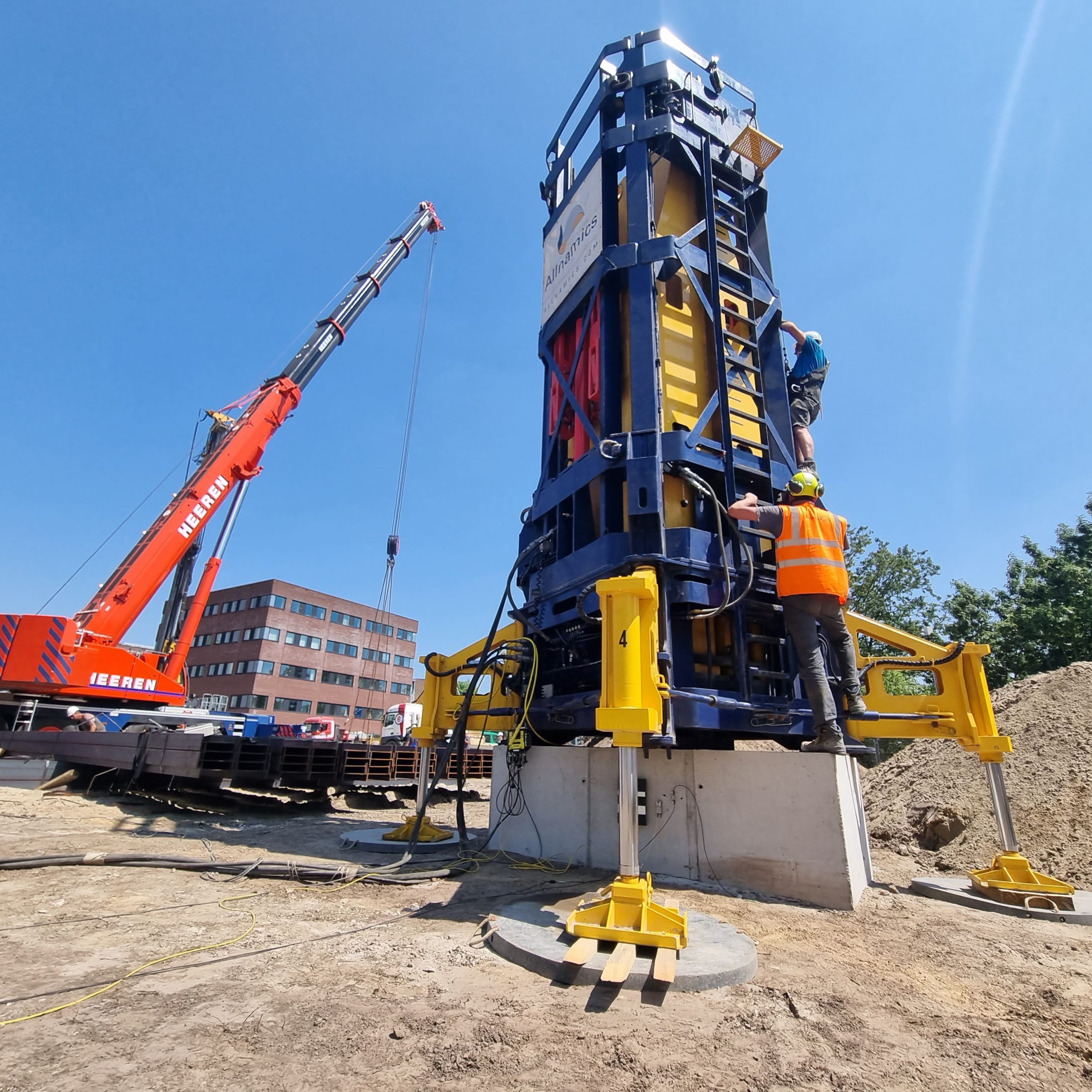
- Pile load testing services: We perform Static Load Testing, Dynamic Load Testing, and Rapid Load Testing to verify that your chosen pile length achieves the required bearing capacity and settlement performance under real site conditions.
- Signal matching and analysis: Our engineers use AllWave-DLT software to interpret dynamic test data with high accuracy, giving you reliable capacity estimates that inform length optimisation decisions.
- Drivability studies: Before installation begins, we model pile behaviour during driving to assess whether the proposed length and pile type are compatible with the soil profile and available equipment.
- Pile integrity testing: We verify the structural quality of installed piles, identifying any damage or anomalies that could affect load transfer along the shaft or at the toe.
- Independent technical review: We provide expert assessment of existing foundation designs, helping you identify whether pile lengths are conservative, optimised, or in need of revision.
- Offshore and onshore capability: We operate in both environments, supporting foundation programs for offshore wind, marine infrastructure, civil construction, and urban development projects.
If your project involves complex stratigraphy, variable soil conditions, or high-consequence foundations where pile length decisions carry significant risk, contact us to discuss your project to discuss how we can support your team with testing, analysis, and independent verification.