


Yes, Rapid Load Testing can take creep into account, but it does not measure creep directly. Because a rapid load test applies force over a period of milliseconds to seconds rather than hours or days, the soil does not experience the sustained loading that produces creep deformation. The raw test result must therefore be interpreted with methods that account for time-dependent soil behaviour before it can be compared to a static load test result. The sections below explain how creep affects pile testing, why it matters specifically for RLT, and what correction approaches are available.
How does creep affect pile load test results?
Creep causes a pile to continue displacing under a constant load over time. In a static load test, this time-dependent deformation accumulates during each load increment, and the measured load-displacement curve already reflects that sustained response. In faster test methods, the soil does not have enough time to creep, so the measured resistance can differ from the long-term static capacity.
Creep is most pronounced in cohesive soils such as clay and silt. In these materials, pore water pressure changes slowly under load, and the soil skeleton continues to deform as excess pore pressures dissipate. In granular soils, creep is generally less significant because drainage occurs quickly and the soil response is more immediate.
For any pile load test, the practical consequence is that the measured resistance depends on how long the load is applied. A test that loads a pile quickly will mobilise a different soil response than one that holds the load for minutes or hours. Understanding this difference is the starting point for interpreting rapid load test results correctly.
Why is creep a specific challenge for Rapid Load Testing?
Creep is a particular challenge for Rapid Load Testing because the load duration is too short for time-dependent soil deformation to develop. A typical rapid load test applies force over a period of roughly 100 to 200 milliseconds. Creep in cohesive soils operates on a timescale of minutes to hours, so the soil simply does not have time to respond in the same way it would under sustained static loading.
This creates a systematic difference between the resistance measured during a rapid load test and the resistance that would be measured in a static load test on the same pile. The effect is known as a loading-rate effect: soil loaded quickly can exhibit higher apparent resistance than the same soil loaded slowly. Research into Statnamic testing in clay has shown that the measured failure load can increase meaningfully with each logarithmic increase in loading rate. Because this effect is real and measurable, it cannot be ignored when deriving a static-equivalent capacity from a rapid load test result.
A further complication is that loading-rate effects are not uniform across all soil types or conditions. Factors such as soil plasticity, overconsolidation ratio, soil structure, and even temperature can influence how strongly the rate effect manifests. This means that a single universal correction factor does not exist for all cohesive soils. The magnitude of the correction depends on the specific soil profile and pile configuration being tested.
What correction methods exist to account for creep in RLT?
The primary correction method used in Rapid Load Testing is the Unloading Point Method (UPM), which separates the measured force into components representing soil resistance, pile inertia, and velocity-dependent damping. By removing the inertial and damping contributions, the method derives a static-equivalent resistance from the rapid load test signal. This approach is recognised in international standards including ISO 22477-10 and ASTM D7383.
However, the Unloading Point Method addresses inertia and rate-dependent damping in a general sense. For cohesive soils where creep-related loading-rate effects are significant, additional soil-specific corrections may be needed on top of the standard UPM analysis. These corrections are typically applied as a reduction factor to the derived static-equivalent capacity, and their magnitude is established through one of the following approaches:
- Empirical correlation with static load tests: Comparing rapid load test results with static load tests on the same or similar piles in the same soil profile allows a project-specific correction factor to be established. This is the most reliable approach and is recommended by standards such as NEN 7201:2025 for certain test classes.
- Literature-based rate factors: Published research provides rate correction values derived from controlled testing programmes. These values can inform the analysis, but they should be applied with caution because they reflect specific soil and pile conditions that may not match the project at hand.
- Advanced numerical modelling: Soil models that explicitly represent rate-dependent behaviour and pore pressure response can be used to simulate the rapid load test and derive a more refined static-equivalent result. This approach requires detailed soil characterisation and specialist expertise.
It is important to note that none of these correction methods transforms a rapid load test into a direct measurement of static capacity. The corrected result is always a derived estimate, and its reliability depends on the quality of the test execution, the accuracy of the inertia correction, and the appropriateness of the rate correction for the soil conditions present.
How accurate are creep-corrected RLT results compared to static load tests?
When the test is executed correctly and the appropriate corrections are applied, creep-corrected rapid load test results can agree closely with static load test results in granular soils. In cohesive soils, the agreement is achievable but requires more careful analysis and, in many cases, project-specific calibration against a static reference test.
The accuracy of the corrected result depends on several factors working together:
- The load duration must be long enough to limit stress wave effects in the pile, so that the pile can be treated as a single moving mass during analysis.
- The measurement equipment must capture force and displacement accurately throughout the loading event.
- The inertia correction must reflect the actual mass distribution of the pile.
- The rate correction applied to account for loading-rate effects in the soil must be appropriate for the specific soil type and conditions.
- The pile must be loaded to a sufficient displacement level to mobilise the information needed. If failure is not reached, extrapolating an unobserved failure load from the load-displacement curve introduces additional uncertainty.
Where these conditions are met and a static reference test is available for calibration, the corrected rapid load test result can serve as a reliable indicator of static pile capacity. Where no static reference exists and the soil is highly cohesive, the result carries greater uncertainty and should be interpreted with that limitation clearly stated.
When should RLT be preferred despite creep limitations?
Rapid Load Testing is worth considering when high test loads are needed and a conventional static reaction system would be costly, time-consuming, or physically impractical. The method is also attractive when multiple piles need to be tested within a short programme, or when site constraints make a large static test frame difficult to install.
For cast-in-place concrete piles, a rapid load test can offer an advantage over Dynamic Load Testing because the force is measured directly and the longer load duration reduces peak stresses in the pile. This makes RLT a practical option for pile types that are sensitive to high-impact loading.
The creep-related limitations do not disqualify RLT in cohesive soils. They do mean that the test design, analysis, and interpretation must be handled with greater care. In practice, RLT in clay is most reliable when:
- The loading-rate effect for the relevant soil type has been assessed in advance.
- A project-specific correlation with a static load test is either available or planned as part of the test programme.
- The analysis is carried out by specialists with experience in rate-dependent soil behaviour and the applicable standards.
When these conditions are in place, the speed, cost efficiency, and logistical advantages of Rapid Load Testing can outweigh the additional analytical effort required to account for creep and loading-rate effects.
How We Support Rapid Load Testing Projects
At Allnamics, we carry out Rapid Load Testing as a complete service, from test design through to final interpretation. Our team combines direct field experience with in-depth knowledge of the standards and correction methods that apply to different soil conditions and pile types. When you work with us on a rapid load test project, we help you get results you can rely on.
Here is what we bring to your project:
- Test design tailored to your soil profile: We assess whether RLT is appropriate for your pile-soil combination and identify in advance whether loading-rate corrections will be needed.
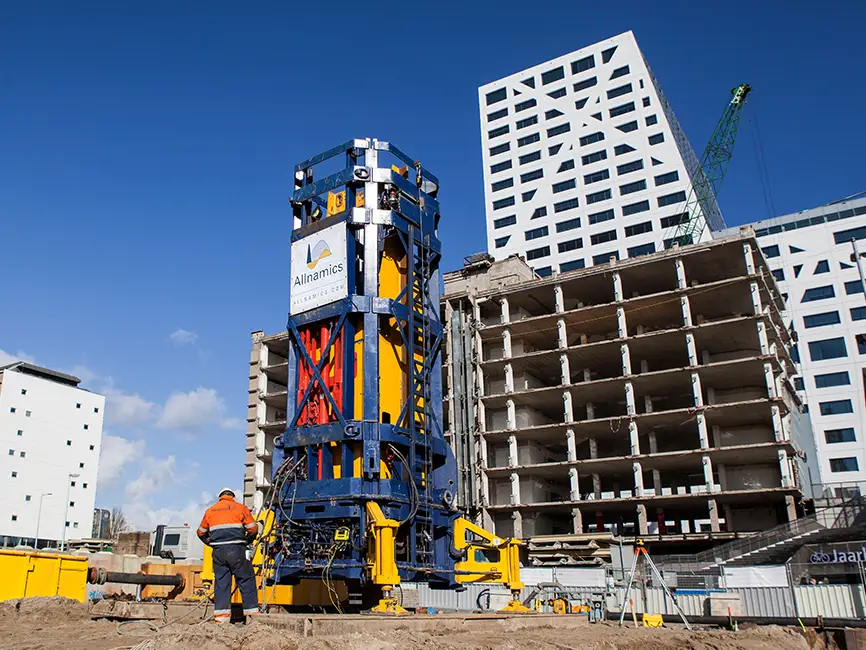
- StatRapid equipment: We use our own in-house-developed StatRapid system, which generates a controlled load pulse using a drop mass and spring assembly, giving you accurate force and displacement measurements throughout the test.
- Specialist interpretation: We apply the Unloading Point Method and, where the soil conditions require it, additional rate corrections informed by the relevant literature and project-specific data.
- Comparison with static reference tests: Where your project calls for calibration against a static load test, we can integrate both test types into a single programme and provide a combined analysis.
- Reporting aligned with applicable standards: Our reports reference ISO 22477-10, ASTM D7383, NEN 7201:2025, and other relevant standards, giving you documentation that supports regulatory review and project sign-off.
If you are planning a foundation testing programme and want to understand whether Rapid Load Testing is the right approach for your project, contact our team to discuss your specific conditions and requirements.