

Pile driving in chalk is difficult to predict because chalk behaves unlike any other weak rock or soft soil. Its response to driving can shift from near-free penetration to sudden refusal within the same profile, and conventional soil resistance models built for sand or clay fail to capture the mechanisms that govern chalk’s behavior. The sections below address the most common questions engineers face when planning pile installation through chalk formations.
Why does chalk behave so differently from other weak rocks during pile driving?
Chalk behaves differently from other weak rocks because its structure degrades rapidly under repeated loading, producing a remolded material at the pile-soil interface that bears little resemblance to the intact chalk measured during site investigation. Low-to-medium density chalk is particularly unpredictable: field records show both near-zero resistance and abrupt refusal in profiles that appear geologically uniform.
Most weak rocks retain a relatively stable interface shear strength as a pile advances. Chalk does not. The crushing and remolding of chalk particles at the shaft and toe create a paste-like material whose frictional properties depend heavily on effective stress conditions at that moment in the driving sequence. This means the resistance a pile encounters at any given depth is partly a product of what has already happened during installation, not just the intact properties of the chalk at that level.
A further complication is that chalk’s cone penetration resistance, the primary input for most soil resistance to driving (SRD) models, does not translate directly into driving resistance the way it does in sand or stiff clay. Research by Buckley, Kontoe, Jardine, and co-authors identified three phenomena that standard SRD approaches overlook: the specific relationship between cone penetration resistance and Chalk Resistance to Driving (CRD), the progressive reduction of local stresses as driving continues, and effective-stress-dependent interface shear failure characteristics. Together, these make chalk a category of its own in soil modelling for pile driving.
What is the ‘friction fatigue’ effect and how does it affect pile capacity in chalk?
The term sometimes referenced in chalk pile literature as the “friction fatigue” effect describes the dramatic loss of shaft friction that occurs as chalk degrades and remolds around a driven pile. The remolded chalk paste at the interface has significantly lower shear strength than intact chalk, which means the pile’s long-term capacity can be substantially lower than predictions based on intact chalk properties would suggest.
This degradation is not uniform along the pile shaft. Chalk near the top of the pile has experienced far more loading cycles than chalk near the advancing toe. The material at the upper shaft may be fully remolded and paste-like, while chalk just below the current pile tip is still relatively intact. This gradient of degradation means that shaft friction varies with depth in a way that is difficult to capture with a single friction factor applied uniformly across the pile length.
For capacity assessment, this has direct consequences. A pile driven through chalk may achieve the target penetration depth but carry less load than designed if the shaft friction in the remolded zone is significantly reduced. Post-installation testing is therefore important not just to confirm penetration but to verify that the actual load-transfer mechanism matches design assumptions.
How does chalk grade and structure influence drivability predictions?
Chalk grade and structure influence drivability predictions because they control how quickly and completely the material degrades under driving energy. Higher-grade, denser chalk tends to maintain more structural integrity during installation, while low-to-medium density chalk degrades rapidly, producing the unpredictable resistance patterns that make drivability studies in chalk so challenging.
Chalk is not a homogeneous material. Within a single borehole, you may encounter intact blocky chalk, heavily fractured zones, flint bands, and putty chalk, each responding differently to pile driving. Fractured zones can allow rapid penetration, while intact high-density chalk can generate sudden refusal. Flint layers introduce abrupt resistance spikes that standard SRD profiles do not anticipate.
The structural variability also affects how friction fatigue develops along the shaft. In granular soils, friction fatigue follows reasonably predictable patterns tied to the number of loading cycles. In chalk, the rate of degradation depends on the local grade, moisture content, and effective stress state, all of which vary with depth. A drivability prediction that treats chalk as a single uniform layer will produce results that diverge significantly from actual installation behavior.
Why do wave equation analyses often fail to predict pile driving in chalk?
Wave equation analyses often fail to predict pile driving in chalk because the soil models embedded in standard drivability software are calibrated for sand and clay behavior. They do not account for the stress-dependent degradation, the specific CRD-to-CPT relationship, or the progressive reduction in local shaft resistance that characterizes chalk during driving.
The wave equation approach itself is sound. It models the coupled interaction between hammer, pile, and soil resistance through stress-wave propagation, and it remains the most rigorous method available for drivability analysis. The problem lies in the soil input, not the wave equation. When the SRD model does not reflect chalk’s actual behavior, the blow count predictions and refusal risk assessments that come out of the analysis are unreliable regardless of how accurately the hammer and pile are modeled.
Several specific gaps explain the failure:
- Standard SRD methods assume stable interface friction. In chalk, interface friction degrades progressively as driving advances, and this reduction is stress-dependent rather than simply cycle-dependent.
- CPT-to-SRD correlations developed for sand and clay do not apply to chalk. The CRD must be derived from chalk-specific relationships that account for the material’s crushing behavior.
- Friction fatigue models underestimate the rate of strength loss in chalk. The degradation in chalk is faster and more severe than in most granular soils, and a uniform beta factor applied along the full shaft length produces physically unrealistic results.
- Toe resistance models do not capture chalk’s crushing and paste formation at the pile tip. This leads to overestimation of toe resistance in some cases and underestimation in others.
The practical consequence is that both refusal and unexpectedly easy penetration can occur in chalk profiles where the wave equation analysis predicted moderate, manageable blow counts. This is why chalk requires a dedicated modelling approach rather than a standard sand or clay case applied with adjusted parameters.
What monitoring and testing methods help manage chalk pile driving uncertainty?
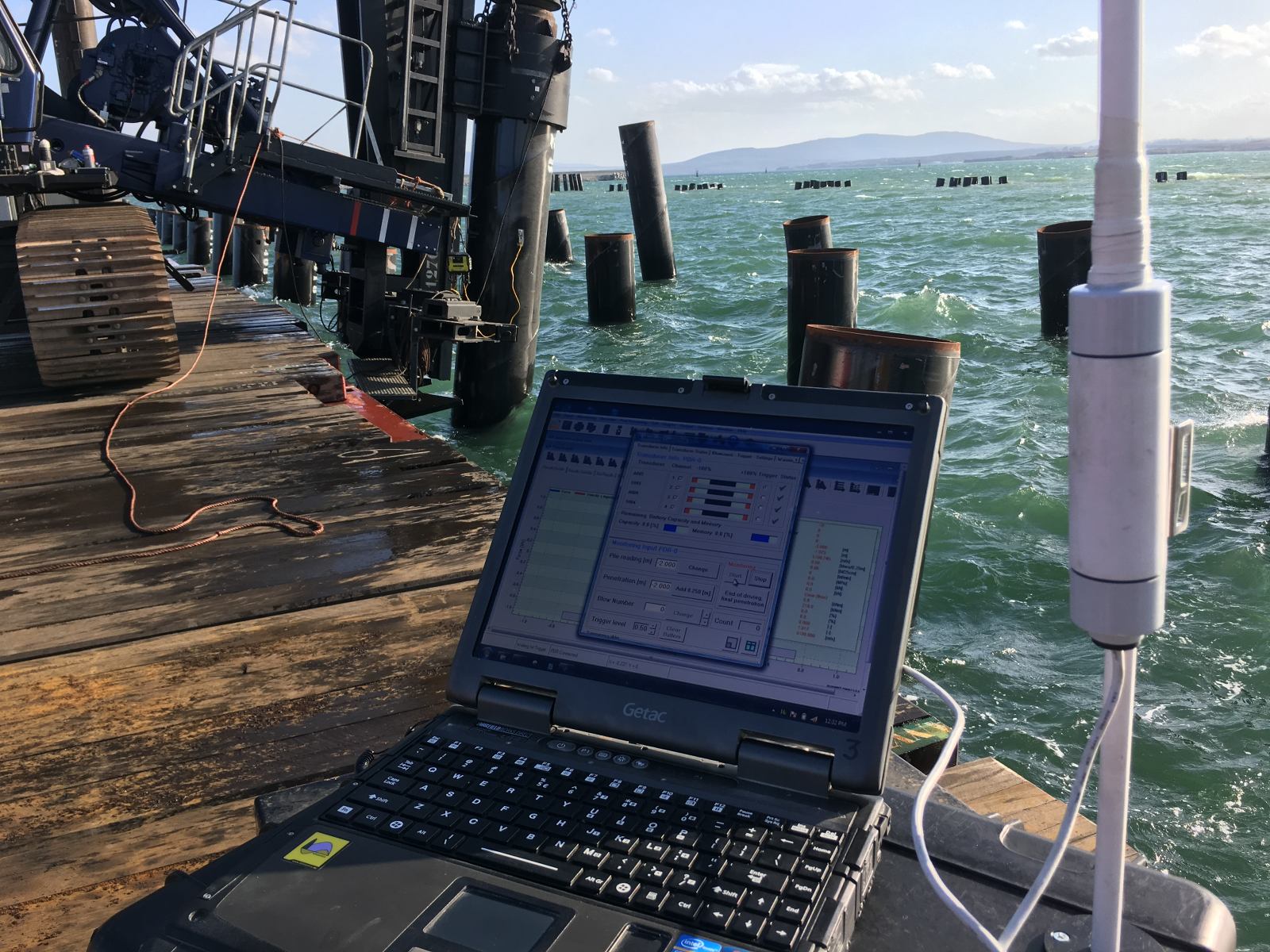
Dynamic load testing during installation, combined with real-time pile driving analysis, is the most effective way to manage chalk pile driving uncertainty. These methods provide measured data on energy transfer, soil resistance, and pile integrity blow by blow, allowing your team to detect unexpected resistance changes and adjust the installation strategy before problems escalate.
Because chalk behavior can shift rapidly with depth, monitoring must be continuous rather than limited to spot checks. Key methods that add value in chalk installations include:
- Dynamic Load Testing (DLT) with signal matching: Measures force and velocity at the pile head during driving. Signal matching against a wave equation model allows back-calculation of actual SRD distribution, which can then be used to update the drivability prediction for remaining penetration.
- Pile Driving Analysis (PDA): Provides real-time blow-by-blow data on transferred energy, compression and tension stresses, and pile integrity. In chalk, where refusal risk is high, PDA data allows the installation team to recognize when blow counts are approaching critical thresholds before pile damage occurs.
- Pile Integrity Testing (PIT): After installation, PIT can identify damage that may have occurred during driving through hard chalk layers or flint bands.
- Post-installation load testing: Because shaft friction in remolded chalk may be lower than predicted, static or rapid load testing after installation provides direct verification of actual pile capacity rather than relying on design assumptions.
Pre-installation drivability studies also benefit from incorporating chalk-specific soil models rather than generic SRD approaches. When CPT data is available, using a CRD-based interpretation that accounts for stress reduction and interface degradation produces more reliable blow count profiles and refusal risk assessments than standard methods.
How We Help with Chalk Pile Drivability Predictions
We work with foundation contractors, offshore developers, and engineering consultancies on pile installations where standard drivability approaches are not sufficient. Chalk is one of the most demanding formation types we encounter, and our approach combines chalk-specific soil modelling with hands-on monitoring to reduce installation risk.
Here is what we bring to chalk pile driving projects:
- Chalk-specific drivability studies using soil models that account for CRD-to-CPT relationships, progressive stress reduction, and interface shear degradation, rather than applying generic sand or clay SRD methods.
- AllWave-PDP simulations that model the full hammer-pile-soil interaction across successive penetration depths, producing blow count profiles, refusal risk assessments, and pile stress envelopes for the complete installation sequence.
- Dynamic Load Testing and Pile Driving Analysis during installation, providing real-time data that allows your team to respond to unexpected chalk behavior before it causes pile damage or schedule disruption.
- Signal matching and back-analysis to update SRD models based on measured driving data, improving predictions for remaining penetration and informing decisions about hammer selection or installation strategy adjustments.
- Post-installation load testing to verify actual pile capacity in chalk, where remolded shaft friction may differ from design assumptions.
If your project involves pile installation through chalk and you want a drivability assessment that reflects how chalk actually behaves, contact our team to discuss your site conditions and project requirements.
Gerelateerde artikelen
- Why is soil stratigraphy important in a Drivability Prediction?
- What is the difference between Rapid Load testing and Static Load testing?
- Is the Rapid Load testing better than Static Load testing?
- How does a pile driving analyser measure force and velocity?
- What is the future of real-time pile monitoring on sites?