


Rapid Load Testing is not inherently better than Static Load Testing, but it is often the more practical choice. For most foundation projects, a rapid load test delivers reliable bearing capacity data at significantly lower cost and with far less logistical complexity than a static test. The right method depends on your project conditions, soil type, pile type, and what level of certainty you need. The sections below answer the most common questions engineers and project teams ask when choosing between the two methods.
How does Rapid Load Testing actually work?
A rapid load test applies a controlled force to the pile head over a duration that is much shorter than a static test but significantly longer than a dynamic impact. This intermediate load duration is what defines the method. The pile moves as a near-rigid body during the test, which allows engineers to model it as a concentrated mass and interpret the results using established analytical methods.
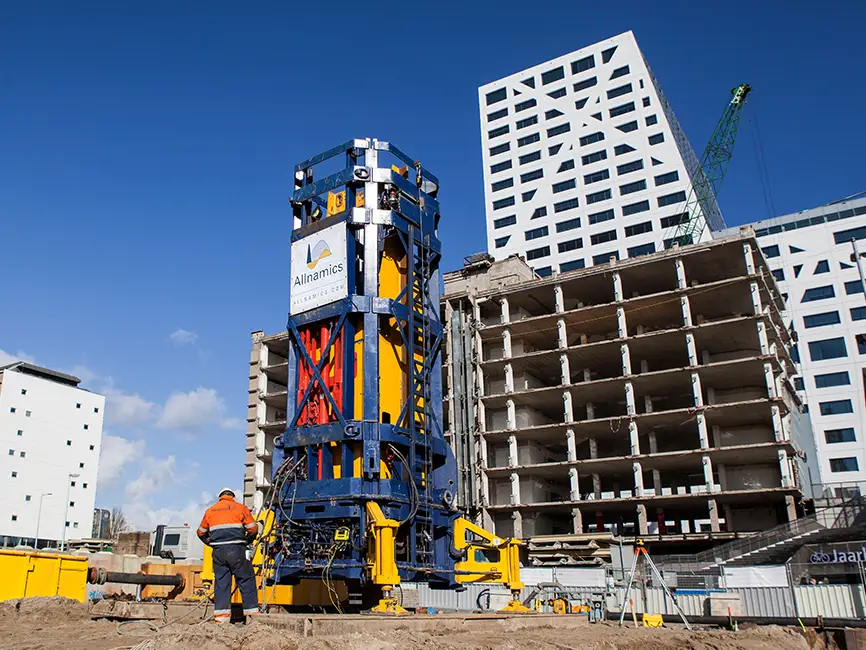
In practice, the load is generated either by accelerating a reaction mass upward using gas pressure (the Statnamic method) or by dropping a falling mass onto a spring-buffer system (the StatRapid method). The buffer or spring package controls the shape and duration of the force pulse. Typical pile velocities during a rapid load test range from around 0.1 to 2 metres per second, far slower than a dynamic impact but far faster than a static load step.
During the test, sensors measure force directly at the pile head using a calibrated load cell, along with acceleration and displacement. These measurements feed into interpretation methods such as the Unloading Point Method, which separates the measured resistance into its static, inertial, and rate-dependent components. The result is an estimate of the static bearing capacity of the pile.
One important physical check is always required: the load duration must be long enough to suppress stress wave propagation effects within the pile. This depends on pile length, wave speed, and in some cases the shear wave velocity of the surrounding soil. Rapid load testing satisfies this condition by design, which is what separates it from conventional dynamic load testing.
What are the main differences between Rapid Load Testing and Static Load Testing?
The most important difference between Rapid Load Testing and Static Load Testing is the duration over which the load is applied. In a static test, load is applied in increments and held for extended periods, the pile moves extremely slowly and all sections respond almost simultaneously. In a rapid load test, the entire loading event lasts a fraction of a second, requiring additional interpretation steps to extract equivalent static resistance.
Beyond load duration, the two methods differ in several practical ways:
- Reaction system: Static Load Testing requires a substantial reaction structure: kentledge, anchor piles, or a ground anchor frame. Rapid Load Testing uses the inertia of a reaction mass, eliminating the need for a fixed reaction system.
- Mobilised displacement: Static tests typically mobilise larger pile head displacements, making them better suited for full load-settlement curve characterisation. Rapid tests mobilise smaller displacements at high velocity.
- Soil rate effects: Because the load is applied quickly, cohesive soils can exhibit higher resistance during a rapid test than they would under slow static loading. Interpreting rapid load test results in clay therefore requires a rate-effect correction, which adds a layer of analysis not needed for static tests.
- Test duration and mobilisation: A static test on a large pile can take days to set up and execute. A rapid load test is typically completed within hours, with a much smaller equipment footprint.
- Force measurement: In a rapid load test, force is measured directly at the pile head with a load cell, independent of pile material properties. In a static test, force is applied and measured through the jack and reaction system.
Is Rapid Load Testing as accurate as Static Load Testing?
Rapid Load Testing produces reliable bearing capacity results when applied correctly, but accuracy depends on soil type, interpretation method, and whether rate-effect corrections are properly applied. In granular soils and many mixed soil profiles, well-executed rapid load tests show good agreement with static load test results. In cohesive soils such as clay, additional care is needed.
The reason accuracy varies by soil type comes down to loading-rate effects. Clay can exhibit meaningfully higher resistance under rapid loading than under slow static loading. Research has shown that failure load can increase with each logarithmic increase in loading rate, and this effect varies with soil plasticity, structure, consolidation history, and other factors. There is no single universal correction factor, rate-effect adjustments must be project-specific and soil-specific.
For piles in granular soils, or where the test is used to verify a specific design load rather than map the full load-settlement curve, rapid load tests are widely accepted under international standards including ASTM D7383 and ISO 22477-10. The method has been validated through decades of comparative research against static load tests across many soil conditions and pile types.
One area where static testing retains a clear advantage is in producing a detailed load-settlement curve at very large displacements. If your project requires full mobilisation of pile resistance to failure under slow loading, a static test provides that directly without the interpretation layer that rapid testing requires.
When should you choose Rapid Load Testing over Static Load Testing?
Rapid Load Testing is the stronger choice when logistical constraints, cost, or pile characteristics make a static test impractical or disproportionately expensive. It is particularly well suited to projects where multiple piles need to be tested, where access is restricted, or where the reaction system required for a static test would be difficult to construct.
Specific situations where a rapid load test is the more practical option include:
- Large-diameter bored or CFA piles where the forces required for a static test would demand a very large and costly reaction frame
- Offshore or marine environments where installing a static reaction system is technically complex or prohibitively expensive
- Projects with tight schedules where the setup and execution time of a static test would delay the programme
- Acceptance testing of multiple piles where rapid testing allows more piles to be checked within the same budget
- In-situ concrete piles with lower concrete strength where the controlled force pulse of a StatRapid system reduces peak stresses at the pile head, lowering the risk of damage compared to a dynamic impact test
- Situations where a bi-directional static test has not fully mobilised resistance and supplementary verification is needed
The Barcelona case referenced in technical literature illustrates this well: large in-situ concrete piles with working loads between 6 and 8 MN were tested using StatRapid after a bi-directional static test did not fully mobilise available resistance. Dynamic load testing was considered unsuitable for those piles due to the risk of high stress concentrations at the pile head.
When is Static Load Testing still the better option?
Static Load Testing remains the preferred method when you need a direct, unambiguous measurement of pile behaviour under slow, sustained loading, particularly when the full load-settlement response is needed, when soil conditions make rate-effect corrections uncertain, or when contractual or regulatory requirements specify it.
Choose a static load test when:
- Your project requires a complete load-settlement curve to failure under drained or slow-loading conditions
- The pile is in highly sensitive or structured clay where rate-effect behaviour is difficult to characterise
- Regulatory frameworks, client specifications, or design codes on your project mandate static testing for acceptance
- You need to verify creep behaviour or long-term settlement under sustained load
- The pile capacity is within a range where a static reaction system is straightforward to construct and the cost difference is not significant
Static testing also provides a direct reference dataset that can be used to calibrate or validate rapid load test results on the same project. When both methods are used together, the static test anchors the interpretation of the rapid tests, increasing confidence across a larger number of tested piles.
Can Rapid Load Testing and Static Load Testing be used together?
Yes, combining Rapid Load Testing and Static Load Testing on the same project is a well-established and effective approach. The two methods complement each other directly. A static test on one or a small number of piles provides a verified reference for the load-settlement behaviour, while rapid load tests allow you to extend verification cost-effectively across more piles or locations.
This combined approach is particularly valuable on large projects where testing every pile statically would be impractical. By running a static test first and comparing its results with a rapid load test on the same or a similar pile, your team can validate the interpretation method and rate-effect corrections for the specific soil conditions on site. Subsequent rapid tests then carry a higher level of confidence because the methodology has been locally calibrated.
The combination also works well when different pile types or load levels are present on the same site. Static testing can address the most critical or atypical piles, while rapid testing covers the broader programme. This risk-based approach to testing gives you better coverage without proportionally increasing cost or programme duration.
How Allnamics Supports Your Pile Load Testing Programme
We work with foundation contractors, EPC contractors, engineering consultancies, and project owners to design and execute pile testing programmes that match the technical demands and practical constraints of each project. Whether your project calls for rapid load testing, static load testing, or a combination of both, we provide independent expertise at every stage.
Our support includes:
- Test programme design: We help you determine which method or combination of methods is appropriate for your pile type, soil conditions, and project objectives
- StatRapid and Statnamic testing: We execute rapid load tests using our own equipment, including the StatRapid system, which generates controlled force pulses using a falling mass and spring-buffer package, suitable for pile resistances up to 16 MN
- Static load testing: We plan and execute static load tests where direct load-settlement measurement is required or specified
- Rate-effect analysis: We apply project-specific rate-effect corrections for cohesive soils, drawing on decades of research and field experience to avoid overestimation of static capacity
- Independent interpretation and reporting: We deliver clear, technically rigorous reports that support design decisions, regulatory submissions, and client acceptance
- Offshore and onshore capability: We operate globally, including in challenging offshore and marine environments where conventional static testing is not feasible
If you are planning a foundation testing programme and want to discuss which approach fits your project, contact our team directly. We will give you a straightforward assessment of your options.
Gerelateerde artikelen
- What are the advantages of AllWave-PDP and AllWave-VDP?
- Is pile head preparation required for Rapid Load Testing?
- What is the effect of pile installation method on capacity?
- What needs to be assessed before reusing an existing foundation?
- Why is pile load testing required for offshore wind installations?