


Hookload is important in a Vibratory Driving Prediction because it directly determines the net downward force acting on the pile during installation. When you subtract the crane line tension (hookload) from the pile’s submerged weight, you get the actual driving force available to overcome soil resistance. Without an accurate hookload value, your vibratory driving prediction will misrepresent penetration rates, refusal risk, and installation duration from the very first meter.
This matters most in offshore and nearshore projects, where large-diameter piles, deep water, and complex soil profiles amplify the consequences of any modelling error. The sections below work through the mechanics, the modelling implications, and the risks of getting hookload wrong in practice.
What does hookload actually measure during pile installation?
Hookload measures the tension in the crane line that supports the pile during vibratory driving. It represents the portion of the pile’s total weight that the crane is carrying at any given moment. The difference between the pile’s submerged weight and the hookload gives you the net vertical force that the vibratory hammer system is pushing into the ground.
During a typical installation sequence, the hookload is not static. At the start of driving, before the pile has penetrated the seabed, the crane carries most of the pile’s weight. As the pile advances and soil friction builds up along the shaft, the soil itself begins to carry part of the load. The hookload reading at the crane therefore drops progressively as shaft friction increases, and it can rise again if the pile encounters a hard layer or if the vibratory hammer loses penetration efficiency.
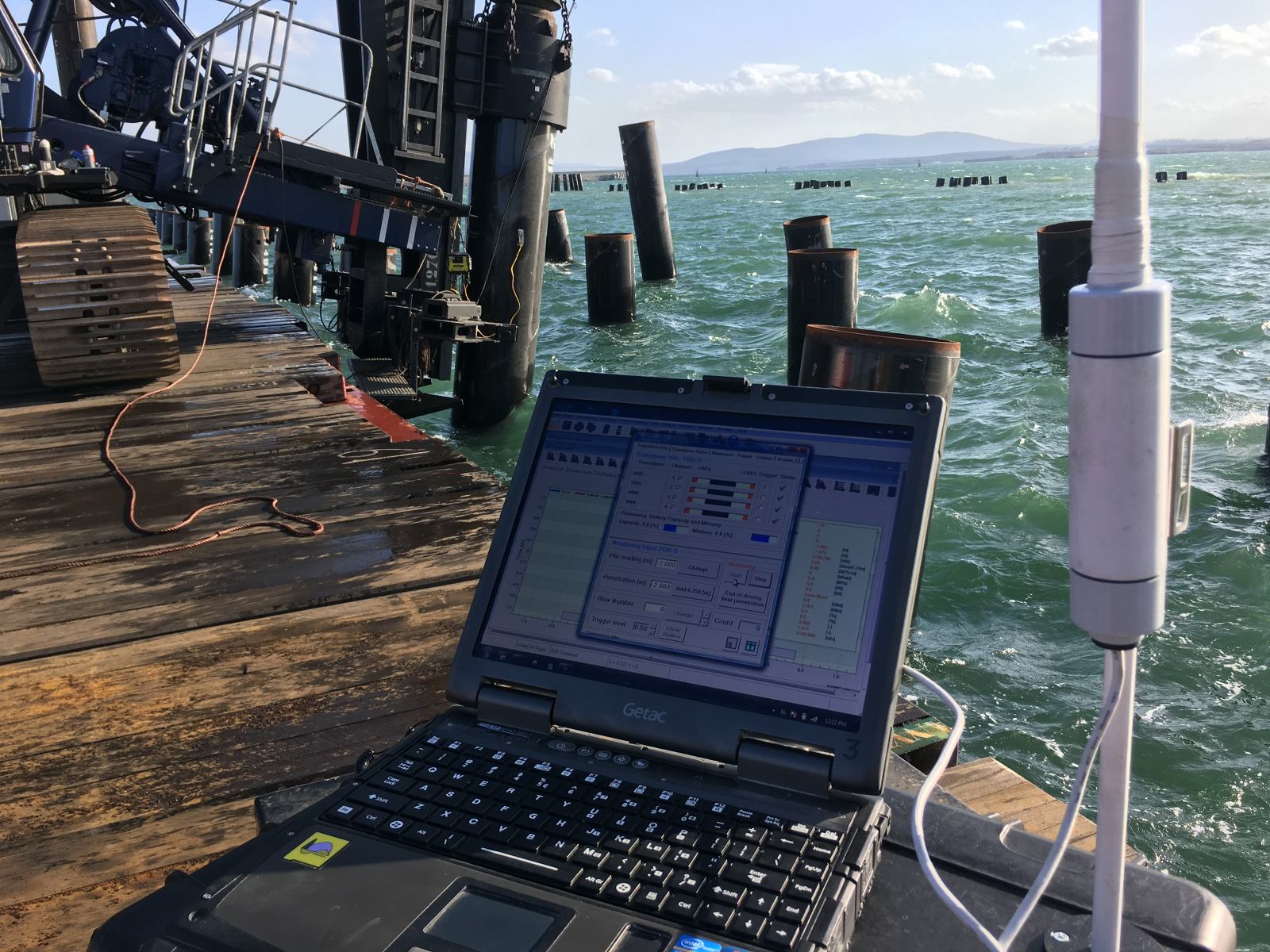
In practical terms, hookload monitoring gives your installation team a real-time window into what is happening at the pile-soil interface without requiring sensors at the pile tip. A sudden change in hookload during driving is one of the clearest early indicators of a changing soil condition, a developing plug, or an approaching refusal situation.
How does hookload affect vibratory driving prediction accuracy?
Hookload directly affects the accuracy of a Vibratory Driving Prediction because it defines the net force balance in the simulation. In AllWave-VDP, the vibratory driving model accounts for the dynamic equilibrium between the hammer’s eccentric moment, the pile’s inertia, the crane line tension, and the soil resistance. If the hookload input is wrong, the predicted penetration rate and refusal depth will be wrong too.
The net downward force on the pile is calculated as:
- Pile submerged weight minus hookload equals the static contribution to penetration
- This static force combines with the dynamic force generated by the vibratory hammer’s eccentric moment
- Together they must overcome the soil’s shaft friction and toe resistance at each penetration increment
If you overestimate the hookload, your model assumes the crane is carrying more weight than it actually is, which means the simulation underestimates the net driving force. The prediction will show slower penetration rates and a higher refusal risk than reality. Conversely, underestimating hookload leads to an overly optimistic prediction that may not flag genuine refusal risk in time for your team to respond.
The sensitivity is particularly pronounced in soft-to-medium soils where the net driving force is the dominant factor controlling penetration rate. In dense sands or stiff clays, soil resistance dominates and the hookload contribution is relatively smaller, but it still shifts the balance enough to affect blow rate predictions and installation duration estimates meaningfully.
What causes hookload to change during vibratory pile driving?
Hookload changes during vibratory pile driving because the distribution of the pile’s weight between the crane and the surrounding soil shifts continuously as the pile penetrates. Several physical mechanisms drive these changes, and understanding them helps you interpret monitoring data correctly and update your prediction in real time.
Shaft friction buildup and soil fatigue
As the pile advances, more of the shaft comes into contact with the soil, and cumulative shaft friction increases. This transfers load from the crane to the ground, reducing hookload. However, vibratory driving also induces soil fatigue along the shaft. At a typical vibratory frequency of around 23 Hz, the soil near the top of the pile can experience thousands of loading cycles within minutes, progressively reducing its shear strength. This friction fatigue effect means that the upper shaft friction does not grow linearly with penetration depth. A realistic model must treat fatigue as a function of local loading history rather than applying a uniform reduction factor across the entire pile length.
Soil layering and resistance transitions
When the pile tip crosses from a softer layer into a stiffer one, toe resistance increases sharply. The vibratory hammer may slow or stall, and the crane may need to apply more tension to prevent the system from locking up. This causes hookload to rise. Conversely, when the pile passes through a hard layer into softer material below, hookload can drop quickly. These transitions are visible in real-time hookload data and are valuable calibration points for post-analysis and signal matching.
Hammer performance and dynamic coupling
The vibratory hammer’s eccentric moment generates a dynamic force that alternately pushes the pile down and pulls it up. During the upward phase, the crane line tension fluctuates. The mean hookload measured over multiple cycles reflects the static equilibrium, but peak values during each cycle can differ significantly. Hammer performance changes, such as a drop in eccentric moment due to mechanical wear or hydraulic pressure variation, will also shift the hookload reading even if soil conditions remain constant.
How is hookload used in drivability simulation software?
In drivability simulation software, hookload enters the model as a boundary condition that defines the static force balance at the top of the pile. In AllWave-VDP, the vibratory driving simulation models the pile as a one-dimensional stress-wave system, and hookload is one of the inputs that sets the net downward static force before the dynamic hammer force is applied at each time step.
The software uses hookload in combination with the following parameters to compute penetration at each increment:
- Pile geometry and material properties: cross-section, wall thickness, steel grade, and total length
- Submerged pile weight: accounting for water depth and pile buoyancy
- Vibratory hammer characteristics: eccentric moment, operating frequency, and bias weight
- Soil resistance model: shaft friction and toe resistance derived from CPT data, including friction fatigue parameters
- Hookload: the crane line tension, which reduces the net static driving force
The AllWave software package supports the full prediction-monitoring-postdiction workflow. After installation, measured hookload data from the crane and any pile-top instrumentation can be used in back-analysis to calibrate the soil model. This signal matching process compares predicted and measured penetration rates, and the updated soil model feeds into an experience database that improves future predictions. A deviation between predicted and actual hookload behaviour is therefore not just an error to explain; it is information that makes the next prediction more reliable.
For sensitivity analysis, the software allows you to run predictions across a range of hookload values. This is useful when the exact crane configuration or rigging arrangement is not yet confirmed, and you need to understand how much the predicted penetration rate varies across plausible hookload scenarios.
What are the risks of underestimating hookload in offshore projects?
Underestimating hookload in offshore projects leads to an overly optimistic Vibratory Driving Prediction that overestimates the net driving force. The simulation will predict faster penetration rates and a lower refusal risk than the installation will actually deliver. In offshore environments, where mobilisation costs are high and weather windows are limited, this type of prediction error carries serious operational and financial consequences.
The most direct risk is unexpected early refusal. If the model assumes a higher net driving force than the crane actually provides, the predicted penetration curve will show the pile reaching target depth when in reality the system stalls short of it. Your team then faces remedial options mid-installation, which may include switching to a larger hammer, applying soil removal techniques, or accepting a shallower final penetration that may not meet the design requirement.
Beyond refusal risk, underestimating hookload affects the following:
- Installation duration estimates: penetration rates will be slower than predicted, extending time on site and increasing vessel day-rate costs
- Pile stress predictions: an incorrect force balance shifts the calculated stress distribution along the pile shaft, potentially missing tensile stress peaks that could cause pile damage
- Hammer selection: if the prediction suggests a smaller hammer is sufficient, the selected equipment may be inadequate for actual site conditions
- Refusal criteria planning: without an accurate hookload baseline, the threshold at which your team decides to stop driving and investigate is poorly calibrated
In offshore wind foundation projects, where monopiles and jacket piles must reach precise penetration depths to meet structural and fatigue design requirements, these risks translate directly into project delays, cost overruns, and potential structural non-conformances. The quality of the drivability prediction is ultimately bounded by the quality of its inputs, and hookload is one of the inputs your team controls directly through crane configuration and rigging design.
How We Help with Vibratory Driving Prediction
We build Vibratory Driving Predictions that treat hookload as a first-class input, not an afterthought. Our approach combines CPT-based soil modelling, friction fatigue analysis, and the AllWave-VDP simulation environment to give your team a prediction that reflects the actual force balance your crane and hammer system will produce on site.
Here is what we provide in practice:
- Hookload sensitivity analysis: we run predictions across a defined range of crane line tensions so you understand how your penetration rate and refusal risk change with realistic hookload variation
- Soil model development from CPT data: we build shaft friction and toe resistance profiles that account for friction fatigue as a function of local loading history, not a uniform reduction factor
- AllWave-VDP simulation: our in-house software models the full vibratory driving process, including the dynamic coupling between hammer, pile, and soil, with hookload integrated into the static force balance at every penetration increment
- Installation monitoring and back-analysis: during and after installation, we compare predicted and measured hookload behaviour, update the soil model through signal matching, and feed the results into our experience database to improve future predictions
- Risk-based reporting: we present results in terms of refusal risk, installation duration ranges, and pile stress envelopes, giving your project team the information needed to select equipment, plan contingencies, and set realistic refusal criteria
If your project involves large-diameter piles, complex soil profiles, or tight installation windows where a prediction error carries significant cost, contact us to discuss how we can support your drivability study.