


In a rapid load test, load is measured primarily using a calibrated load cell mounted at the pile head, which records the applied force directly throughout the duration of the test pulse. This direct measurement approach is one of the defining advantages of Rapid Load Testing over methods that derive force indirectly from strain measurements. The sections below unpack how each part of the measurement system works and what influences the accuracy of the result.
What instruments are used to measure load in Rapid Load Testing?
Rapid Load Testing uses a combination of a calibrated load cell, accelerometers, and displacement transducers to capture the full mechanical response of the pile during the test pulse. The load cell measures the applied force directly at the pile head, while accelerometers record the acceleration of the pile throughout the loading event, and displacement sensors track pile movement.
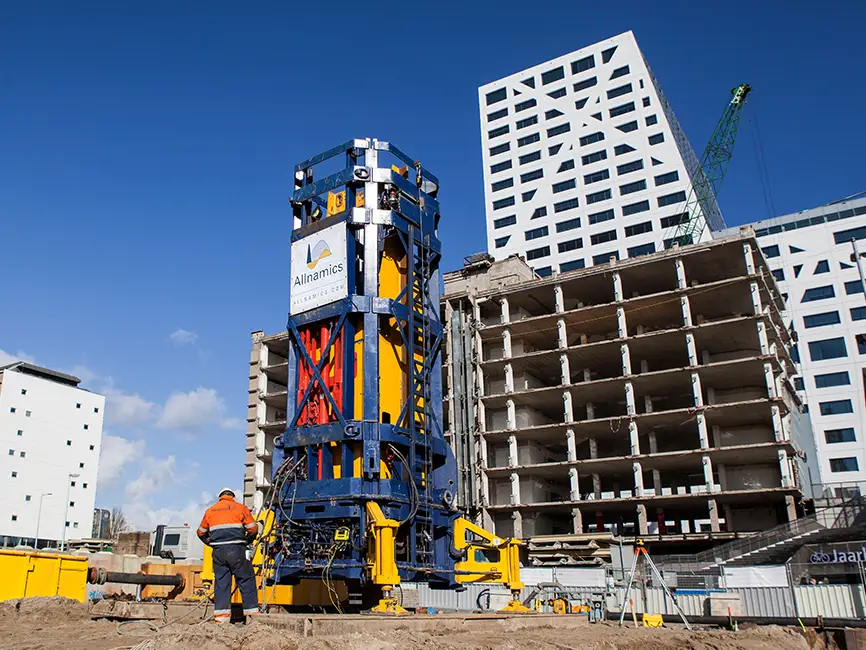
The load cell sits between the loading device and the pile head, registering the compressive force as the pulse is applied. In systems such as Statnamic, where a reaction mass is propelled upward by gas pressure, the load cell captures the downward reaction force on the pile. In systems such as StatRapid, where a falling mass strikes a spring or buffer assembly, the load cell records the force transmitted through that buffer to the pile head.
Accelerometers are typically mounted near the pile head and measure acceleration in the axial direction. Their output feeds into the interpretation process, where it is used to calculate the inertial force component acting on the pile mass. Displacement is either measured directly with a transducer or derived by double integration of the acceleration signal. Together, these instruments provide the data needed to separate the total measured force into its soil resistance, inertial, and damping components.
How is acceleration converted into a load value?
Acceleration data from the accelerometers are converted into an inertial force by multiplying the measured acceleration by the known mass of the pile. This inertial force is then subtracted from the total force recorded by the load cell to isolate the soil resistance acting on the pile during the test.
The governing equation used in Rapid Load Testing interpretation is derived from Newton’s second law. The total force applied to the pile equals the sum of the soil resistance, the inertial force of the pile mass, and a velocity-dependent damping term that accounts for rate effects in the soil. Written simply:
- Total applied force (F) = Soil resistance (R) + Inertial force (m × a) + Damping force (c × v)
The load cell provides F directly. The accelerometers provide the acceleration (a), and the pile mass (m) is known from geometry and material properties. Velocity (v) is obtained by integrating the acceleration signal over time. The damping coefficient (c) is estimated through the chosen interpretation method, such as the Unloading Point Method, the Sheffield Method, or the Variable Damping Method. Each of these approaches handles the rate-dependent soil behavior differently, and the choice of method depends on pile type, soil conditions, and the purpose of the test.
Why can’t a standard load cell alone measure the full load?
A load cell alone cannot capture the full picture because the force it records includes not just soil resistance but also the inertial force required to accelerate the pile mass and a damping component linked to the speed of loading. Without separating these contributions, the raw load cell reading would significantly overestimate the static bearing capacity of the pile.
During a Rapid Load Test, the loading pulse is applied over a duration typically ranging from around 100 to 200 milliseconds. This is long enough to limit stress wave propagation effects within the pile, which is what distinguishes Rapid Load Testing from Dynamic Load Testing. However, the pile still accelerates measurably during this period, and that acceleration requires force. If you read only the load cell output at peak force, you are looking at a value that includes the force needed to move the pile itself, not just the resistance the soil provides.
Additionally, the soil around the pile responds differently at high loading rates than it does under slow static loading. Cohesive soils in particular exhibit rate-dependent behavior, meaning the resistance they mobilize during a rapid test is higher than what they would provide under a conventional static load. The damping term in the interpretation equation accounts for this rate effect, allowing engineers to derive a static equivalent resistance from the dynamic measurement. This is why specialist interpretation, not just raw load cell data, is always required to produce a meaningful result.
How does load measurement in Rapid Load Testing compare to Static Load Testing?
In Static Load Testing, load is applied slowly and measured directly with a load cell or hydraulic jack gauge, with no inertial or damping corrections needed. In Rapid Load Testing, the load cell still measures force directly, but the result requires post-processing to remove inertial and rate-dependent components before it can be compared to a static bearing capacity.
The table below summarizes the key differences in how load is measured and interpreted across the two methods:
- Static Load Testing: Load applied incrementally over hours; load cell or jack pressure gauge records force; no inertial correction needed; result is directly the static resistance.
- Rapid Load Testing: Load applied as a pulse over milliseconds to hundreds of milliseconds; calibrated load cell records total applied force; accelerometers and displacement sensors provide additional data; inertial and damping corrections applied during interpretation to derive static equivalent resistance.
One practical advantage of Rapid Load Testing is that the load cell measures force directly at the pile head, rather than deriving it from strain measurements and assumed pile properties. This is particularly relevant for large-diameter cast-in-place concrete piles, where the actual concrete cross-section and elastic modulus can be uncertain. In Dynamic Load Testing, the calculated force depends on the accuracy of those material assumptions, which introduces additional uncertainty. The direct force measurement in Rapid Load Testing removes that dependency.
What factors affect the accuracy of load measurement in Rapid Load Testing?
The accuracy of load measurement in a Rapid Load Test depends on the calibration quality of the load cell, the correct determination of pile mass, the quality of the acceleration signal, and the suitability of the interpretation method chosen for the specific soil and pile conditions.
Several factors can influence the final result:
- Load cell calibration: The load cell must be calibrated to a traceable standard before the test. Any drift or error in calibration directly affects the measured force.
- Pile mass determination: The inertial correction depends on knowing the pile mass accurately. For cast-in-place piles with variable cross-sections, this introduces uncertainty that must be managed carefully.
- Signal quality from accelerometers: Noise or drift in the acceleration signal propagates into the velocity and displacement calculations, affecting both the inertial correction and the interpretation of soil resistance.
- Loading rate and pulse duration: The pulse must be long enough to satisfy the Rapid Load Test criteria for the specific pile, which depends on pile length, wave speed, and the shear wave velocity of the surrounding soil. If the pulse is too short, stress wave effects in the pile become significant and the assumptions underlying RLT interpretation no longer hold.
- Soil type and rate dependency: Cohesive soils exhibit stronger rate-dependent behavior than granular soils. The choice of interpretation method, and the damping parameters used within it, must reflect the actual soil conditions to produce a reliable static equivalent resistance.
- Buffer or spring assembly design: In systems like StatRapid, the buffer package shapes the force pulse. The buffer must be designed to produce a pulse of appropriate duration and magnitude for the pile being tested.
Standards such as ISO 22477-10 and ASTM D7383 both emphasize that specialist knowledge and experience are required not only for executing the test but also for interpreting the results. The accuracy of the final bearing capacity estimate depends as much on the quality of the analysis as on the quality of the raw measurements.
How We Help You with Rapid Load Testing
We have been involved in the development and application of Rapid Load Testing for decades, and we bring that depth of experience directly to your project. Whether you need a rapid load test carried out on site or an independent review of existing test data, we provide the technical expertise to ensure your results are reliable and defensible.
Here is what we offer:
- Full rapid load test execution using StatRapid and Statnamic systems, with direct force measurement via calibrated load cells and full instrumentation of the pile head
- Expert signal interpretation using established methods including the Unloading Point Method, Sheffield Method, and Variable Damping Method, selected to match your pile type and soil conditions
- Independent technical review of rapid load test data from other sources, including assessment of measurement quality, interpretation choices, and derived capacity values
- Advice on test design, including pulse duration requirements, instrumentation setup, and method selection based on your pile geometry and site conditions
- Reporting aligned with international standards including ISO 22477-10, ASTM D7383, and NEN 7201:2025
If you are planning a foundation testing program or have questions about how Rapid Load Testing fits your project, contact our team and we will help you find the right approach.