


Rapid Load Testing (RLT) is a pile load testing method that applies a controlled force pulse to a pile head over a duration typically between 50 and 200 milliseconds. This duration is long enough to limit stress wave propagation effects within the pile, yet short enough to generate the required force using the inertia of a moving mass rather than a large static reaction structure. The sections below answer the most common questions about how RLT works, how it compares to other testing methods, and when to use it on your project.
How does Rapid Load Testing work?
Rapid Load Testing works by dropping a mass onto a spring or buffer system placed on top of the pile, generating a compressive force pulse that lasts long enough for the pile to behave approximately as a rigid body during the test. Because the pile moves largely as a single unit rather than transmitting a sharp stress wave from top to bottom, the test results can be interpreted using relatively straightforward analytical methods compared to Dynamic Load Testing.
During the test, three core measurements are recorded simultaneously: the force applied at the pile head, the displacement of the pile head, and the acceleration of the pile. From these measurements, the static pile resistance can be derived by correcting for the inertia of the pile and the rate-dependent behavior of the surrounding soil.
The analysis must address two separate effects. First, the dynamic behavior of the pile itself must be evaluated to confirm that stress wave phenomena are sufficiently suppressed during the load pulse. Second, the rate-dependent behavior of the soil must be corrected, because the high loading speed can mobilize a higher apparent resistance than a slow static load would. This correction is particularly important in cohesive soils, where pore water pressure and damping effects can significantly influence the measured resistance. The separation between pile dynamics and soil rate effects is one of the defining conceptual features of modern Rapid Load Testing.
Additional instrumentation can be installed at different depths along the pile shaft. This allows your team to measure the distribution of normal force through the pile, making it possible to distinguish shaft friction from base resistance and to optimize geotechnical design parameters beyond simple capacity verification.
What’s the difference between Rapid Load Testing and Static Load Testing?
The key difference between Rapid Load Testing and Static Load Testing is how the reaction force is generated. In a Static Load Test (SLT), the load is applied gradually using a hydraulic jack reacting against a kentledge or anchor pile system, and the pile behavior is genuinely static throughout. In a Rapid Load Test, the inertia of a falling mass provides the reaction, eliminating the need for a large permanent reaction structure.
This difference has direct practical consequences for your project planning:
- Reaction structure: SLT requires a substantial reaction system, which becomes increasingly large and costly at high test loads. RLT uses the mass of the falling weight as its own reaction, making very high force levels achievable with a compact setup.
- Preparation time: Static tests require significant preparation time to assemble the reaction frame and apply load increments. RLT setups are faster to mobilize and execute.
- Direct measurement: In SLT, force and displacement are measured directly, and the result requires no correction for dynamic effects. RLT data must be processed to remove inertia contributions and loading-rate effects before a static equivalent resistance can be determined.
- Soil sensitivity: In cohesive soils, the high loading rate in RLT can mobilize a higher apparent resistance than a static load would. Careful interpretation is required, and the applicable standard must be followed to ensure the corrected result is valid.
For very high test loads, RLT offers a practical and cost-effective alternative to SLT. However, RLT is not a direct substitute in all situations. The choice depends on soil conditions, pile type, required accuracy, and the standards applicable to your project.
How does Rapid Load Testing differ from Dynamic Load Testing?
The fundamental difference between Rapid Load Testing and Dynamic Load Testing (DLT) is the duration of the applied force pulse. In DLT, a hammer strikes the pile and generates a very short, sharp stress wave that travels down the pile and reflects back. In RLT, the force pulse lasts long enough for stress wave effects within the pile to become negligible, allowing the pile to be treated as a concentrated mass rather than a wave-propagating medium.
This distinction matters for both analysis and pile safety:
- Stress wave analysis: DLT relies on stress wave theory and requires signal matching software to derive soil resistance. RLT uses simpler mass-spring models, such as the Unloading Point Method, because the pile behaves more like a rigid body during the test.
- Peak stresses in the pile: DLT generates high compressive and tensile stresses in the pile. RLT, particularly when using a spring or buffer system, spreads the impact over a longer duration and reduces peak stresses at the pile head. This makes RLT more suitable for cast-in-situ concrete piles, which typically have lower concrete strengths than precast piles.
- Applicable pile types: DLT is well suited to driven piles where the hammer is already present during installation. RLT is often preferred for bored piles, CFA piles, and large-diameter cast-in-situ piles where high-energy impacts could cause damage.
Both methods require specialist knowledge for execution and interpretation. International standards including ISO 22477-10 and ASTM D7383 cover RLT specifically, while DLT is governed by its own set of standards and procedures.
What are the advantages of Rapid Load Testing?
Rapid Load Testing offers several practical advantages over both Static Load Testing and Dynamic Load Testing, making it a useful option for a wide range of foundation projects.
- No large reaction structure: The falling mass provides its own reaction, so you avoid the cost and logistical complexity of building a kentledge or anchor pile system, especially at high test loads.
- Suitable for large-diameter piles: RLT can test large bored or cast-in-situ piles without generating the high peak stresses associated with DLT, reducing the risk of pile damage during testing.
- Separation of shaft and base resistance: With additional instrumentation along the pile shaft, RLT can distinguish between shaft friction and base resistance, providing detailed information for design optimization.
- Faster mobilization: Compared to SLT, RLT equipment can be transported, assembled, and operational in a matter of hours, reducing downtime on your construction program.
- High force capacity: Modern RLT systems can test piles with resistances in the range of several meganewtons, covering the demands of large infrastructure and offshore projects.
- Recognized by international standards: RLT is covered by ISO 22477-10, ASTM D7383, and national standards such as NEN 7201:2025, giving your project a clear regulatory framework for execution and reporting.
When should Rapid Load Testing be used on a project?
Rapid Load Testing is most appropriate when you need to verify pile capacity at high load levels, when a large static reaction structure is impractical, or when the pile type makes Dynamic Load Testing unsuitable due to the risk of damage from high-energy impacts.
Consider RLT in the following situations:
- Large-diameter bored, CFA, or cast-in-situ concrete piles where DLT impact stresses could exceed safe limits for the pile material
- Projects where test loads are high enough to make SLT reaction systems disproportionately expensive or logistically difficult
- Sites where space constraints limit the construction of a conventional reaction frame
- Projects requiring detailed information on the distribution of shaft friction and base resistance, not just total capacity
- Situations where a previous static test did not fully mobilize the available resistance and supplementary verification is needed
RLT is not always the right choice. In cohesive soils, the loading rate correction requires careful analysis, and the applicable standard may impose additional conditions related to the soil around the pile base. Your geotechnical engineer should assess whether the soil conditions and pile type are suitable before selecting RLT as the testing method. Rapid Load Testing projects vary considerably in scope, and the right configuration depends on your specific ground conditions and design requirements.
What equipment is used to perform Rapid Load Testing?
Rapid Load Testing equipment consists of a mass that generates the force pulse, a spring or buffer system that controls the pulse duration, and instrumentation that records force, displacement, and acceleration at the pile head. The specific hardware varies depending on the system used, but two main approaches are recognized in international standards.
Statnamic systems
Statnamic systems generate the downward force by rapidly accelerating a reaction mass upward using a controlled gas pressure build-up. The upward acceleration of the mass produces a downward reaction force on the pile. Statnamic was developed from the mid-1980s onward and was among the first systems to demonstrate the practical viability of Rapid Load Testing at scale.
StatRapid and falling-mass systems
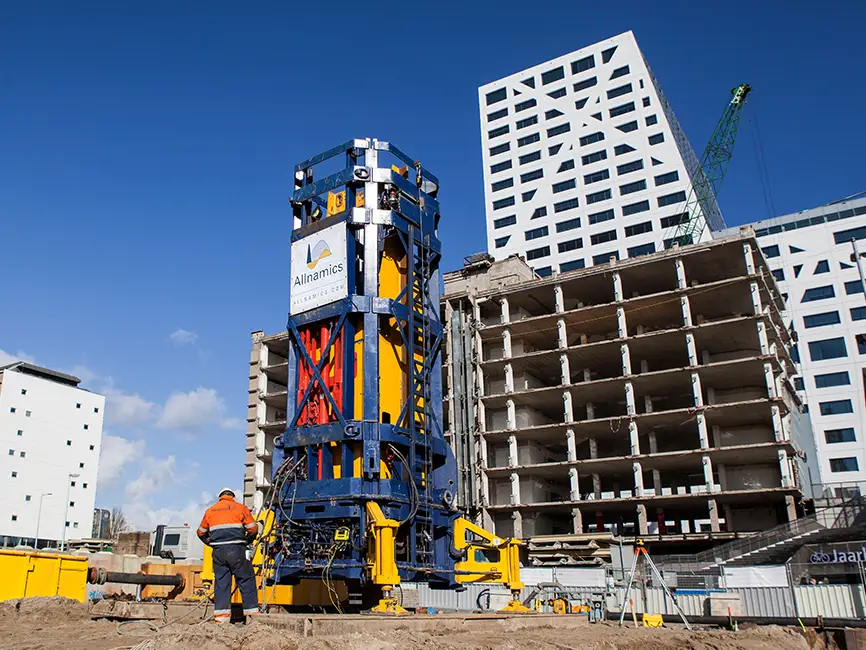
StatRapid generates the force pulse mechanically by dropping a mass onto a specially designed spring or buffer package placed on the pile head. The buffer extends the duration of the impact, transforming what would otherwise be a short dynamic blow into a longer force pulse that meets RLT criteria. The drop height and mass control the force level, while the buffer configuration controls pulse duration and shape. StatRapid is modular and transportable by road, with configurations capable of testing pile resistances across a wide range. ASTM D7383 refers to this approach as Procedure B, distinguishing it from gas-pressure systems classified as Procedure A.
In both system types, the core instrumentation includes calibrated load cells to measure force, an optical or electronic displacement measurement system, and accelerometers. Additional strain gauges or load cells can be installed at depth within the pile to measure internal force distribution. All instrumentation must be calibrated, and the test must be executed and interpreted by specialists with experience in both the equipment and the applicable standards.
How Allnamics Supports Your Rapid Load Testing Program
We have been involved in the development and application of Rapid Load Testing since its earliest stages, and we bring that depth of experience directly to your project. Our team covers the full scope of RLT work, from pre-test prediction and equipment configuration to on-site execution and detailed post-test analysis.
Here is what we provide:
- Pre-test prediction: We assess the required mass, buffer configuration, and drop height to achieve your target load level and pulse duration, and we verify that the test conditions will satisfy the applicable standard.
- StatRapid execution: We operate our own StatRapid equipment, a modular falling-mass system designed specifically for Rapid Load Testing, capable of testing large-diameter piles at high load levels without the risk of damaging impact stresses.
- Advanced instrumentation: We install and operate load cells, optical displacement systems, accelerometers, and internal pile instrumentation to capture both total capacity and the distribution of shaft friction and base resistance.
- Data interpretation: We apply recognized analysis methods, correcting for pile inertia and soil rate effects, and we report results in accordance with ISO 22477-10, ASTM D7383, NEN 7201:2025, or the standard applicable to your project.
- Independent technical review: If your project requires an independent assessment of RLT results or a comparison with other test methods, we provide that review with full technical documentation.
Whether you are planning a testing program for a large infrastructure project, verifying pile performance on an offshore development, or supplementing an earlier static test with additional data, we can help you design and execute a Rapid Load Test that gives you reliable, actionable results. Contact us to discuss your project requirements.
Gerelateerde artikelen
- How is the load measured with Rapid Load Testing?
- How do you account for pile relaxation in test results?
- What is the difference between compression and tension pile testing?
- How does pile driving prediction prevent installation problems?
- What is the difference between static and dynamic pile load testing?