


Pile head movement directly indicates how a pile responds to an applied load, and that response is one of the most reliable indicators of bearing capacity. When you apply a load to a pile and measure how much the pile head moves, you gain real data about whether the pile is performing as designed or falling short. The sections below unpack the specific questions engineers and project teams ask most often about pile head movement and what it means for foundation performance.
What does pile head movement tell you about a pile’s performance?
Pile head movement tells you how a pile transfers load into the surrounding soil and whether it has reached, approached, or exceeded its bearing capacity. The magnitude, rate, and recovery of that movement under a known applied load reveal whether the pile is behaving elastically, mobilizing shaft friction or end bearing, or beginning to fail. Without measuring pile head movement, you are relying entirely on predictive models rather than observed behavior.
When a load is applied and the pile head moves only a small amount before stabilizing, the pile is transferring load efficiently into the soil. When movement continues to increase under a constant load, or accelerates as load increases, the pile is approaching or exceeding the soil’s resistance. The shape of the movement response over time is just as informative as the total displacement value.
Pile head movement also reflects the load transfer mechanism. A pile that relies primarily on end bearing will typically show less movement before reaching capacity than a friction pile, because end bearing mobilizes quickly. A friction pile may show more gradual movement as shaft resistance builds progressively along its length. Understanding which mechanism governs your pile design helps you interpret movement data correctly.
How is the load-settlement curve used to determine bearing capacity?
The load-settlement curve plots applied load against pile head displacement and is the primary tool for determining bearing capacity from a pile load test for capacity verification. Bearing capacity is identified at the point where the curve shows a clear change in behavior: either a defined failure load where settlement increases rapidly without additional load, or a defined limit based on an acceptable settlement criterion specified in the project design.
In a well-performing pile, the early part of the curve is relatively steep and linear, meaning small displacements occur for each increment of load. As the pile approaches its capacity, the curve flattens and bends, indicating that soil resistance is being fully mobilized. If the curve shows a distinct “plunge” where displacement increases sharply with little or no increase in load, that point marks clear geotechnical failure.
Not all load-settlement curves show a sharp failure point. For many pile types and soil conditions, the curve continues to rise gradually. In these cases, engineers apply defined criteria to establish a working capacity, such as a maximum allowable settlement at a specified load, or a load corresponding to a fixed displacement limit. The specific criterion depends on the applicable standard, the structure being supported, and the tolerable deformation of the superstructure.
The load-settlement curve also reveals stiffness behavior. A pile that shows large settlements at low loads may have integrity issues, poor contact at the toe, or inadequate shaft resistance. Comparing the measured curve against the predicted design curve tells your team whether the pile is performing within expectations or requires further investigation.
What’s the difference between elastic and plastic pile head movement?
Elastic pile head movement is the portion of displacement that recovers when the load is removed. Plastic pile head movement is the permanent, irrecoverable displacement that remains after unloading. Separating these two components is important because they indicate different things about pile behavior and soil resistance mobilization.
During a pile load test, the total measured displacement at any load level is the sum of elastic and plastic components. When you unload the pile and measure the rebound, the difference between the maximum displacement and the recovered position is the permanent set. A pile that recovers most of its displacement elastically is behaving within the elastic range of the soil-pile system. A pile that retains significant permanent set has mobilized plastic deformation in the soil, meaning resistance has been partially or fully overcome at that load level.
Elastic movement reflects the compression of the pile shaft itself and the elastic deformation of the surrounding soil. This is expected and acceptable behavior. Plastic movement reflects soil yielding, which becomes a concern when it occurs at loads below the design working load or when the magnitude of permanent set exceeds acceptable limits.
In dynamic load testing, the distinction between elastic and plastic movement is captured through the set per blow and the elastic rebound measured at the pile head during impact. Signal matching analysis then uses these measurements to separate shaft friction from end bearing and to estimate static capacity. In static load testing, the separation is direct and unambiguous because you can observe the full loading and unloading cycle on the load-settlement curve.
How does pile head movement differ between static, dynamic, and rapid load testing?
Pile head movement is measured differently in each testing method, and the resulting data reflect different aspects of pile and soil behavior. Static load testing measures slow, sustained displacement under a gradually applied load. Dynamic load testing measures rapid displacement over milliseconds during a hammer impact. Rapid load testing sits between the two, applying an impulse load over a duration long enough to eliminate stress wave effects while still being faster than a static test.
Static load testing
In a static load test, load is applied in increments and held at each level while displacement is recorded over time. This produces a direct, time-dependent load-settlement curve that captures creep behavior, long-term settlement, and the full elastic-plastic response of the pile. The pile head movement data require no interpretation model, making static load testing the most straightforward method for evaluating bearing capacity and settlement performance.
Dynamic load testing
In dynamic load testing, strain and acceleration sensors at the pile head record the pile’s response to a hammer blow. Displacement is not measured directly but is derived from the acceleration signal through double numerical integration. This introduces additional processing steps and associated uncertainty, particularly for cast-in-situ concrete piles where cross-section properties vary. The movement data feed into signal matching analysis, which models stress wave propagation to estimate static capacity. The pile head movement during a dynamic test lasts only milliseconds and cannot capture time-dependent soil behavior.
Rapid load testing
Rapid load testing applies a controlled impulse load over a duration typically between 50 and 200 milliseconds, which is long enough to avoid the stress wave complications of dynamic testing while still being much faster than a static test. Load and displacement are measured directly during the test. Because stress wave effects are eliminated, the accuracy of capacity determination is significantly higher than in dynamic testing, and the results are closer in character to a static load test. Rapid load testing is particularly useful where dynamic testing alone may not capture the full soil response, such as in cohesive soils or for larger-diameter piles.
What causes unexpected pile head movement during or after installation?
Unexpected pile head movement during or after installation typically signals that the pile is not behaving as predicted by the design model. The most common causes include soil conditions that differ from the site investigation data, pile damage during driving, inadequate penetration depth, or time-dependent changes in soil resistance after installation.
- Soil variability: Layered geology, unexpected soft zones, or localized obstructions can cause a pile to stop short of the design depth or to penetrate faster than expected, both of which affect the load-settlement response.
- Pile damage during driving: Excessive driving stresses can cause cracking, buckling, or toe damage, particularly in concrete piles. A damaged pile will show anomalous movement under load that does not match the design prediction.
- Setup and relaxation effects: In cohesive soils, soil resistance increases over time after driving as excess pore water pressures dissipate. In some soils, the opposite occurs and resistance decreases. Both effects can cause pile head behavior at testing to differ from what was observed during installation.
- Group effects: When piles are installed in close proximity, the installation of adjacent piles can cause heave or lateral displacement of previously installed piles, altering their position and potentially their capacity.
- Inadequate toe bearing: If the pile toe has not reached a competent bearing layer, the pile may show excessive settlement under relatively low loads, with movement that does not stabilize as expected.
Real-time monitoring of driving stresses during installation helps identify problems before they compound. Measuring force and velocity at the pile head during driving allows your team to detect excessive compressive or tensile stresses, poor hammer performance, or sudden changes in soil resistance that may indicate the pile is not installing as planned.
When should pile head movement measurements trigger further testing?
Pile head movement measurements should trigger further testing when the observed displacement pattern falls outside the range predicted by the design, when permanent set exceeds acceptable limits at loads below the design working load, or when movement continues to increase under a sustained constant load without stabilizing. Any of these patterns indicates that the pile may not achieve the required bearing capacity or serviceability performance.
Specific situations that warrant follow-up testing include:
- Settlement at the working load that exceeds the allowable limit specified in the design or applicable standard
- A load-settlement curve that shows no clear stabilization and continues to rise steeply at loads approaching the design capacity
- Elastic rebound during dynamic testing that is inconsistent with the expected pile stiffness, suggesting damage or cross-section irregularity
- Significant variation in pile head movement across a group of nominally identical piles tested under the same conditions
- Unexpected movement after installation, such as continued settlement or heave without applied load, which may indicate soil consolidation, group effects, or structural issues
When dynamic load testing results show a wide bandwidth in signal matching outcomes, or when the pile type and soil conditions reduce confidence in the dynamic test interpretation, supplementary static or rapid load testing provides the additional certainty needed. This is particularly relevant for large-diameter bored piles in cohesive soils, where dynamic testing is inherently less accurate and the consequences of an incorrect capacity assessment are significant.
The threshold for triggering further testing also depends on the consequence class of the structure. For high-consequence foundations supporting critical infrastructure, a smaller deviation from predicted behavior justifies additional investigation than would be acceptable for a lower-risk application.
How Allnamics Supports Pile Head Movement Analysis and Capacity Verification
We work with project teams at every stage where pile head movement data matters, from installation monitoring through to full capacity verification and post-construction assessment. Our approach combines field measurement, advanced analysis, and engineering judgment to give you reliable answers about how your piles are actually performing.
Here is what we provide:
- Static Load Testing (SLT): Direct measurement of load and pile head displacement under sustained loading, producing a clear load-settlement curve for unambiguous capacity and serviceability assessment.
- Dynamic Load Testing (DLT) with signal matching: Efficient capacity verification during or after installation, using our AllWave-DLT software and experienced engineers to minimize interpretation bandwidth and deliver reliable results for driven piles in suitable soil conditions.
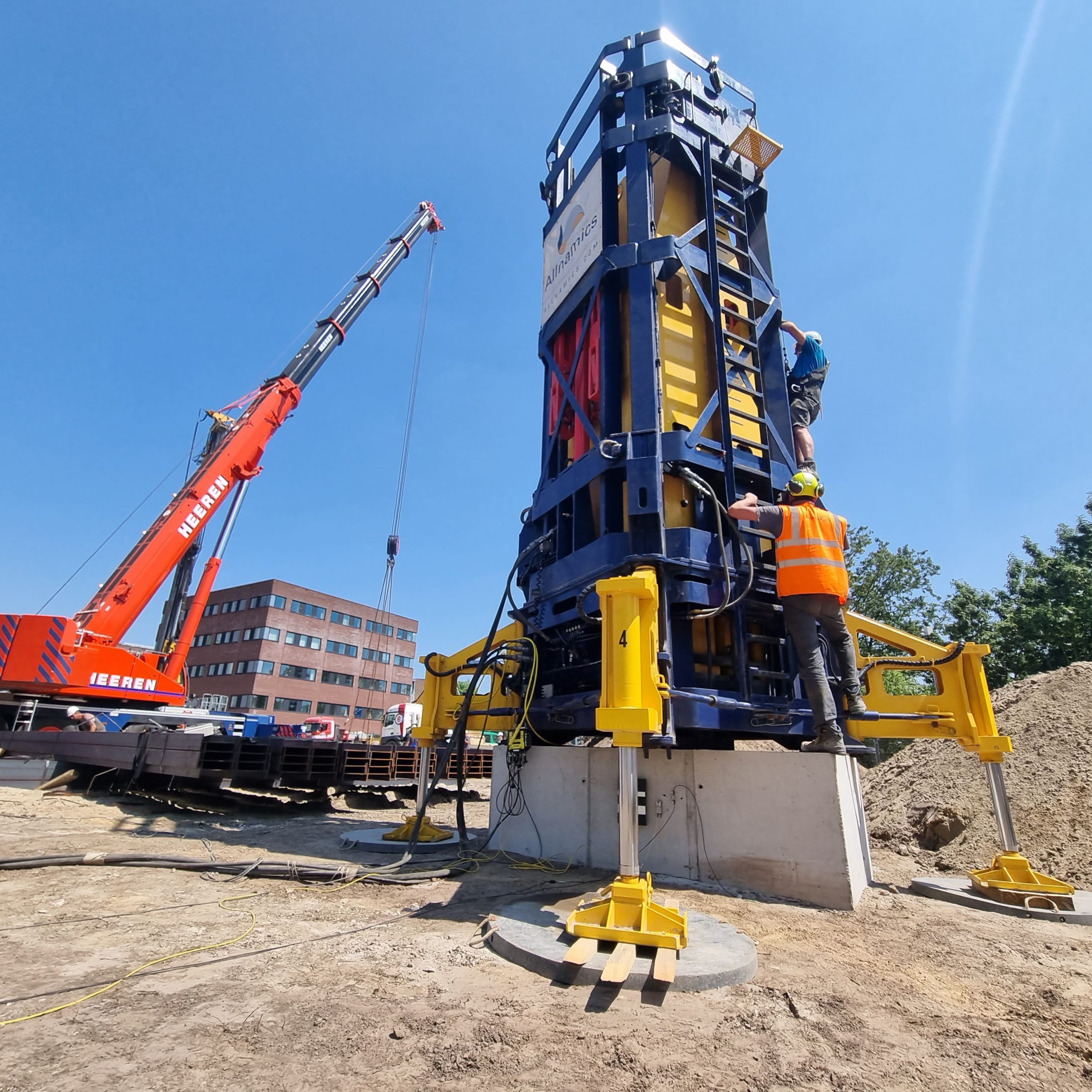
- Rapid Load Testing (RLT) with StatRapid and Statnamic: A direct testing method that eliminates stress wave effects and delivers accuracy significantly closer to static testing, particularly useful for larger piles, cohesive soils, or where dynamic testing alone is insufficient.
- Pile Driving Analysis (PDA) and installation monitoring: Real-time measurement of driving stresses, hammer performance, and soil resistance during installation, allowing your team to detect problems before they affect the completed foundation.
- Pile Integrity Testing (PIT): Detection of structural defects or damage that pile head movement data alone cannot reveal, providing a complete picture of pile condition.
- Independent technical review and consultancy: Expert assessment of pile head movement data, load-settlement curves, and testing results for projects where independent verification is required by regulation or client specification.
If your project involves pile head movement results that raise questions, or if you want to select the right testing method before work begins, contact us to discuss your foundation requirements and project conditions.