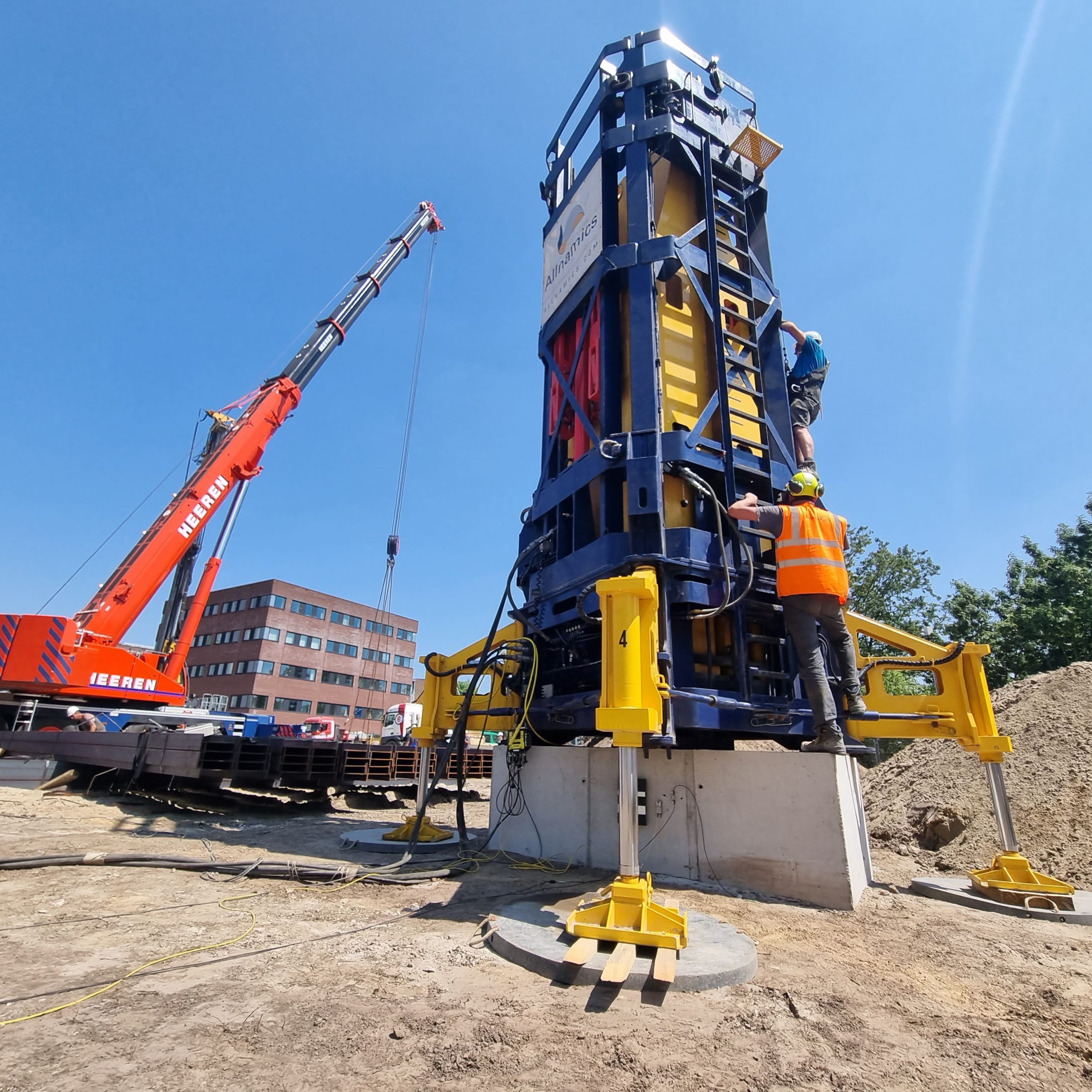



Pile testing plays a direct and important role in foundation reuse decisions by providing engineers with verified data on the load-bearing capacity, structural integrity, and current condition of existing piles. Without this data, reuse decisions rest on assumptions that can lead to costly failures or missed opportunities. The sections below address the most common technical questions that arise when evaluating whether an existing foundation can be reused.
How do engineers assess the load-bearing capacity of existing piles?
Engineers assess the load-bearing capacity of existing piles by applying controlled loads to the pile and measuring its response in terms of displacement, force, and structural behavior. The most direct method is a pile load test for capacity verification, which generates a load-settlement curve that shows how the pile performs under real conditions rather than relying on original design assumptions or soil investigation data alone.
Several testing methods are available depending on the pile type, site access, and the level of certainty required:
- Static Load Testing (SLT): A sustained load is applied incrementally, and pile head displacement is measured over time. This produces a direct, unambiguous load-settlement curve and captures time-dependent behavior such as creep, making it the most straightforward method for assessing capacity and settlement performance.
- Dynamic Load Testing (DLT): Sensors attached to the pile measure force and velocity during a hammer impact. Signal matching analysis then derives bearing capacity and soil resistance distribution. DLT is efficient and well-suited to driven piles, particularly end-bearing steel piles in granular soils.
- Rapid Load Testing (RLT): A controlled impulse load is applied over a longer duration than a DLT blow, eliminating stress wave effects and improving the accuracy of capacity determination. RLT is useful where dynamic testing alone may not capture the full soil response.
For existing foundations where original installation records are incomplete or unavailable, the choice of method depends on pile geometry, material, soil conditions, and the consequences of getting the assessment wrong. In many reuse evaluations, combining methods gives the most reliable picture: a pile load test on a representative sample of piles, supported by integrity testing across a broader group.
What does pile integrity testing reveal about foundation condition?
Pile integrity testing reveals the structural condition of a pile by detecting defects, damage, or discontinuities that visual inspection cannot identify. It assesses whether the pile cross-section is consistent along its length, whether cracks or voids are present, and whether the pile reaches its expected depth. This information is important for any reuse decision because a pile that appears sound at the surface may have internal damage that compromises its capacity.
The most widely used technique is Sonic Integrity Testing (SIT), also known as Pile Integrity Testing (PIT). A small impact is applied to the pile head, and the resulting stress wave is measured as it travels down the pile and reflects back. Variations in the wave pattern indicate changes in cross-section, material properties, or pile length. The method is non-destructive, fast to execute across large numbers of piles, and provides a useful screening tool before more detailed load testing is commissioned.
Integrity testing is particularly relevant for older foundations where construction records may be incomplete, where the piles have been in service for decades, or where the site has experienced ground movement, vibration, or other disturbances since installation. It helps your team prioritize which piles require further investigation and which can be accepted with confidence, making the overall assessment program more targeted and cost-effective.
When is foundation reuse technically viable?
Foundation reuse is technically viable when pile load testing and integrity testing confirm that existing piles retain sufficient bearing capacity, structural integrity, and compatibility with the loads imposed by the new structure. Viability depends on three factors: what the piles can carry, what the new building requires, and whether the two can be matched without modification.
Capacity and structural condition
The existing piles must demonstrate, through testing, that they can sustain the design loads of the new structure with an appropriate safety margin. If original installation records exist, they provide a useful starting point, but they do not replace direct measurement. Piles installed decades ago may have experienced changes in surrounding soil conditions, groundwater levels, or adjacent construction activity that affect their current performance. A pile load test on a representative selection of piles gives your team verified data rather than assumptions.
Compatibility with new structural demands
Even structurally sound piles may not be reusable if the new structure imposes significantly different load patterns, eccentricities, or lateral demands that the existing pile layout cannot accommodate. The geometry of the existing pile group, pile head connections, and pile cap condition all influence whether the foundation can be adapted. Where the new loads are lower than the original design, reuse is often straightforward. Where loads increase or the structural configuration changes substantially, engineering analysis must confirm that the existing system can be adapted safely.
What are the risks of reusing foundations without pile testing?
Reusing foundations without pile testing exposes a project to the risk of building on a foundation whose actual capacity and condition are unknown. If existing piles have degraded, been damaged, or were originally installed to a lower standard than records suggest, the new structure may experience differential settlement, structural distress, or, in serious cases, foundation failure. These outcomes are far more expensive to address after construction than the cost of testing before it begins.
Beyond structural risk, there are regulatory and liability implications. Building authorities and structural engineers of record typically require verified evidence of foundation performance before approving reuse. Without a documented pile load test or integrity assessment, your team cannot demonstrate compliance, which can delay planning approvals or create liability exposure if problems emerge later.
There is also a missed opportunity risk. Without testing, engineers often apply conservative assumptions that lead to unnecessary strengthening or partial replacement of foundations that are actually performing well. Testing can reveal that existing piles carry more capacity than assumed, reducing the scope and cost of remediation work. In this sense, skipping testing does not save money; it removes the information needed to make cost-effective decisions.
How does pile testing support sustainability goals in redevelopment?
Pile testing supports sustainability goals in redevelopment by providing the verified data that makes foundation reuse possible. Reusing existing foundations avoids the carbon emissions, material consumption, and construction waste associated with installing new piles. Concrete and steel production are among the most carbon-intensive activities in construction, so retaining and reusing what is already in the ground represents a meaningful reduction in a project’s overall environmental footprint.
The connection between testing and sustainability is direct: without a pile load test confirming that existing foundations meet performance requirements, reuse cannot be justified to clients, regulators, or structural engineers. Testing converts an unknown asset into a verified one, which is the prerequisite for any reuse decision. Projects that skip this step typically default to new foundations, not because reuse was impossible, but because the evidence to support it was never gathered.
Sustainability in foundation engineering also extends beyond individual projects. As decarbonization targets become more demanding across the construction sector, the reuse of existing foundations is increasingly recognized as the most sustainable option available, ahead of even the most efficient new pile designs. Testing makes that option accessible by removing the technical uncertainty that would otherwise prevent it.
How We Help with Foundation Reuse Decisions
We support foundation reuse decisions at every stage, from initial condition assessment through to verified capacity confirmation and structural compatibility analysis. Our approach combines the full range of pile testing methods with decades of experience in foundation inspection and reuse consultancy.
- Foundation inspections: When the condition of an existing foundation is unknown, we carry out a structured inspection to determine its current status and advise on what further investigation or remediation is needed.
- Pile integrity testing: We screen existing pile groups using Sonic Integrity Testing to identify structural defects, discontinuities, or unexpected pile lengths before committing to a full load testing program.
- Pile load testing: We perform Static Load Testing, Dynamic Load Testing, and Rapid Load Testing to verify the bearing capacity of existing piles under conditions that reflect the demands of the new structure.
- Reuse and decarbonization consultancy: Our specialists advise on whether and how existing foundations can be reused, including structural compatibility analysis and recommendations for any necessary strengthening or adaptation.
- Independent technical review: For projects requiring regulatory approval or third-party validation, we provide independent assessments that give clients, authorities, and structural engineers the documented evidence they need.
If you are evaluating an existing foundation for reuse and need verified data to support that decision, contact our team to discuss the right testing approach for your project.