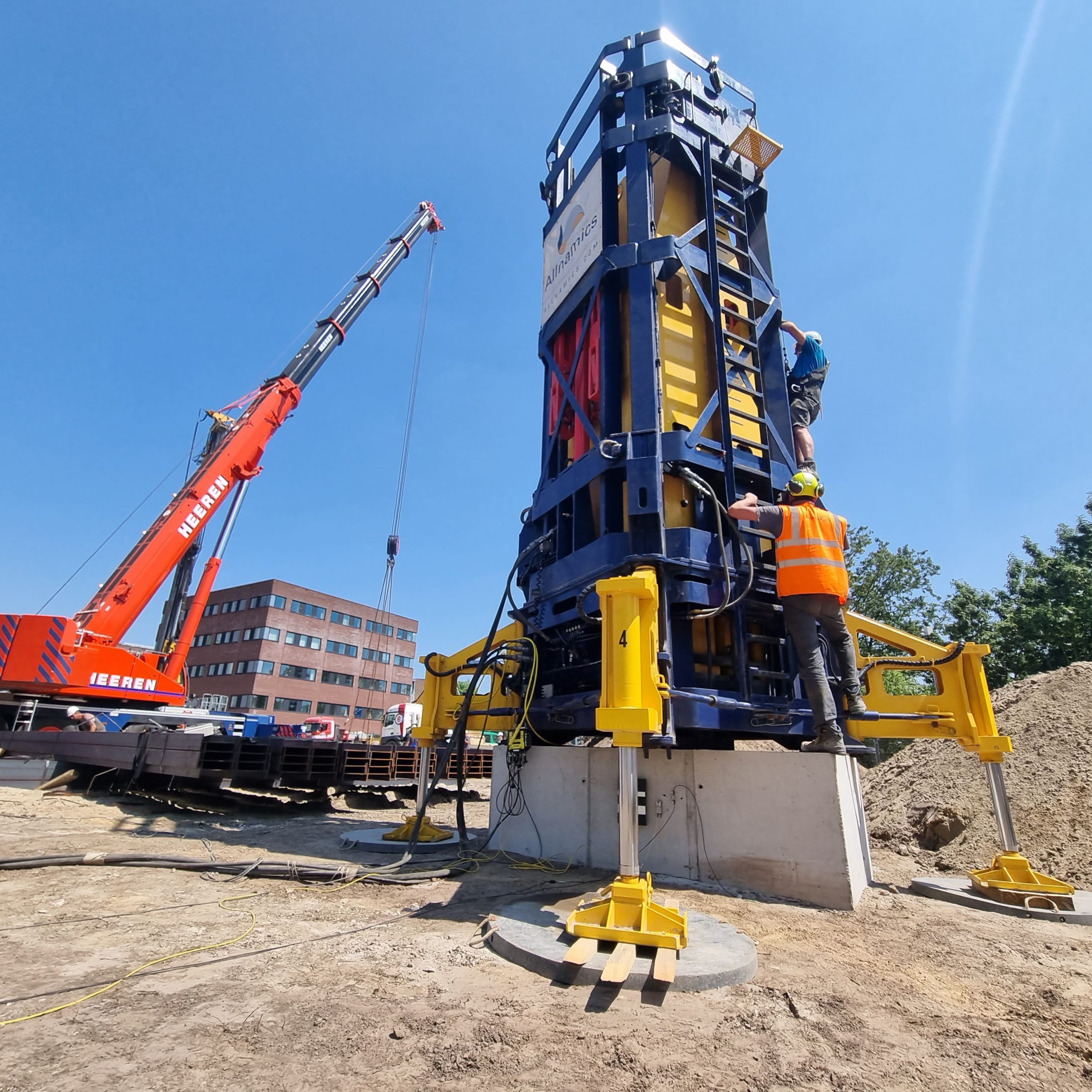



Discrepancies between static and dynamic pile load test results occur because the two methods measure fundamentally different physical phenomena under different loading conditions, timescales, and soil response mechanisms. Static load testing applies a slow, sustained force and records real displacement directly, while dynamic load testing applies a millisecond impact and derives capacity through wave equation analysis. The gap between results is not a sign that one method is wrong — it reflects genuine differences in what each test captures. The sections below unpack the specific technical reasons behind these differences and explain when they matter most for your project decisions.
Why do static and dynamic pile tests measure different things?
Static and dynamic pile tests measure different things because they apply load in fundamentally different ways and derive their results through different physical processes. Static load testing for pile capacity measures force and displacement directly using load cells and displacement gauges under a slowly applied, sustained load. Dynamic load testing derives force from measured strain multiplied by pile stiffness, and derives displacement by double numerical integration of measured acceleration — both indirect calculations that introduce additional processing steps and associated uncertainty.
This distinction matters more for some pile types than others. For steel casing piles with a well-defined, constant cross-section, the indirect derivation in dynamic testing introduces acceptable inaccuracy. For cast-in-situ concrete piles, where cross-section area and concrete stiffness vary along the shaft and are not precisely known, those same post-processing steps can produce significant errors. The pile material and geometry are simply better defined for steel than for cast concrete, and the accuracy of dynamic testing depends heavily on how well the pile’s physical properties can be characterized.
Static load testing also produces a direct, unambiguous load-settlement curve that engineers and clients can read without interpretive models. Dynamic results require signal matching analysis, which introduces user dependency and a bandwidth of possible outcomes. For projects with strict regulatory requirements or mandatory independent verification, this interpretive simplicity gives static testing a clear advantage as an evidentiary record.
How does soil setup and relaxation affect test comparisons?
Soil setup and relaxation directly affect the bearing capacity a pile exhibits at the time of testing, which means a dynamic test performed at a different time than a static test will measure a different soil state — not a different pile. Setup refers to the increase in soil resistance that occurs after pile installation as excess pore water pressures dissipate and the surrounding soil consolidates around the pile. Relaxation is the opposite effect, where resistance decreases over time, most commonly in dense sands or weak rocks.
For driven piles, the waiting period between installation and testing — known as setup time — is one of the most important variables controlling how closely dynamic and static results will correlate. If a dynamic test is performed too soon after driving, pore pressures generated during installation have not yet dissipated, and the measured resistance will underestimate the pile’s long-term static capacity. Conversely, if setup is significant and the static test is performed later, it may record a higher capacity than an early dynamic restrike test captured.
This is why reputable practice requires dynamic tests to be performed at restrike — after an appropriate waiting period that allows the soil to reach a representative state. The waiting period must be calibrated to the soil type and pile installation method. In fine-grained cohesive soils, setup can take days or weeks, and dynamic testing during this window will produce results that diverge substantially from long-term static behavior. In granular soils, setup is faster and more predictable, which is one reason dynamic and static results correlate better in sands and gravels than in clays.
What role does strain rate dependency play in result differences?
Strain rate dependency is a soil behavior characteristic that causes soil resistance to appear higher under fast loading than under slow loading. Because dynamic load testing applies a load lasting only milliseconds, the soil experiences a much higher rate of strain than it does under the sustained, slowly applied force of a static load test. In rate-sensitive soils, this difference in loading speed produces a measurable difference in apparent resistance — and therefore a difference in the capacity values each test reports.
This effect is most pronounced in fine-grained cohesive soils such as clay. Clay exhibits significant rate-dependent behavior because its shear strength is influenced by the speed at which it is sheared. Under the rapid impact of a dynamic test, clay can appear stronger than it actually is under slow static loading conditions. Signal matching analysis attempts to account for this through damping parameters in the soil model, but these parameters must be assumed or calibrated, and they introduce additional uncertainty into the result.
Rapid Load Testing — which applies a load lasting roughly 100 milliseconds, intermediate between static and dynamic — also requires a correction for rate effects, applied through methods such as the Unloading Point Method. This correction is better defined than dynamic damping parameters, but it still requires careful application. In granular soils, rate dependency is much less significant, which is another reason dynamic and static results align more closely in sands than in clays. When your project involves thick layers of cohesive soil, strain rate dependency should be treated as a primary source of divergence between test methods, not a secondary concern.
How do signal matching assumptions introduce uncertainty in DLT?
Signal matching introduces uncertainty in dynamic load testing because the analysis requires engineers to build a numerical model with a large number of adjustable parameters, and no unique solution exists for any given pile. Different combinations of soil model parameters can produce equally plausible matches to the measured signal, meaning two experienced engineers analyzing the same test data with the same software can arrive at different capacity estimates. This inherent user dependency creates a bandwidth of outcomes rather than a single definitive answer.
The signal matching process works by iteratively adjusting a soil resistance model — including parameters for shaft friction distribution, toe resistance, and soil damping — until the calculated upward force wave matches the wave derived from field measurements. Software such as AllWave-DLT or CAPWAP performs this analysis, but the quality of the result depends heavily on the engineer’s judgment in setting up the model, selecting starting parameters, and evaluating the quality of the match.
Conditions that minimize signal matching uncertainty
The bandwidth of signal matching outcomes is smallest when field measurements are collected with well-maintained, calibrated equipment, and when the pile has a constant, well-defined cross-section. End-bearing steel piles with a long free-standing length and the toe in rock or granular soil represent the most favorable conditions. Under these circumstances, the soil model has fewer degrees of freedom, the pile’s physical properties are clearly defined, and an experienced engineer can achieve a reliable, well-constrained result.
Conditions that widen the uncertainty range
Uncertainty grows significantly for piles with variable cross-section properties, friction piles with minimal free-standing length, and piles where a significant proportion of resistance comes from cohesive soil. Cast-in-situ concrete piles combine all of these unfavorable characteristics simultaneously — variable geometry, uncertain material properties, and often a friction-dominated load transfer mechanism in cohesive soil. For these pile types, the signal matching bandwidth can be wide enough that dynamic load testing should be supplemented with project-based verification testing rather than used as a standalone method. It is also worth noting that signal matching results are consistently more reliable than direct methods such as the CASE method or driving formulae applied directly to field data, even when conditions are unfavorable.
What pile-related factors can cause test result divergence?
Pile-related factors that cause divergence between static and dynamic test results include pile material, cross-section consistency, load transfer mechanism, and the condition of the pile at the time of testing. These factors influence how accurately dynamic testing can model the pile’s physical behavior and how closely the derived capacity reflects what a static test would measure under sustained loading.
Steel casing piles with a constant cross-section along the full shaft length provide the most favorable conditions for dynamic testing. Their material properties are well-defined, their geometry is consistent, and stress wave modeling through the pile is straightforward. For these piles, dynamic and static results typically fall within 10 to 20% of each other in granular soils — a range acceptable for many projects.
Friction piles and cast-in-situ concrete piles present a different picture. For friction piles in granular soils, the correlation between dynamic and static results typically falls within 20 to 40%. In cohesive soils, correlation can be significantly weaker, and dynamic testing should generally be avoided as a standalone method. Cast-in-situ concrete piles combine uncertain cross-section geometry, variable concrete quality, and a load transfer mechanism that is often dominated by shaft friction — all factors that reduce the accuracy of stress wave modeling and widen the gap between dynamic and static results.
Damaged piles introduce additional complexity. Cracks, changes in cross-section, or soil inclusions alter how stress waves travel through the pile, making signal matching harder to perform accurately. In these cases, dynamic test results may be unreliable without supplementary integrity testing to characterize the pile’s condition before interpreting capacity data.
When should discrepancies trigger further investigation?
Discrepancies between static and dynamic pile test results should trigger further investigation when the difference exceeds the expected accuracy range for the pile type and soil conditions, when the direction of the discrepancy is inconsistent with known soil behavior, or when the consequences of an incorrect capacity assessment are high. Not every difference signals a problem — some divergence is expected and explainable — but unexplained or large discrepancies warrant a structured response before construction proceeds.
As a practical reference, dynamic and static results for end-bearing driven piles in granular soils should correlate within roughly 10 to 20%. For friction piles and cast-in-situ concrete piles in granular soils, a range of 20 to 40% is more typical. If your results fall outside these ranges without a clear explanation — such as inadequate setup time, insufficient drop energy, or known pile damage — that gap deserves investigation rather than acceptance.
Specific situations that should prompt further review include:
- Dynamic results consistently higher than static results — this can indicate that damping parameters in the signal matching model are underestimated, or that rate effects in cohesive soil are inflating apparent dynamic resistance
- Dynamic results consistently lower than static results — this may indicate insufficient drop energy to fully mobilize soil resistance, or that setup was incomplete at the time of the dynamic test
- High variability between signal matching interpretations — if different engineers produce substantially different capacity estimates from the same data, the bandwidth is too wide to rely on the result without supplementary testing
- Unexpected pile behavior during static testing — abrupt changes in the load-settlement curve, excessive settlement at low loads, or failure at a load well below the dynamic estimate all warrant pile integrity investigation
- Cast-in-situ concrete piles in cohesive soils — this combination carries the highest risk of unreliable dynamic results, and any significant discrepancy should prompt static or Rapid Load Testing on additional piles
Because dynamic tests can both overestimate and underestimate pile capacity, appropriate safety factors must always be applied to dynamic load test results. These factors should be calibrated to the bandwidth of the signal matching analysis and to site-specific variables including pile type, soil type, and setup conditions. When safety factors alone are insufficient to manage the uncertainty — particularly on high-consequence projects — supplementary static or Rapid Load Testing provides the additional confidence that dynamic testing alone cannot deliver.
How Allnamics Approaches Test Result Discrepancies
When static and dynamic pile test results diverge, the cause is rarely obvious from the numbers alone. Identifying whether the discrepancy reflects a soil behavior effect, a signal matching limitation, a pile condition issue, or a testing procedure problem requires both technical depth and direct field experience. This is where we add value.
We bring together specialists in pile testing, wave equation analysis, and geotechnical engineering who work with these questions on real projects across a wide range of pile types, soil conditions, and project environments. Here is how we help your team work through result discrepancies:
- Independent signal matching review: We analyze dynamic load test data using AllWave-DLT, our in-house developed software, and assess whether the signal matching model is well-constrained or whether the bandwidth of outcomes is too wide to support reliable conclusions
- Setup time assessment: We evaluate whether the waiting period between installation and testing was sufficient for the soil conditions, and advise on restrike timing to improve result reliability
- Supplementary testing recommendations: Where dynamic results are uncertain or the pile type is unfavorable for dynamic testing, we recommend and perform Static Load Testing or Rapid Load Testing to provide direct, independently measured verification
- Pile integrity assessment: If pile damage or cross-section variability may be contributing to discrepancies, we perform Sonic Integrity Testing or Sonic Logging to characterize the pile’s physical condition before drawing capacity conclusions
- Combined testing programs: For large production pile programs, we design testing strategies that combine dynamic testing for broad quality control with static or Rapid Load Testing on a subset of trial piles, giving your project both efficiency and confidence
If your project is producing results that do not align as expected, or if you want to design a testing program that minimizes the risk of ambiguous outcomes from the start, contact us to discuss your project requirements and your specific pile types, soil conditions, and project requirements.