


Elastic settlement and plastic settlement differ in one fundamental way: elastic settlement is recoverable, while plastic settlement is permanent. When a load is applied to a foundation, elastic settlement occurs immediately and reverses when the load is removed. Plastic settlement, by contrast, involves irreversible deformation of the soil structure that remains even after the load is lifted.
This distinction matters enormously in foundation engineering because plastic settlement accumulates over time and can compromise structural integrity, whereas elastic settlement is generally predictable and manageable through design. Understanding both types helps engineers select the right foundation system, specify appropriate pile load testing programs, and set realistic performance expectations for a structure throughout its service life.
The sections below address the most common questions engineers and project teams ask about settlement behavior, causes, soil vulnerability, monitoring, and when pile foundations become a concern.
How do elastic and plastic settlement behave differently under load?
Elastic settlement occurs instantly when a load is applied and disappears when the load is removed, following the same stress-strain relationship as a spring. Plastic settlement, also called permanent or residual settlement, does not reverse. Once the soil deforms plastically, that deformation becomes part of the ground’s new equilibrium state, regardless of whether the load continues or is removed.
In practice, both types of settlement often occur simultaneously when a foundation is loaded. The total settlement a structure experiences is the sum of its elastic and plastic components. During the early stages of loading, elastic behavior dominates. As stress increases and exceeds the soil’s yield point, plastic deformation begins to accumulate alongside the elastic response.
The load-displacement curve from a static load test illustrates this clearly. At low load levels, the curve is nearly linear and the pile or foundation returns close to its original position when unloaded. At higher loads, the curve becomes nonlinear, and the residual displacement after unloading represents the plastic component. Engineers use this curve to identify the transition point and to confirm that a foundation operates safely within its elastic range under service loads.
The key behavioral difference also plays out over time. Elastic settlement is essentially instantaneous in granular soils. Plastic settlement, particularly in fine-grained soils, can develop slowly over months or years as excess pore water pressures dissipate and soil particles rearrange. This time-dependent plastic deformation is called consolidation settlement, and it is one of the most significant challenges in foundation design for structures built on soft ground.
What causes plastic settlement in foundation soils?
Plastic settlement is caused by irreversible rearrangement of soil particles under stress. When the applied load exceeds the soil’s preconsolidation pressure, the soil structure yields and compresses permanently. The primary mechanisms are shear failure within the soil mass, volumetric compression as voids collapse, and the slow expulsion of pore water from fine-grained soils under sustained load.
Several factors drive the onset and magnitude of plastic settlement:
- Stress history of the soil: Normally consolidated soils, which have never been loaded beyond their current stress state, are far more susceptible to plastic deformation than overconsolidated soils, which have previously been compressed to higher stress levels and partially rebounded.
- Void ratio and compressibility: Soils with high void ratios, such as soft clays and organic soils, contain more water-filled space that can collapse under load, producing large plastic settlements.
- Rate of loading: Rapid loading in fine-grained soils generates excess pore water pressure that temporarily supports part of the applied stress. As that pressure dissipates over time, the effective stress on the soil skeleton increases, triggering further plastic compression.
- Creep: Even at constant load levels below the yield point, some soils continue to deform slowly over time through a process called secondary compression or creep. This is a form of plastic deformation that occurs independently of pore pressure changes.
- Cyclic loading: Repeated loading and unloading cycles, such as those from traffic, wave action, or machinery, can cause progressive plastic strain accumulation even when individual load peaks remain within what would otherwise be an elastic range.
For pile foundations specifically, plastic settlement at the pile toe occurs when the soil beneath the pile tip is compressed beyond its elastic limit. This is why pile load tests that mobilize full resistance, including toe resistance, provide the most reliable data for predicting long-term settlement behavior.
Which soil types are most vulnerable to each settlement type?
Granular soils such as sand and gravel are most prone to elastic settlement, which occurs quickly and is largely recoverable. Fine-grained cohesive soils such as soft clay, silt, and peat are most vulnerable to plastic settlement, particularly the slow, time-dependent consolidation type that can continue for years after construction is complete.
Soils dominated by elastic settlement
Dense sands and gravels have high stiffness and low compressibility. When loaded, they deform elastically and reach equilibrium quickly because water drains freely through their pore structure. Elastic settlement in these soils is typically small, rapid, and well-predicted by standard elastic theory. Foundations on dense granular soils generally perform well in terms of settlement control, provided the applied stress remains within the soil’s bearing capacity.
Stiff overconsolidated clays also exhibit relatively elastic behavior under working loads because their stress history has already compressed them significantly. Settlement in these soils tends to be modest and largely immediate, though some time-dependent creep can still occur.
Soils dominated by plastic settlement
Soft normally consolidated clays are the most problematic soil type for plastic settlement. Their high water content, high compressibility, and low permeability mean that consolidation settlement develops slowly and can be very large in magnitude. Structures built on soft clay without adequate pile foundations or ground improvement frequently experience differential settlement that damages finishes, services, and structural connections over time.
Organic soils and peat are even more compressible and are subject to both primary consolidation and significant secondary compression. Settlement in these materials can continue for decades. Loose fills and recently deposited alluvial soils also carry elevated plastic settlement risk, particularly when they have not had time to consolidate under their own weight before a structure is built on top.
In mixed soil profiles, where granular layers alternate with soft clay layers, the total settlement combines elastic response from the granular zones with plastic consolidation from the clay layers. This combination makes settlement prediction more complex and reinforces the value of site-specific testing rather than relying solely on general soil models.
How is settlement measured and monitored on construction sites?
Settlement is measured on construction sites using a combination of surface monitoring points, embedded sensors, and reference benchmarks tied to stable datums. The most common instruments include settlement plates, extensometers, inclinometers, piezometers, and precision leveling surveys. Together, these tools track how much a structure or the ground surface moves over time and in which direction.
A well-designed monitoring program distinguishes between elastic and plastic components by recording displacement both during loading and after load changes. If a measurement point returns to its original position after a load is removed, the movement was elastic. Residual displacement that remains after unloading confirms plastic deformation has occurred.
Key instruments used in settlement monitoring include:
- Settlement plates and surface markers: Simple, cost-effective devices placed at the ground surface or on structural elements. Repeated precision leveling surveys track vertical movement over time.
- Borehole extensometers: Measure compression within specific soil layers at depth, allowing engineers to identify which stratum is contributing most to total settlement.
- Piezometers: Monitor pore water pressure changes in fine-grained soils. Rising and falling pore pressures indicate the progress of consolidation, which directly relates to the rate of plastic settlement.
- Inclinometers: Detect lateral movement and tilting, which can accompany differential settlement in embankments, retaining walls, and structures on variable ground.
- Automated real-time monitoring systems: For high-risk or time-sensitive projects, sensors connected to data loggers and remote monitoring platforms provide continuous readings and can trigger alerts when movement exceeds predefined thresholds.
The frequency of monitoring depends on the construction phase and the rate of expected settlement. During active loading, such as when fill is being placed or a structure is being built, more frequent readings capture the settlement response in detail. Once construction is complete, monitoring intervals can be extended, though long-term programs remain important for structures on soft ground where consolidation continues well beyond the construction period.
When does settlement become a structural concern for pile foundations?
Settlement becomes a structural concern for pile foundations when it exceeds the tolerances the structure can accommodate without damage, or when differential settlement between adjacent piles or foundation elements creates distortion that stresses beams, columns, facades, or services. Absolute settlement values matter less than the difference in settlement between points, because differential movement generates bending and shear forces that uniform settlement does not.
For pile foundations, the primary concern is whether the pile is operating within its elastic range under service loads. If applied loads push the pile-soil system into plastic deformation, settlement will accumulate and may not stabilize. This is why pile load tests are performed: they generate a direct load-displacement curve that shows exactly where elastic behavior ends and plastic deformation begins for the specific pile type, length, and soil conditions at the site.
Several conditions signal that settlement is becoming a structural concern:
- Differential settlement exceeding design tolerances: Most structures tolerate some absolute settlement, but angular distortion between adjacent foundation points beyond roughly 1 in 300 to 1 in 500 can cause cracking in masonry, misalignment of structural frames, and damage to cladding or glazing systems.
- Settlement that continues to accelerate: Stable settlement that slows over time is generally manageable. Settlement that accelerates or shows no sign of stabilizing suggests ongoing plastic deformation and possible progressive failure of the soil beneath the pile toe.
- Pile groups with uneven load distribution: When piles within a group carry significantly different loads due to eccentric loading or variable soil conditions, some piles may be pushed into plastic deformation while others remain elastic, creating differential settlement within the group itself.
- Negative skin friction: In areas where surrounding soil consolidates and settles around a pile, the downward drag force on the pile shaft adds to the structural load, potentially pushing the pile beyond its design capacity and triggering additional settlement.
A pile load test conducted before or during construction provides the most reliable basis for assessing these risks. The load-settlement curve it produces shows not only the pile’s capacity but also the stiffness of its response, allowing engineers to confirm that service loads remain well within the elastic range and that long-term plastic settlement will be minimal.
How We Help You Understand and Control Settlement
Settlement analysis and foundation performance verification are areas where the right testing program makes a measurable difference to project outcomes. We support engineers, contractors, and asset owners at every stage where settlement behavior matters, from design verification through construction monitoring and long-term performance assessment.
Here is how we help your team address settlement-related challenges:
- Static Load Testing (SLT): We perform static load tests that generate direct, unambiguous load-settlement curves. These tests capture both elastic and plastic settlement behavior under controlled, sustained loading, giving you the data needed to confirm design assumptions and identify the onset of plastic deformation.
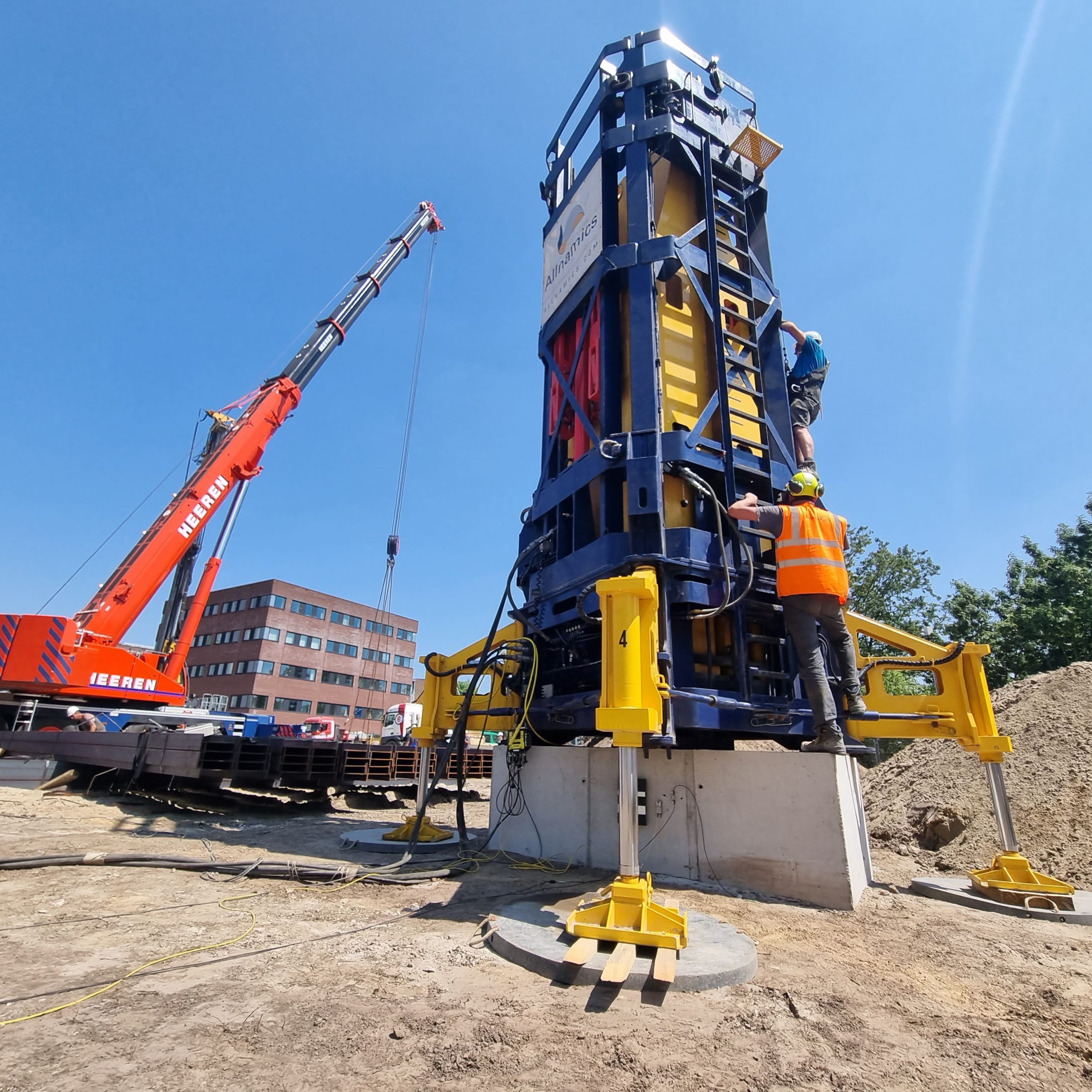
- Rapid Load Testing (RLT): For projects where static testing is logistically challenging, our Rapid Load Testing method delivers accurate load-displacement data efficiently, without the need for a reaction frame or dead weight.
- Dynamic Load Testing (DLT): We use dynamic testing for capacity verification on driven piles in granular soils, integrated into broader programs that include static or rapid testing where settlement behavior governs design.
- Geotechnical monitoring programs: We design and install monitoring systems that measure settlement, pore water pressure, inclination, and deformation in real time, giving your team continuous visibility into how foundations and surrounding ground are behaving during and after construction.
- Foundation assessment and forensic investigation: When unexpected settlement occurs in existing structures, we investigate the cause, assess the extent of plastic deformation, and advise on remediation or load redistribution strategies.
- Independent technical review: We provide independent verification of settlement predictions and foundation designs, supporting regulatory submissions and giving project stakeholders confidence in the technical basis for key decisions.
If your project involves soft ground, variable soil conditions, or structures where settlement tolerances are tight, contact us to discuss your project to discuss how a targeted testing and monitoring program can reduce your risk and give you reliable data from the ground up.