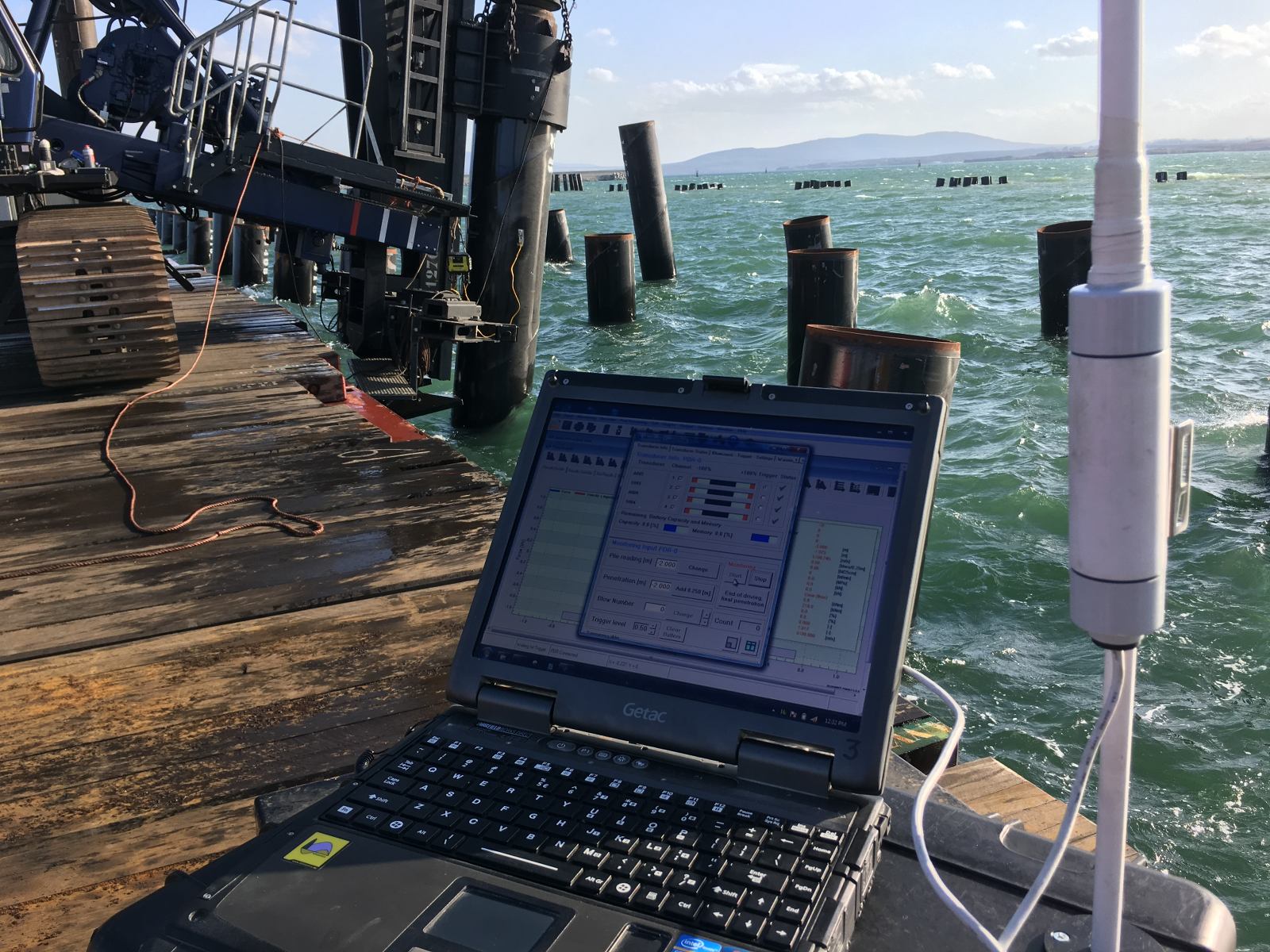


The relationship between vibratory hammer frequency and eccentric moment is direct and multiplicative: together, these two parameters determine the centrifugal force the hammer generates, which drives pile penetration. Frequency controls how many vibration cycles occur per second, while eccentric moment defines the amplitude of those vibrations. Neither parameter alone determines hammer performance; the combination of both governs how effectively the hammer overcomes soil resistance. The sections below unpack each aspect of this relationship and explain how engineers apply it in practice, including the role of tools like AllWave-VDP in vibratory driving prediction.
How does eccentric moment affect the force output of a vibratory hammer?
Eccentric moment directly controls the centrifugal force a vibratory hammer produces. The centrifugal force is calculated as the product of the eccentric moment, the square of the angular frequency, and the total eccentric mass. This means that increasing the eccentric moment, while keeping frequency constant, raises the dynamic force output proportionally, which in turn increases the displacement amplitude imposed on the pile.
In practical terms, eccentric moment is a measure of how far the rotating eccentric masses are positioned from the axis of rotation, multiplied by their mass. A larger eccentric moment generates a stronger oscillating force, which pushes the pile through greater displacement per cycle. This is particularly relevant in cohesive soils, where the pile must achieve sufficient displacement amplitude to generate plastic deformation in the surrounding soil. If the amplitude is too small, the soil response remains largely elastic and the pile makes little or no permanent penetration.
It is important to understand that eccentric moment does not act in isolation. The actual force delivered to the pile also depends on the dynamic interaction between the hammer, the pile, and the soil. As soil resistance changes with depth, the same eccentric moment can produce different penetration results. This is why soil-specific analysis is always needed alongside hammer parameter selection.
What happens to pile penetration when frequency changes?
Changing the operating frequency of a vibratory hammer affects penetration rate in a non-linear way, because centrifugal force scales with the square of frequency. Doubling the frequency quadruples the centrifugal force, assuming eccentric moment stays constant. However, higher frequency also means more vibration cycles per unit of time, which accelerates soil fatigue and can significantly reduce soil resistance around the pile shaft.
In granular soils, this soil fatigue effect is particularly pronounced. Cyclic loading disrupts the contact forces between soil particles, causing a temporary but substantial reduction in shear resistance. At a frequency of around 23 Hz, for example, a vibratory hammer can produce roughly 10,000 cycles in approximately seven minutes. The soil at the upper part of the pile shaft experiences the full loading history of those cycles, while the soil near the current pile tip has only been loaded for a fraction of that time. This means soil fatigue is not uniform along the pile; it varies with depth and local loading history.
In cohesive soils, frequency changes have a different effect. These soils retain more residual strength after cyclic loading, so simply increasing frequency does not guarantee improved penetration. The pile must still generate enough displacement per cycle to overcome the remaining soil resistance. When amplitude drops too low, which can happen if frequency is raised without adjusting eccentric moment, penetration can stall even at high centrifugal force levels.
Why can’t frequency and eccentric moment be optimized independently?
Frequency and eccentric moment cannot be optimized independently because they interact to produce the centrifugal force, and that force must be matched to both the soil resistance and the structural limits of the pile. Optimizing one parameter without considering the other risks either insufficient penetration or damaging stress levels in the pile.
Consider what happens when frequency is increased without adjusting eccentric moment: centrifugal force rises sharply, but the displacement amplitude per cycle may not increase proportionally if the pile-soil system responds differently at higher frequencies. Conversely, raising eccentric moment without considering frequency can produce excessive displacement amplitudes that generate stress levels beyond what the pile can safely handle.
The soil model adds another layer of complexity. As the knowledge base from Allnamics’ research highlights, the ground reaction during vibratory driving depends on displacement, velocity, and acceleration simultaneously. Simple linear constants are not sufficient to describe this interaction realistically. The relationship between frequency, eccentric moment, and actual penetration therefore requires a coupled analysis that accounts for:
- Spring stiffness of the soil
- Damping characteristics at the pile-soil interface
- Added mass effects from the surrounding soil
- Local fatigue history at each depth increment
This is precisely why simplified rules of thumb are unreliable for vibratory driving prediction. A full numerical simulation, using one-dimensional stress-wave analysis and a realistic soil model, is the only way to assess the combined effect of frequency and eccentric moment across varying soil conditions.
What is the difference between fixed and variable eccentric moment hammers?
Fixed eccentric moment hammers operate at a single, preset eccentric moment, meaning the centrifugal force output at any given frequency is constant throughout the drive. Variable eccentric moment hammers allow the operator to adjust the eccentric moment during installation, giving real-time control over the force amplitude and displacement imposed on the pile.
Fixed eccentric moment hammers
These hammers are simpler in design and typically less expensive. They work well in uniform soil conditions where the required force output is predictable from the start. The limitation is that the operator cannot adapt to unexpected changes in soil resistance: if the pile encounters a stiffer layer, the only adjustment available is to change the operating frequency, which affects force output but also changes the number of cycles per second and the soil fatigue rate.
Variable eccentric moment hammers
Variable hammers allow the eccentric moment to be changed while the hammer is running. This gives the operator the ability to start with a lower eccentric moment during initial penetration, reducing the risk of excessive vibrations near sensitive structures, and then increase it progressively as the pile advances deeper. This flexibility is particularly useful in urban environments, in layered soil profiles, or when driving near existing infrastructure where vibration limits must be respected. The trade-off is greater mechanical complexity and higher equipment cost.
From a Vibratory Driving Prediction standpoint, variable hammers require more detailed modelling because the analysis must account for the changing hammer configuration at different penetration depths.
How do engineers select the right frequency and eccentric moment for a project?
Engineers select frequency and eccentric moment by matching the hammer’s force output to the soil resistance profile, the pile’s structural capacity, and any site-specific constraints such as vibration limits. The process starts with a soil model derived from site investigation data, typically CPT results, and uses numerical simulation to predict penetration performance across the full installation depth.
The selection process generally follows these steps:
- Characterize the soil resistance profile using CPT or borehole data, identifying layers with high shaft friction or toe resistance that the hammer must overcome.
- Define the pile’s structural limits, the maximum allowable compressive and tensile stresses during installation, to set an upper boundary on force output.
- Run a vibratory driving prediction using software that models the full hammer-pile-soil interaction, including soil fatigue as a function of local loading history at each depth.
- Evaluate the predicted penetration rate and adjust frequency and eccentric moment until the simulation shows adequate penetration through all soil layers without exceeding structural limits.
- Check vibration levels at nearby structures if the site requires it, and adjust hammer parameters or installation sequence accordingly.
A key principle from stress-wave analysis applies here: rated hammer energy is not equal to energy delivered to the pile. The actual energy transfer depends on the full dynamic system: hammer, pile, and soil together. This means that selecting a hammer based on its rated specifications alone is insufficient. The analysis must simulate the actual energy transfer through the system under realistic soil conditions.
In granular soils, engineers often find that a moderate frequency combined with a well-matched eccentric moment produces better results than simply maximizing centrifugal force. In cohesive soils, achieving sufficient displacement amplitude per cycle is the primary concern, which may favour a higher eccentric moment over a higher frequency.
How Allnamics Supports Vibratory Driving Prediction
We provide advanced vibratory driving prediction services and software that give your team the analytical depth needed to select and validate hammer parameters before installation begins. Our approach combines decades of experience in pile driving analysis with purpose-built numerical tools grounded in one-dimensional stress-wave theory and realistic soil modelling.
Here is what we offer for projects involving vibratory hammer selection and installation planning:
- AllWave-VDP simulations that model the full hammer-pile-soil interaction for vibratory driving, including soil fatigue as a function of local loading history at each depth increment
- CPT-based soil modelling that translates site investigation data into realistic resistance profiles for use in drivability studies
- Hammer parameter optimization: we evaluate frequency and eccentric moment combinations to identify the operating window that achieves the required penetration without exceeding pile stress limits
- Vibration assessment for projects near sensitive structures, helping your team stay within site-specific vibration limits throughout installation
- Independent technical review of contractor-proposed hammer selections, providing an objective check before mobilization
- AllWave-PDP for impact driving when your project involves a combination of vibratory and impact installation methods
Whether you are planning a new offshore foundation, a nearshore marine structure, or an onshore infrastructure project, selecting the right vibratory hammer parameters early reduces installation risk and avoids costly delays. Contact us to discuss your project and find out how our drivability prediction services can support your team.