


Creep causes piles to continue settling gradually over time even when the applied load remains constant. This time-dependent deformation occurs because soil particles rearrange slowly under sustained stress, and it is most pronounced in fine-grained cohesive soils such as soft clay and peat. The sections below explain how creep develops, which conditions amplify it, and what engineers can do to measure, predict, and control it.
What causes creep in pile foundations under sustained load?
Creep in pile foundations is caused by the slow, time-dependent rearrangement of soil particles under a constant applied load. Unlike elastic deformation, which occurs immediately when a load is applied, creep continues long after loading is complete because fine-grained soils cannot instantly dissipate the excess pore water pressure generated by the new stress state.
When a pile transfers load into the surrounding soil, two processes unfold. The first is primary consolidation, where water is gradually squeezed out of the soil voids as excess pore pressure dissipates. The second is secondary compression, often called true creep, which continues even after pore pressures have fully equalized. During secondary compression, the soil skeleton itself deforms plastically as particles reorient and organic matter compresses under sustained stress.
The rate and magnitude of creep depend on several interacting factors: the compressibility of the soil, the magnitude and duration of the applied load, the drainage conditions around the pile, and the stiffness of the pile-soil interface. In end-bearing piles, where load is transferred primarily to a firm stratum at depth, creep is generally limited. In friction piles, where load is distributed along the shaft through soft or compressible layers, creep can accumulate significantly over years or decades.
How does creep settlement differ from elastic settlement in piles?
Elastic settlement in piles occurs immediately when a load is applied and recovers fully when the load is removed. Creep settlement, by contrast, develops gradually under sustained load and is largely permanent. The two mechanisms operate on entirely different timescales and have different implications for structural design and long-term performance.
Elastic settlement reflects the compression of the pile shaft itself and the immediate deformation of the soil at the pile toe. It is predictable, proportional to load, and well-captured by standard geotechnical calculations. Creep settlement accumulates over months or years and is governed by the viscous behavior of the soil skeleton rather than its stiffness alone.
From a practical standpoint, this distinction matters because elastic settlement can be accounted for during construction by adjusting pile cut-off levels or structural connections. Creep settlement, however, continues after the structure is in service, potentially causing differential movement between foundation elements, distortion of structural frames, and damage to finishes or services. A pile load test that measures displacement under sustained load is one of the few tools that directly captures this time-dependent behavior in the field.
Which soil types cause the most creep in pile foundations?
Soft clays, peats, and organic silts cause the most creep in pile foundations. These fine-grained, cohesive soils have low permeability and high compressibility, which means they drain slowly and continue to deform under sustained stress long after primary consolidation is complete. Peat is particularly problematic because its organic content makes it highly compressible and prone to secondary compression over extended periods.
Soft marine clays and estuarine deposits, common in coastal and delta regions, also exhibit significant creep. These soils often have a high natural water content and a loose, open structure that collapses progressively under load. Glacial lake clays and sensitive Scandinavian or Canadian quick clays behave similarly.
In contrast, dense sands, gravels, and competent rock generate very little creep because their granular structure transfers load through grain-to-grain contact without significant time-dependent deformation. Stiff overconsolidated clays occupy a middle ground: they creep less than normally consolidated clays but can still exhibit measurable secondary compression under high sustained loads.
For projects where piles pass through compressible layers before reaching a firm bearing stratum, the surrounding soft soil can still impose negative skin friction on the pile shaft as it consolidates and settles. This downdrag effect adds to the effective load on the pile and can accelerate creep-related settlement if not accounted for in design.
How is long-term creep settlement measured and monitored in practice?
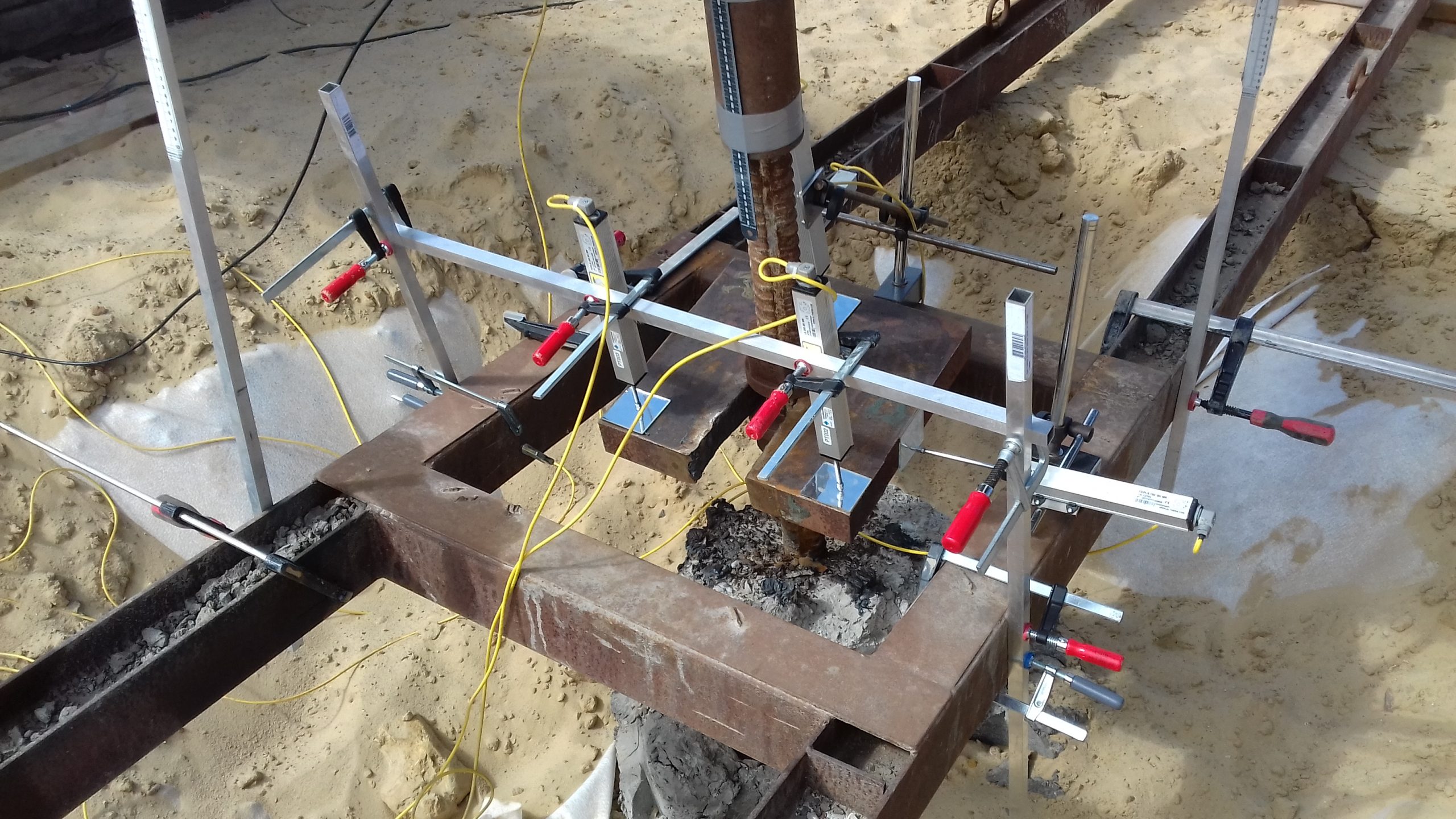
Long-term creep settlement is measured by tracking pile head displacement under a sustained, constant load over time. The most direct method is static load testing, where a controlled load is applied to a pile and held at each load increment for a defined period while displacement is recorded continuously. The resulting load-settlement curve captures both immediate elastic response and time-dependent creep behavior within the test duration.
Measuring creep during pile load tests
During a static pile load testing procedure, engineers hold each load increment for a set period, typically one hour or until the rate of settlement falls below a defined threshold. The settlement recorded during this hold period, beyond the initial elastic compression, represents measurable creep. By comparing creep rates across load increments, engineers can identify the load level at which creep accelerates, which often signals proximity to the pile’s ultimate capacity.
Instrumentation embedded along the pile shaft, such as strain gauges or distributed fiber optic sensors, provides additional detail by showing how load is transferred at different depths and where creep-related movement is concentrated. This data is particularly valuable for friction piles in layered soil profiles.
Monitoring creep in the field over time
For structures already in service, geotechnical monitoring programs track settlement using precise leveling surveys, settlement plates, extensometers, or automated sensor arrays. Monitoring points installed at pile heads or on the structure above allow engineers to plot settlement against time and identify whether movement is decelerating as expected or continuing at a rate that warrants intervention.
Automated monitoring systems can record data continuously and trigger alerts when settlement rates exceed predefined thresholds, giving asset owners and engineers early warning of developing problems. This approach is especially useful for infrastructure assets such as bridges, embankments, and port structures where differential settlement between foundation elements can affect operational safety.
When does creep settlement become a structural risk for a building or infrastructure project?
Creep settlement becomes a structural risk when it is differential rather than uniform, when it exceeds the tolerance limits of the structure above, or when it continues at a rate that does not decelerate over time. A building that settles uniformly by 50 mm may suffer no structural damage, while differential settlement of 20 mm between adjacent columns can crack facades, distort door frames, and overstress connections.
The risk threshold depends on the type of structure. Rigid reinforced concrete frames are sensitive to differential settlement because they cannot redistribute load easily. Flexible steel structures tolerate more movement before damage occurs. Sensitive equipment, precision manufacturing facilities, and structures with brittle finishes have very low tolerance for any ongoing movement.
For infrastructure, the consequences of unchecked creep can be more severe. Bridge abutments that settle relative to approach embankments create the “bump at the bridge” effect, which accelerates pavement deterioration and creates a safety hazard. Port quay walls and crane rails that settle unevenly disrupt operations and impose unintended loads on mooring structures.
Creep also becomes a risk when it is not anticipated in the original design. If a pile load test was not conducted or did not include a sustained-load phase, the design may underestimate long-term settlement, leaving no margin for the movement that develops after the structure enters service.
How can creep effects be reduced or accounted for in pile design?
Creep effects can be reduced by selecting pile types and configurations that minimize load transfer through compressible soil layers, and accounted for by incorporating time-dependent settlement predictions into the design from the outset. Both strategies require a clear understanding of the soil profile and the expected load history of the structure.
Key design approaches include:
- End-bearing piles to firm strata: Founding piles in dense sand, gravel, or rock eliminates the primary driver of creep by bypassing compressible layers entirely. This is the most effective way to limit long-term settlement.
- Preloading or surcharging: Applying a temporary load greater than the design load before construction accelerates primary consolidation and reduces the creep that would otherwise occur during the structure’s service life.
- Pile stiffness and spacing optimization: Stiffer piles and closer spacing reduce the load per pile, keeping stress levels in the soil below the range where creep rates become significant.
- Negative skin friction allowances: In areas where surrounding soil will consolidate independently of the pile, design loads should include a downdrag component to avoid underestimating long-term pile head settlement.
- Secondary compression coefficients in settlement calculations: Using established soil mechanics parameters such as the secondary compression index allows engineers to estimate long-term creep settlement and set realistic performance expectations for the structure.
- Sustained-load pile testing: Conducting static load tests with extended hold periods at each load increment provides direct evidence of creep behavior under site-specific conditions, reducing reliance on conservative assumptions.
Where creep cannot be eliminated, designing the structure to tolerate predicted movement, through flexible connections, adjustable bearings, or planned maintenance interventions, is a practical alternative to attempting to prevent all settlement.
How Allnamics Helps You Understand and Manage Pile Creep
We work with engineers, developers, and asset owners to characterize creep behavior, verify pile performance under sustained load, and set up monitoring programs that track long-term settlement throughout a structure’s service life. Our approach combines field testing, embedded instrumentation, and continuous monitoring to give you reliable data at every stage of a project.
Specifically, we can support your project with:
- Static load testing with sustained-load phases that directly measure creep settlement under controlled conditions, producing a load-settlement curve your team can use to validate design assumptions
- Embedded instrumentation along the pile shaft to identify where load transfer occurs and where time-dependent movement is concentrated in layered soil profiles
- Long-term geotechnical monitoring programs using settlement sensors, extensometers, and automated data acquisition systems that track pile head movement continuously after construction
- Foundation assessments for existing structures where ongoing settlement raises questions about structural safety or remaining service life
- Independent technical reviews of creep settlement predictions and pile design assumptions for projects in soft clay, peat, or other compressible soil environments
If your project involves piles in compressible ground, or if you are seeing unexpected settlement in an existing structure, contact us to discuss your project to discuss how we can help you get the data you need to make confident engineering decisions.