


You assess pile group behaviour from single pile tests by applying interaction factors, group efficiency calculations, and settlement superposition methods that translate individual pile response into predicted group performance. Single pile tests give you the load-transfer profile, stiffness, and capacity of one pile under controlled conditions, and from that data, engineers can derive how multiple piles will behave when their stress fields overlap in shared soil. The sections below walk through the mechanics of group behaviour, the tools used to interpret single pile data at group scale, and the conditions under which that approach is reliable.
Why don’t pile groups behave like multiple single piles?
Pile groups do not behave like the sum of individual piles because the stress fields generated by each pile overlap in the surrounding soil. When piles are installed close together, the soil between and beneath them experiences combined loading from every pile simultaneously, which changes how that soil deforms and how resistance is mobilised. The result is that a group of piles typically settles more and may carry less total load than the same number of isolated piles would suggest.
This phenomenon is driven by pile-soil-pile interaction. When one pile is loaded, it displaces soil and generates a stress bulb that extends outward. A neighbouring pile sits within that stress bulb, so the soil it relies on for resistance is already partially stressed before its own load is applied. The combined effect compresses the soil more deeply and over a wider volume than any single pile would on its own.
The practical consequence is that group settlement can be significantly larger than single pile settlement at the same average load per pile. For closely spaced friction piles in compressible soil, this difference can be substantial. For end-bearing piles founded on a stiff stratum, the interaction effect is smaller because the hard layer limits differential compression. Understanding this distinction is the starting point for any pile load testing and group analysis based on single pile test results.
What is the group efficiency factor and how is it calculated?
The group efficiency factor is a ratio that expresses the total capacity of a pile group as a fraction of the sum of the individual pile capacities. It accounts for the reduction in resistance that occurs when piles interact through shared soil. A group efficiency factor below 1.0 means the group carries less total load than the individual pile capacities added together would predict.
The factor is typically calculated using one of two approaches:
- Empirical formulas such as the Converse-Labarre equation, which calculate efficiency based on pile diameter, spacing, and the number of piles in each row and column. These are straightforward to apply but do not account for soil type or load-transfer mechanism directly.
- Block failure analysis, which checks whether the group might fail as a single large block of soil rather than through individual pile failure. The block perimeter and base area define the block capacity, and if this is lower than the sum of individual capacities, the block value governs.
In practice, group efficiency is close to 1.0 for end-bearing piles on a competent stratum and for piles with large centre-to-centre spacing, typically more than five to six pile diameters. For friction piles in soft clay at tight spacing, efficiency can drop noticeably. Your single pile load test gives you the individual pile capacity that feeds directly into both calculation approaches, making accurate single pile data a prerequisite for meaningful group efficiency assessment.
How are single pile test results used to predict group settlement?
Single pile test results are used to predict group settlement by extracting the load-settlement curve and stiffness of one pile, then applying superposition or equivalent raft methods to estimate how the group as a whole will deform under its combined load. The single pile test provides the empirical foundation; analytical or numerical methods scale that data to group geometry and soil conditions.
Superposition of interaction factors
The most widely used approach applies interaction factors to the single pile stiffness. For each pile in the group, the additional settlement caused by every other loaded pile is calculated and added to the pile’s own settlement. This requires the load-settlement relationship from the single pile test, the pile spacing, and an interaction factor derived from elastic theory or empirical charts. The total settlement at any pile head is the sum of its own settlement plus contributions from all neighbours.
Equivalent raft method
For large groups in compressible soil, engineers often use the equivalent raft method. The pile group is treated as a single large raft foundation located at a depth that reflects where the load transfers into the soil, typically at two-thirds of the pile length for friction piles or at the pile toe for end-bearing piles. Settlement is then calculated using conventional soil mechanics for that raft, with the single pile test informing the load distribution and the depth of the equivalent foundation level.
Both approaches depend on the quality of the load-settlement data from the single pile test. A static load test provides the most direct and unambiguous load-settlement curve, capturing the full stiffness response under sustained loading, which is what group settlement calculations require.
What are pile-soil-pile interaction factors and how do they work?
Pile-soil-pile interaction factors are dimensionless coefficients that quantify how much additional settlement one pile experiences due to the loading of a neighbouring pile. They are derived from elastic theory and express the ratio of the additional settlement at a receiver pile to the settlement of the loaded source pile. The larger the factor, the stronger the interaction between the two piles.
Interaction factors depend on three main variables:
- Pile spacing: Interaction decreases as spacing increases. At spacings beyond about eight pile diameters, the effect becomes small enough to ignore in most practical cases.
- Pile slenderness: Longer, slender piles generate stress fields that extend further into the surrounding soil, increasing interaction at a given spacing compared to short, stubby piles.
- Load-transfer mechanism: Friction piles interact more strongly than end-bearing piles because their load is distributed along the shaft rather than concentrated at the toe, creating a broader zone of soil stress.
In practice, interaction factors are read from published charts developed by researchers such as Poulos, or calculated using boundary element or finite element methods. Your single pile test result anchors the calculation by providing the measured stiffness of one pile in the actual soil at the site, replacing the theoretical single pile stiffness that published charts assume. This makes the group settlement prediction site-specific rather than purely theoretical.
When is a single pile test sufficient to characterise group behaviour?
A single pile test is sufficient to characterise group behaviour when the soil profile is reasonably uniform across the group footprint, the piles are end-bearing on a competent stratum, and the pile spacing is large enough that interaction effects are small. Under these conditions, the single pile response is representative of every pile in the group, and interaction corrections are modest enough that analytical methods produce reliable group predictions.
The approach becomes less reliable in the following situations:
- Variable soil conditions: If soil properties change significantly across the group area, a single test pile may not represent the full range of pile behaviour within the group.
- Closely spaced friction piles in soft clay: Interaction effects are large, time-dependent behaviour matters, and the group may behave more like a block than a collection of individual piles. A single pile test captures none of the group-scale consolidation behaviour.
- Large groups with significant differential settlement risk: Where the group footprint is wide and soil compressibility varies with depth, the equivalent raft approach requires soil characterisation data beyond what a single pile test provides.
For high-consequence projects, testing multiple piles across the group footprint and combining those results with geotechnical investigation data gives a more complete picture. A single pile test remains a useful and often sufficient starting point for preliminary design and for groups where conditions are favourable, but it should be supplemented with engineering judgement about the representativeness of the test location.
What testing methods provide the most useful data for group analysis?
The testing methods that provide the most useful data for pile group analysis are those that deliver a complete load-settlement curve, accurate load-transfer profiles along the pile shaft, and reliable stiffness measurements under sustained loading. Static load testing is the most direct source of this information, but dynamic and rapid load testing also contribute useful data depending on the project context.
Static load testing
Static load testing applies a controlled, slowly increasing load to the pile and measures displacement directly using load cells and displacement gauges. It produces an unambiguous load-settlement curve that captures stiffness, yield point, and ultimate capacity. When instrumented with strain gauges along the shaft, it also gives the load-transfer distribution, showing how much load is carried by friction at each depth and how much reaches the toe. This profile is directly usable in interaction factor calculations and equivalent raft analyses.
Rapid load testing
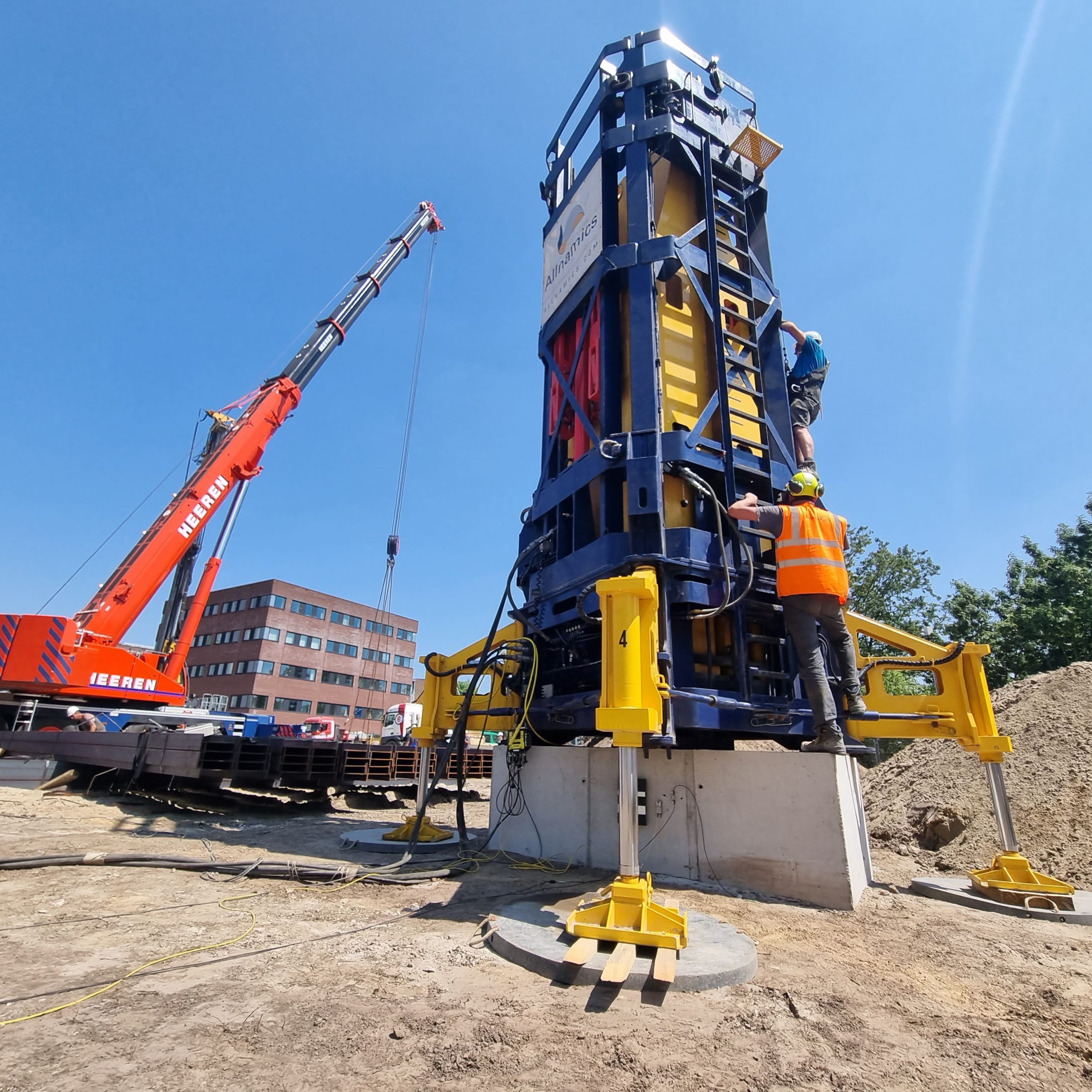
Rapid load testing applies a load over a duration of around 100 milliseconds, which is long enough to separate inertial and damping effects from static resistance. It produces a load-displacement response that, after signal processing, approximates the static load-settlement curve. For projects where full static testing is logistically difficult, rapid load testing offers a practical alternative that still generates the stiffness and capacity data needed for group analysis.
Dynamic load testing
Dynamic load testing is most useful for capacity verification across a large number of piles rather than for generating the detailed stiffness data that group settlement analysis requires. It does not produce a load-settlement curve directly, and its accuracy is lower for friction piles and cast-in-situ concrete piles. However, it is valuable for confirming that production piles within a group achieve the capacity established by the trial pile test, providing quality control across the full foundation program.
For group analysis specifically, the most useful combination is a statically or rapidly tested trial pile with shaft instrumentation, supported by dynamic testing of production piles for quality assurance. This gives you reliable input data for the group model and confidence that the piles being modelled actually match the tested pile’s performance.
How We Support Pile Group Assessment
Translating single pile test results into reliable group behaviour predictions requires both high-quality test data and experienced interpretation. We support your project at every stage of that process, from selecting the right test method to delivering the analysis your design team needs.
- Static load testing with shaft instrumentation: We design and execute static load tests with embedded strain gauges that give you the full load-transfer profile, not just the pile head response. This data feeds directly into interaction factor calculations and equivalent raft analyses.
- Rapid load testing: Where static testing is logistically constrained, our rapid load testing services provide load-settlement data suitable for group stiffness analysis at lower mobilisation cost and shorter programme duration.
- Dynamic load testing for production pile QC: We use dynamic load testing to verify that production piles across the group footprint match the capacity of the tested trial pile, giving you confidence in the uniformity of your foundation.
- Independent technical review and group analysis: Our geotechnical engineers interpret test results in the context of your specific group geometry, soil profile, and design requirements, delivering a clear assessment of predicted group settlement and capacity.
- Offshore and onshore capability: We carry out pile load testing and foundation assessment for projects in both onshore and offshore environments, including wind farm foundations, marine structures, and large infrastructure schemes.
If you are working through a pile group assessment and want to discuss which testing approach gives you the most useful data for your specific conditions, contact our team directly. We will help you design a testing program that answers the right questions efficiently.