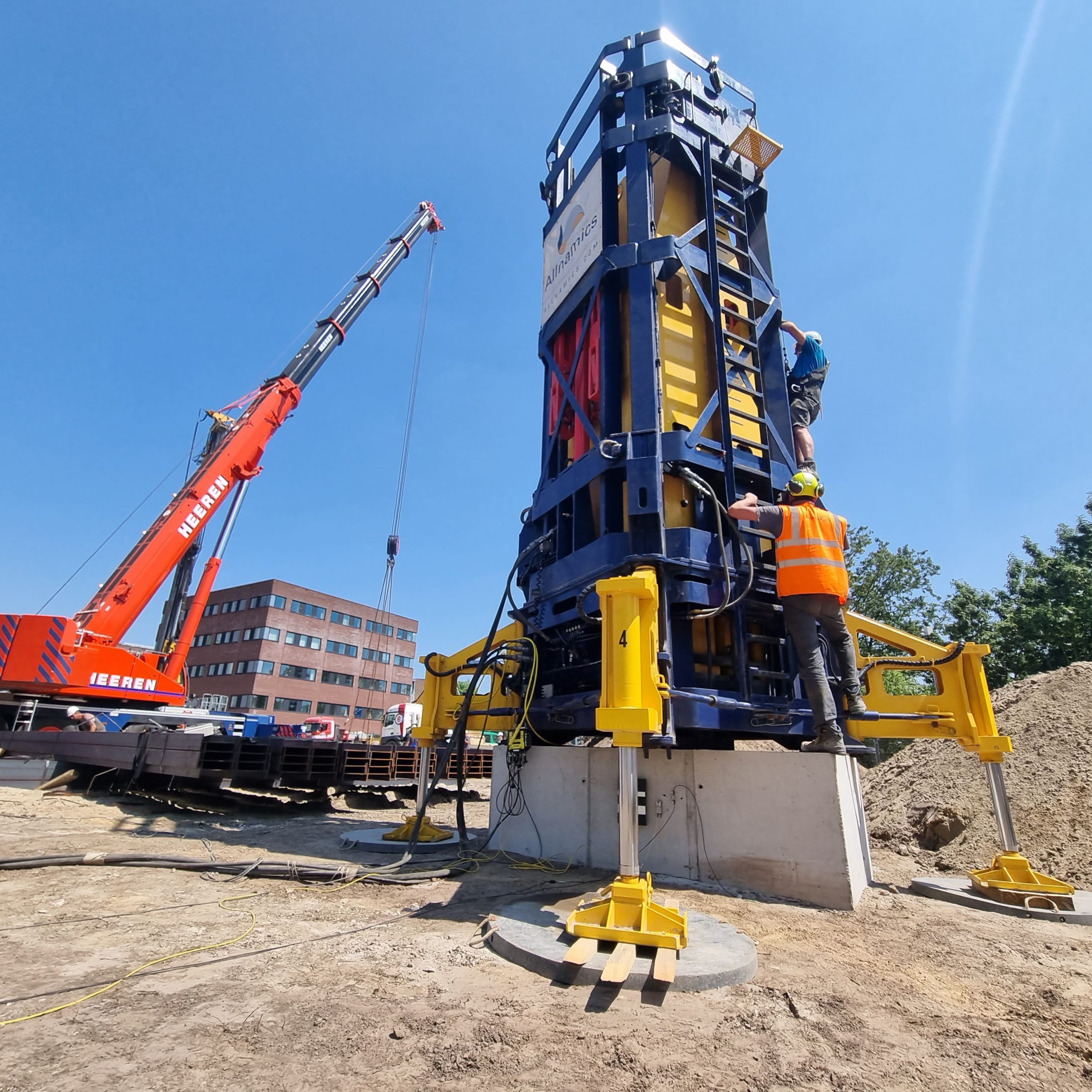



A pile driving prediction, sometimes called a drivability study, is an engineering analysis performed before pile installation to simulate how a pile, the surrounding soil, and the driving hammer will behave during installation. The goal is to confirm that the chosen hammer can drive the pile to its target depth without causing unacceptable stress levels or fatigue damage. Engineers use wave equation software to model the entire driving process and generate actionable guidance before a single blow is struck.
Drivability studies apply to a wide range of foundation types, from onshore foundation piles and sheet pile walls to large-diameter offshore monopiles for wind turbines and oil and gas platforms. The analysis is particularly valuable on projects where installation conditions are uncertain, pile dimensions are large, or the consequences of a failed or damaged pile are severe. The sections below address the most common questions engineers and project teams ask about pile driving predictions.
How does a pile driving prediction actually work?
A pile driving prediction works by building a numerical model of the pile, the soil profile, and the driving hammer, then simulating the stress wave that travels through the pile with each hammer blow. The simulation calculates how much energy reaches the pile tip, how the soil resists penetration at each depth increment, and what stress levels develop in the pile material throughout the driving sequence.
The underlying method is wave equation analysis. When a hammer strikes a pile head, a compressive stress wave propagates downward through the pile. That wave reflects off changes in pile cross-section, soil resistance, and the pile tip. By modeling these interactions mathematically, engineers can predict the blow count required to reach a given depth, the maximum compressive and tensile stresses in the pile, and whether the hammer delivers sufficient energy to overcome soil resistance at the target penetration.
For piles installed with a vibratory hammer, the simulation works differently. Rather than modeling individual impact blows, the analysis models the oscillating force generated by the vibratory hammer and how it interacts with soil resistance over time. The output covers the maximum penetration depth the hammer can achieve, the efficiency of the vibratory process, and the contribution of cyclic stresses to pile material fatigue.
Modern software packages, such as the AllWave suite, run these simulations iteratively across the full depth range of the pile, producing a set of drivability curves that show blow count versus depth, stress envelopes, and hammer performance indicators. These curves give the installation team a clear picture of what to expect at every stage of driving.
What data is needed to run a drivability study?
Running a pile driving prediction requires three categories of input data: a detailed soil profile, the pile geometry and material properties, and the technical specifications of the driving hammer. Without accurate data in all three categories, the reliability of the prediction drops significantly.
Soil data
The soil model is typically built from cone penetration test (CPT) results, borehole logs, or laboratory test data. The analysis needs information on soil layering, unit weight, shear strength, and stiffness. For offshore projects, additional parameters such as cyclic degradation behavior and scour potential may be relevant. The quality of the soil investigation directly limits how reliable the drivability prediction can be, particularly in variable or layered ground conditions.
Pile and hammer data
Pile data includes outer diameter, wall thickness, length, material grade, and any variations in cross-section along the pile shaft. For the hammer, engineers need the rated energy, ram weight, stroke, cushion properties, and the efficiency characteristics of the specific model being used. Hammer manufacturer data sheets provide a starting point, but predictions become more reliable when the model is calibrated against measured performance data from comparable projects.
When all three data sets are complete and of good quality, the prediction can generate output that is directly usable for installation planning, equipment selection, and fatigue assessment. When data is incomplete, engineers typically run sensitivity analyses across a range of assumed values to bracket the expected behavior and identify which uncertainties carry the most risk.
What can go wrong without a pile driving prediction?
Without a pile driving prediction, installation teams face several avoidable risks: selecting a hammer that is too small to reach the target depth, applying excessive energy that damages the pile, or encountering unexpected refusal before the pile reaches its design penetration. Each of these problems is far more expensive to resolve during installation than to prevent during engineering.
The most common consequence of skipping a drivability study is hammer inadequacy. If the selected hammer cannot deliver enough energy to overcome soil resistance at depth, the pile stalls before reaching its design toe level. At that point, the contractor must mobilize a larger hammer, which adds cost, delays the program, and may require redesigning the pile head to handle higher impact loads.
The opposite problem, using a hammer that is too powerful or driving too aggressively, generates tensile and compressive stresses that can crack concrete piles or cause fatigue damage in steel piles. Tensile cracking is particularly dangerous in prestressed concrete piles, where cracks may not be visible externally but compromise structural integrity. For dynamically loaded foundations such as offshore monopiles, fatigue damage accumulated during installation reduces the remaining fatigue life of the structure in service.
On offshore wind projects, where monopiles are large, expensive, and difficult to replace, an undetected installation problem can have serious consequences for the entire wind farm program. A pile driving prediction provides the engineering basis to set installation criteria, define acceptable blow count ranges, and establish limits on hammer energy that protect the pile throughout driving.
How accurate are pile driving predictions compared to actual results?
Pile driving predictions are generally reliable when the input data is of good quality and the model is built by experienced engineers. In favorable conditions, predicted blow counts and stress levels align closely with measured results during installation. Accuracy degrades when soil conditions are highly variable, when hammer performance deviates from manufacturer specifications, or when the soil model does not capture local layering well.
The most important factor affecting accuracy is the quality of the soil investigation. A prediction built on a single borehole may miss lateral variability that significantly changes soil resistance at depth. Predictions built on multiple CPTs across the installation area are considerably more robust. For offshore projects, where soil conditions can change meaningfully over short distances, a thorough site investigation is the single most effective way to improve prediction accuracy.
Hammer performance is the second major source of deviation. Hammers rarely deliver exactly their rated energy on every blow. Cushion condition, stroke variation, and mechanical efficiency all affect the energy actually transferred to the pile. Predictions that account for a realistic range of hammer efficiency, rather than assuming ideal performance, tend to bracket actual results more reliably.
When predictions are compared against monitoring data collected during actual driving, the results typically show good agreement on blow count trends and stress envelopes, with larger deviations at specific depth intervals where soil layering was not fully captured. This comparison is valuable not just for validating the prediction but also for improving the soil model and refining predictions for remaining piles in the same program.
When should a pile driving prediction be commissioned?
A pile driving prediction should be commissioned during the engineering stage, before equipment is selected and before the installation contract is awarded. At this point, the prediction directly informs hammer selection, pile design, and the installation specification, where it has the most influence on project outcomes and cost.
Commissioning a drivability study early in the project timeline allows the design team to:
- Confirm that the proposed pile dimensions are installable with available equipment
- Identify depth intervals where soil resistance may cause refusal or excessive stress
- Set pile material specifications based on predicted stress levels rather than conservative assumptions
- Define installation criteria, including acceptable blow count ranges and maximum hammer energy limits
- Assess fatigue damage accumulation during driving for dynamically loaded foundations
- Compare multiple hammer options to identify the most efficient choice for the project
A prediction commissioned after equipment has already been mobilized can still add value, but its influence is limited. At that stage, the analysis is more likely to confirm a problem than to prevent one. For projects where installation conditions are uncertain or pile dimensions are at the upper end of what available hammers can handle, early commissioning is particularly important.
Predictions should also be updated if significant changes occur during the project. If the soil investigation reveals conditions that differ from the original model, if the pile design changes, or if a different hammer is proposed, the drivability study should be revised before installation proceeds. Treating the prediction as a living document rather than a one-time deliverable gives the project team the most reliable basis for decision-making throughout the installation program.
How Allnamics Supports Pile Driving Predictions
We perform pile driving predictions for a wide range of foundation types and project environments, from onshore foundation piles and sheet pile walls to large-diameter offshore monopiles for wind farms and oil and gas platforms. Our predictions are built using the AllWave software package, which we developed in-house and which reflects decades of calibrated modeling experience and a large database of predicted and measured results.
When you commission a drivability study with us, we provide:
- Impact hammer predictions (PDP): Full drivability analysis covering blow count versus depth, maximum compressive and tensile stresses, hammer energy requirements, and fatigue damage assessment for dynamically loaded piles
- Vibratory hammer predictions (VDP): Simulation of vibratory installation covering maximum penetration depth, hammer efficiency, stress levels, and fatigue contribution for piles installed without impact driving
- Offshore monopile predictions: Specialized analysis for large-diameter offshore piles, including fatigue accumulation during driving and comparison of hammer options for offshore wind and oil and gas projects
- Sheet pile wall design and installation analysis: Drivability studies for both temporary and permanent retaining structures, covering final stage design and installation simulation
- Sensitivity analysis and scenario comparison: Where soil data is incomplete or variable, we run multiple scenarios to bracket expected behavior and identify which uncertainties carry the most project risk
Our team also supports you during installation by comparing predicted results against real-time monitoring data, allowing the installation specification to be refined as driving progresses. This closes the loop between the engineering prediction and what actually happens in the ground.
If you are planning a piling program and want to confirm your hammer selection, protect your piles from installation damage, or meet the requirements of a pile load testing program, contact us to discuss your project to discuss how a drivability study fits your project timeline and scope.