


How does a constant rate of penetration test work?
A constant rate of penetration (CRP) test is a type of static pile load testing in which a pile is pushed into the ground at a fixed, continuous rate while the resistance force is measured. The load applied to the pile head increases as needed to maintain that constant penetration speed, and the test continues until the pile reaches a defined failure condition or a target penetration depth. This approach produces a clear load-settlement curve that directly reveals the pile’s ultimate bearing capacity. The sections below cover how the test works in practice, how it compares to other methods, and which conditions it suits best.
What happens during a constant rate of penetration test?
During a CRP test, a hydraulic jack pushes the pile downward at a controlled, steady penetration rate, typically between 0.5 mm/min and 1.5 mm/min for most soil conditions. The load required to maintain that rate is recorded continuously throughout the test. The test ends when the load-settlement curve clearly flattens, indicating that the pile has reached its ultimate resistance, or when a specified total settlement is achieved.
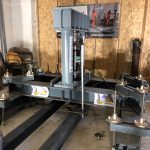
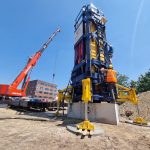
The test setup requires a reaction system to provide the counter-force against which the jack pushes. This is usually a reaction frame anchored by tension piles or kentledge dead weight placed around the test pile. Load cells measure the applied force at the pile head, while displacement transducers or settlement gauges track the pile’s movement with high precision.
Because the penetration rate is held constant, the test typically reaches failure conditions faster than a maintained load test. The continuous loading also means the full load-settlement curve is captured in a single, uninterrupted sequence, making the data straightforward to interpret. The total test duration depends on pile dimensions and target penetration, but CRP tests are generally completed within a few hours.
How does a CRP test differ from a maintained load test?
The key difference between a CRP test and a maintained load test (MLT) is how the load is applied. In a CRP test, the penetration rate is controlled and the load varies to maintain it. In an MLT, the load is applied in fixed increments and held constant at each stage while settlement is monitored over time. These two approaches produce different data and suit different design questions.
Loading control and test duration
A CRP test applies load continuously and reaches ultimate capacity relatively quickly, often within a few hours. An MLT applies load in steps, with each step held for a defined period, meaning the test can take one to several days. For projects where schedule is a constraint, the CRP approach offers a faster path to failure load data.
Time-dependent behavior
Because an MLT holds each load increment for an extended period, it captures creep and time-dependent settlement under sustained loading. This is particularly relevant in soft cohesive soils where long-term consolidation behavior influences pile performance. A CRP test, by contrast, does not replicate sustained loading conditions, so it does not generate the same time-dependent settlement data. For designs governed by long-term settlement rather than ultimate capacity alone, an MLT provides information that a CRP test cannot.
What does a CRP test measure and how is the data interpreted?
A CRP test measures the relationship between applied load and pile head settlement under continuous penetration. The primary output is a load-settlement curve that shows how resistance builds as the pile is pushed deeper. Engineers use this curve to identify the ultimate bearing capacity, typically defined as the load at which the curve becomes approximately horizontal or at which a specified settlement criterion is reached.
Interpretation methods vary by standard and project context. Common approaches include the Chin-Kondner extrapolation, which fits a hyperbolic curve to the data to estimate ultimate load, and direct failure criteria based on a defined settlement limit such as 10% of the pile diameter. The choice of interpretation method affects the reported capacity value, so engineers specify the method in advance as part of the test protocol.
Where the pile is instrumented with strain gauges along its length, the CRP test also reveals how load transfers from the pile to the surrounding soil at different depths. This data distinguishes shaft friction contribution from toe resistance, which is valuable for calibrating design models and understanding how the pile mobilizes capacity in the actual soil profile.
Which soil types and pile types are best suited to CRP testing?
CRP testing is best suited to granular soils such as sand and gravel, where drainage is rapid and the pile’s resistance is not significantly affected by pore water pressure changes during the test. In these conditions, the load-settlement response is stable and the ultimate capacity is reliably captured within the test duration.
In fine-grained cohesive soils such as soft clay, the CRP method is less straightforward. The continuous penetration generates excess pore water pressures that do not dissipate during the test, meaning the measured resistance reflects undrained conditions rather than the long-term drained capacity the pile will experience in service. This does not make the test invalid in clay, but it requires careful interpretation and an understanding of how undrained and drained capacities relate in the specific soil profile.
In terms of pile type, CRP testing applies to both driven piles and bored cast-in-situ piles. For driven piles in granular soils, the test is particularly efficient because the pile’s geometry and material properties are well defined, making the load-settlement data straightforward to interpret. For large-diameter bored piles, the CRP test is a practical option when the reaction system can be scaled to match the higher loads involved. The method is less commonly used for very long, slender piles where elastic compression of the pile shaft itself becomes a significant factor in the measured settlement.
How does a CRP test compare to dynamic and rapid load testing?
A CRP test is a static method that applies load slowly and measures pile response directly. Dynamic load testing (DLT) and rapid load testing (RLT) apply load over much shorter durations and require additional analysis steps to derive static capacity. Each method offers a different balance of accuracy, cost, and logistical complexity.
Dynamic load testing applies a hammer impact lasting milliseconds. Force and velocity are measured at the pile head, and signal matching analysis is used to derive a soil model from which static capacity is estimated. This introduces user dependency and a range of possible outcomes. DLT is efficient for large programs of driven piles in granular soils, but accuracy drops for bored piles and cohesive soils. It does not produce a direct load-settlement curve.
Rapid load testing applies a controlled impulse load over a duration significantly longer than a DLT blow, typically 50 to 200 milliseconds. This eliminates stress wave effects and allows load and settlement to be measured more directly. RLT sits between static and dynamic testing in terms of both test duration and the complexity of data interpretation. It is particularly useful where a direct measurement of capacity is needed but a full static test setup is not practical.
A CRP test, as a static method, produces the most direct and unambiguous load-settlement data. Forces and displacements are measured independently using load cells and displacement gauges, with no post-processing model required to derive capacity. This makes the results easier to defend in regulatory contexts and directly comparable to design assumptions based on static loading. The trade-off is that the test requires a reaction system, which adds cost and setup time compared to dynamic methods.
The table below summarizes the key differences:
- CRP test: Direct load-settlement curve, no model dependency, requires a reaction frame, best for granular soils and where ultimate capacity governs
- Maintained load test: Direct measurement, captures time-dependent behavior, longer duration, suited to cohesive soils and settlement-governed designs
- Rapid load testing: Direct force and settlement measurement, no reaction frame needed, faster than static testing, eliminates stress wave effects
- Dynamic load testing: Indirect method, signal matching required, efficient for large driven pile programs, less accurate for bored piles and clay
What standards and equipment govern CRP testing?
CRP testing is governed by national and international standards that define the penetration rate, test termination criteria, instrumentation requirements, and data interpretation methods. In Europe, EN ISO 22477-1 covers static pile load testing and includes provisions for the CRP method. In the United States, ASTM D1143 addresses axial compressive load testing of piles and includes the CRP procedure as one of the accepted test methods. Project specifications may also reference national annexes or client-specific requirements that supplement these standards.
The core equipment for a CRP test includes a hydraulic jack with a calibrated load cell, a reaction frame or kentledge system, displacement transducers or settlement gauges mounted at the pile head, and a data acquisition system that records load and displacement continuously throughout the test. The penetration rate is controlled either manually by an experienced operator or automatically through a servo-controlled hydraulic system, with the latter providing more consistent rate control and reducing operator influence on the results.
Where embedded instrumentation is specified, vibrating wire strain gauges or sister bars are cast into the pile or attached to the pile shaft before installation. These sensors measure load distribution along the pile during the test, allowing shaft friction and toe resistance to be separated. The data acquisition system must be capable of recording all channels simultaneously at a sufficient sampling rate to capture the continuous loading response without gaps.
How Allnamics Supports Static Pile Load Testing
We carry out static pile load testing, including CRP tests, as part of a broader foundation verification service for construction, infrastructure, offshore, and energy projects. Our team combines decades of experience in pile testing with in-house developed equipment and software, giving your project access to both the field capability and the engineering expertise needed to get reliable results.
Here is what we bring to a CRP test program:
- Test design and protocol development: We define the penetration rate, termination criteria, instrumentation layout, and interpretation method based on your pile type, soil conditions, and design requirements
- Reaction system engineering: We advise on and coordinate the reaction frame or kentledge setup to match the expected test loads
- Field execution: Our engineers manage the full test, from pile head preparation and sensor installation to data acquisition and real-time monitoring during loading
- Data interpretation and reporting: We produce a clear load-settlement curve, apply the agreed interpretation method to determine ultimate capacity, and deliver a report that meets regulatory and client requirements
- Integration with other methods: Where your program benefits from combining static testing with dynamic or rapid load testing, we design a combined approach that maximizes data quality while managing cost and schedule
- Offshore and onshore capability: We perform pile load testing in both onshore and offshore environments, adapting the setup to the logistical constraints of each project
If you are planning a pile testing program and want to discuss whether a CRP test is the right approach for your project, contact our team to talk through your requirements.