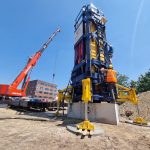



What is a reaction system in static pile load testing?
A reaction system in static pile load testing is the structural setup that provides the opposing force needed to push or pull a test pile to its design load. Without a reaction system, there is nothing to push against, so the load cannot be applied. The two principal types are kentledge systems, which use dead weight stacked above the pile, and anchor pile systems, which use tension piles installed around the test pile to resist the applied force. The sections below explain how each system works, what drives the choice between them, and where each one falls short.
What are the main types of reaction systems used in static load testing?
The two main types of reaction systems used in static pile load testing are kentledge (dead weight) systems and anchor pile systems. A third option, the bi-directional (Osterberg cell) method, eliminates the need for an external reaction system entirely by applying load from within the pile itself. Each approach provides the upward or downward resistance that allows a hydraulic jack to apply a controlled, measurable load to the test pile.
In a compression test, the jack pushes the pile downward, so the reaction system must resist an upward force. In a tension test, the jack pulls the pile upward, so the reaction system must resist a downward force. The choice of system affects cost, logistics, test accuracy, and the risk of interference between the reaction system and the pile being tested.
- Kentledge system: A platform and frame support a large mass of dead weight directly above the test pile
- Anchor pile system: Steel tension piles or ground anchors are installed around the test pile and connected to a reaction beam
- Bi-directional system: A hydraulic cell cast into the pile applies load internally, using the upper and lower pile sections as mutual reaction elements
How does a kentledge reaction system work?
A kentledge reaction system works by stacking a large mass of dead weight, typically concrete blocks or steel ingots, on a platform supported by a frame positioned over the test pile. A hydraulic jack sits between the pile head and the underside of the platform. When the jack extends, it pushes the pile downward while the kentledge mass resists the upward reaction force. The total weight of the kentledge must exceed the maximum test load, including a safety margin.
The platform rests on cribbing or support beams placed at a sufficient distance from the test pile to avoid disturbing the surrounding soil. This standoff distance is important: if the kentledge supports bear too close to the pile, the additional stress they impose on the ground can artificially increase the soil resistance measured during the test, leading to an overestimate of pile capacity.
Kentledge systems are self-contained and do not require any additional piles to be installed. This makes them straightforward to set up on sites where ground conditions are uniform and where the required test load is within a manageable weight range. However, mobilizing, transporting, and positioning hundreds of tonnes of dead weight demands significant logistical planning and heavy lifting equipment.
How does an anchor pile reaction system work?
An anchor pile reaction system works by installing a set of tension piles or ground anchors around the test pile and connecting them to a reaction beam that spans across the pile head. A hydraulic jack between the pile head and the beam pushes the test pile downward while the anchor piles resist the upward force by mobilizing their shaft friction and toe resistance in tension. The load path runs from the jack, through the beam, and into the anchor piles.
Anchor piles are typically installed at a minimum clear distance from the test pile, with most standards specifying a separation of at least three times the pile diameter or a defined minimum distance, whichever is greater. This spacing prevents the anchor piles from drawing on the same zone of soil resistance as the test pile, which would artificially inflate the measured capacity.
The number and size of anchor piles depend on the required test load and the available shaft friction in the soil profile. In favorable ground conditions, a relatively small number of anchor piles can provide substantial reaction capacity. In weak or variable soils, more anchor piles may be needed, which increases cost and program time. Ground anchors, rather than driven or bored piles, are sometimes used as an alternative where site constraints limit pile installation.
Anchor pile systems are generally more compact than kentledge setups and better suited to sites with limited working space or access restrictions. They are also the preferred approach when test loads are very high, since mobilizing equivalent dead weight becomes impractical above a certain threshold.
What factors determine which reaction system to choose?
The choice of reaction system in a static pile load test depends on the required test load, site access and space, ground conditions, pile type, program schedule, and cost. No single system suits every project, and the decision typically involves balancing several competing constraints at once.
- Required test load: Very high test loads favor anchor pile systems, since assembling equivalent kentledge weight becomes logistically prohibitive above roughly 10 to 20 MN depending on site conditions
- Site access and space: Kentledge requires a large footprint and heavy transport; anchor pile systems are more compact but require space for pile installation around the test pile
- Ground conditions: Anchor piles depend on the soil providing adequate tension capacity; in soft or weak soils, achieving sufficient anchor resistance may require many piles or ground anchors
- Pile type and geometry: Large-diameter bored piles with high capacity are often tested using bi-directional methods or anchor systems; smaller driven piles may suit kentledge setups
- Interference risk: Both systems must be positioned to avoid influencing the stress field around the test pile; the required separation distances affect layout planning
- Program schedule: Kentledge can be assembled relatively quickly if the weight is available on site; anchor piles require installation and curing time before testing can begin
- Cost: Kentledge involves transport and handling of heavy materials; anchor pile systems involve additional pile installation costs but may be more economical at high load levels
On projects where the test pile has significant shaft friction and a well-defined geometry, the bi-directional approach can eliminate the need for an external reaction system entirely, which is particularly useful when space is constrained or test loads are very high.
What are the limitations and risks of each reaction system?
Each reaction system in static pile load testing carries specific limitations and risks that can affect test accuracy, safety, and program efficiency. Understanding these risks before selecting a system helps avoid costly problems during the test itself.
Kentledge system limitations and risks
The most significant technical risk with a kentledge system is soil stress interference. If the support cribs or beams are placed too close to the test pile, the weight of the kentledge compresses the surrounding soil and increases the apparent resistance measured during the test. This produces an optimistic result that does not reflect the pile’s true in-service behavior.
Kentledge systems also present logistical and safety challenges. Assembling and positioning hundreds of tonnes of dead weight requires heavy cranes, robust temporary works, and careful ground-bearing assessments. If the ground beneath the kentledge platform is weak or uneven, there is a risk of settlement or instability during the test. The large footprint of a kentledge setup can also conflict with ongoing construction activities on a busy site.
Anchor pile system limitations and risks
The primary technical risk with anchor pile systems is tension capacity uncertainty. If the anchor piles do not develop sufficient resistance, the reaction system may yield before the test pile reaches its target load, making it impossible to complete the test as planned. This risk is higher in soft cohesive soils or where the anchor pile installation quality is variable.
A second concern is upward heave of the soil between the anchor piles and the test pile. As the anchor piles are loaded in tension, they can cause the surrounding ground to heave upward, which may influence the soil resistance acting on the test pile shaft. Adequate spacing between anchor piles and the test pile reduces this effect, but it cannot always be eliminated entirely.
Anchor pile systems also require additional installation time and cost, and the anchor piles themselves may not be usable as production piles after the test, depending on the loads applied and any residual deformation.
How Allnamics Supports Your Static Load Testing Program
We design and execute static pile load tests for a wide range of project types, from urban building foundations to large-scale infrastructure and offshore developments. Our approach covers the full scope of the test program, from reaction system selection and design through to data acquisition, interpretation, and reporting.
When you work with us on a static load test, we help you with:
- Reaction system selection: We assess your site conditions, pile type, required test load, and program constraints to recommend the most appropriate system, whether kentledge, anchor piles, or bi-directional
- Test design and setup: We design the reaction frame, specify separation distances, and plan the load application sequence to ensure the test produces accurate, reliable results
- Instrumented testing: We use purpose-designed equipment to obtain high-quality readings of load and settlement throughout the test, including embedded instrumentation where load transfer distribution is needed
- Compression and tension testing: We perform static tests in both compression and tension, vertically, horizontally, or at any slope, depending on the design requirements
- Result interpretation: Our engineers analyze load-settlement behavior, shaft and toe resistance, and design factors, providing you with the data needed to verify or optimize your foundation design
- Integration with other methods: Where static testing alone does not cover all project needs, we combine it with dynamic load testing or rapid load testing to give you a complete picture of foundation performance
If you are planning a static pile load test and want to discuss which reaction system fits your project, contact our team to talk through the options with an engineer who has hands-on experience across a wide range of ground conditions and project types.
Artículos relacionados
- How does stand-alone data logging work during monopile installation?
- How does a pile driving analyser measure force and velocity?
- How do you assess pile group behaviour from single pile tests?
- How does pile testing support decarbonisation in foundation design?
- How accurate is dynamic pile load testing compared to static testing?