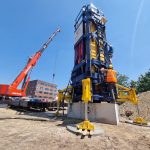



What is low strain integrity testing and what does it detect?
Low strain integrity testing is a non-destructive method used to assess the structural integrity of foundation piles. A small impact is applied to the pile head, and the resulting stress wave is measured and analyzed to identify defects such as cracks, voids, cross-section changes, and soil inclusions. The method is fast, cost-effective, and can be applied to all piles on a site without significant disruption to construction schedules. The sections below answer the most common questions about how the method works, what it detects, and when to use it.
How does low strain integrity testing actually work?
Low strain integrity testing works by striking the pile head with a small hand-held hammer and recording the stress wave that travels down the pile using an accelerometer attached to the pile head. The wave travels through the pile at a speed determined by the material properties, and any change in cross-section, material stiffness, or pile continuity causes a partial reflection of that wave back to the sensor. Analyzing the timing and amplitude of these reflections reveals the location and nature of any anomaly.
The process follows a straightforward sequence:
- The pile head is prepared and cleaned to allow good sensor contact.
- An accelerometer is fixed to the pile head.
- A technician strikes the pile with a calibrated hand hammer.
- The sensor records the velocity response over time.
- The recorded signal is processed using signal matching software to produce a pile shape profile, expressed as impedance along the pile length.
The wave speed through the pile material is known in advance, which means the depth of any reflection can be calculated directly from the time it takes the wave to travel down and return. A clean, uniform pile produces a smooth signal with a single reflection at the pile toe. Anomalies appear as earlier, unexpected reflections in the signal trace. Software such as AllWave-SIT converts these signals into a visual representation of pile impedance with depth, making interpretation more systematic and less dependent on manual reading of raw waveforms.
The term «low strain» refers to the fact that the hammer impact is small enough that the pile material remains within its elastic range throughout the test. No permanent deformation occurs, and the pile is not loaded anywhere near its structural or geotechnical capacity. This distinguishes the method from high strain dynamic testing, where a much heavier impact is used to mobilize soil resistance.
What defects can low strain integrity testing detect?
Low strain integrity testing detects defects that alter the cross-section, continuity, or material stiffness of a pile. The method identifies cracks, changes in cross-sectional area, soil inclusions, voids, and other imperfections that affect how the stress wave travels through the pile. It does not measure bearing capacity, but it does flag structural conditions that could compromise long-term pile performance.
The specific defect types the method can detect include:
- Cracks: Transverse cracks interrupt the pile cross-section and produce a clear reflection in the signal.
- Necking: A reduction in cross-sectional area causes a downward impedance change, visible as a positive reflection in the velocity trace.
- Bulging: An increase in cross-section produces the opposite signal response, indicating more material than expected at that depth.
- Soil inclusions: Pockets of soil trapped within a cast-in-situ pile during concreting reduce local stiffness and show up as anomalies in the signal.
- Voids: Air pockets or honeycombing within concrete piles affect wave transmission and appear as irregularities in the recorded response.
- Pile toe location: When the pile is intact, the method also confirms the actual pile length by identifying the toe reflection.
The method has practical limitations in what it can resolve. Defects located deep in long piles may be difficult to detect because the signal attenuates as it travels, particularly in piles with high soil friction along the shaft. Defects below a major anomaly are also harder to identify, since the first significant reflection reduces the energy available to probe deeper. For large-diameter bored piles where more detailed information is needed, sonic logging through pre-installed tubes provides a more thorough assessment.
What types of piles can be tested with this method?
Low strain integrity testing is most effective on concrete piles, both precast and cast-in-situ. It applies to driven precast concrete piles, bored piles, continuous flight auger piles, and diaphragm wall panels. The method is particularly valuable as a first-pass quality check on cast-in-situ piles, where the concreting process introduces the greatest risk of defects.
The method works best when the pile material has a well-defined and consistent wave speed. Concrete satisfies this requirement well, which is why the test was originally developed for concrete piles and remains most widely used in that context. Steel piles can also be tested, though the high wave speed in steel and the typically uniform geometry of driven steel sections make integrity defects less common and the test less frequently applied.
Timber piles can be assessed using the same principle, though variable material properties in timber make signal interpretation more complex. For large-diameter bored piles with diameters above roughly 600 mm, the one-dimensional wave propagation assumption underlying the method becomes less reliable, and sonic logging is generally preferred as a complement or alternative.
Because the test is fast and requires minimal preparation, it is practical to test every pile on a site rather than a selected sample. This makes it a useful screening tool across an entire pile program, with more detailed follow-up testing applied only to piles where the initial signal raises questions.
What’s the difference between low strain and high strain pile testing?
The key difference between low strain and high strain pile testing is the purpose and the magnitude of the impact applied. Low strain testing uses a small hammer impact to assess pile integrity without mobilizing soil resistance. High strain testing uses a heavy drop hammer to generate forces large enough to mobilize the surrounding soil, allowing bearing capacity to be estimated alongside integrity information.
The two methods answer different questions:
Low strain integrity testing
The goal is to assess the structural condition of the pile. The impact is small, the pile remains elastic, and no significant soil resistance is mobilized. The test tells you whether the pile is continuous, uniform, and free of major defects. It does not tell you how much load the pile can carry. Because the impact is small, the test is quick, inexpensive, and can be applied to every pile on a project.
High strain dynamic load testing
The goal is to estimate bearing capacity and assess pile integrity under realistic loading conditions. A heavy drop mass strikes the pile head, generating forces that mobilize soil resistance along the shaft and at the toe. Sensors measure force and acceleration, and signal matching analysis derives a soil model from which static capacity is estimated. This is a more involved and expensive test, typically applied to a representative sample of piles rather than every pile on site.
In practice, the two methods complement each other. Low strain testing screens the full pile population for structural defects quickly and at low cost. High strain dynamic load testing then provides capacity verification on selected piles, with integrity information as a secondary output. For projects where bearing capacity is the primary concern and piles are driven steel sections with uniform geometry, high strain testing may be the primary method. For cast-in-situ concrete piles where construction quality is the main risk, low strain integrity testing is often the first and most important check.
When should low strain integrity testing be carried out?
Low strain integrity testing should be carried out after pile installation is complete but before the superstructure is built. For cast-in-situ concrete piles, testing takes place once the concrete has reached sufficient strength, typically after a curing period specified by the project engineer. For driven precast piles, testing can be performed shortly after driving is complete.
The timing matters for practical reasons. Testing before the pile cap or ground slab is poured provides access to the pile head, which is a requirement for the test. Once the structure above is in place, access becomes difficult or impossible without intrusive work. Identifying defects at the piling stage also means remediation options are still available and manageable. Discovering a structural problem after the superstructure is loaded is far more costly to address.
There are also situations where testing is useful outside the standard post-installation window:
- Before foundation reuse: When an existing building is being redeveloped and the original piles may be retained, low strain testing provides a rapid assessment of pile condition without excavation.
- After a construction incident: If piles may have been damaged by nearby driving, excavation, or other site activities, testing can confirm whether integrity has been affected.
- As part of a condition assessment: For older structures where foundation performance is uncertain, the method offers a non-destructive starting point before more detailed investigation.
On large projects, testing all piles immediately after installation and before the next construction phase begins is good practice. It keeps the testing program on the critical path and avoids delays caused by the late discovery of defects.
How reliable are low strain integrity test results?
Low strain integrity test results are reliable for detecting significant defects in the upper portion of concrete piles, but the method has well-understood limitations that affect what can be concluded with confidence. Signal quality, pile length, soil conditions, and the experience of the engineer interpreting the results all influence how much information the test can reliably provide.
The method performs best when:
- The pile is relatively short and slender, allowing the stress wave to reach the toe with sufficient energy.
- Soil friction along the shaft is low, so the signal is not heavily attenuated before it returns.
- The pile material is homogeneous concrete with a consistent wave speed.
- The pile head is well-prepared and the sensor is properly coupled.
Reliability decreases for long piles in high-friction soils, where signal attenuation can prevent detection of defects in the lower portion of the pile. In these cases, the absence of a signal anomaly does not necessarily confirm that the lower pile is defect-free. Engineers experienced in the method recognize this limitation and report results accordingly, distinguishing between the portion of the pile that can be assessed with confidence and the portion where signal quality is insufficient for a definitive conclusion.
The interpretation step is also a factor. Raw signals require analysis by a qualified engineer using appropriate software. The same signal can be interpreted differently depending on the analyst’s experience and the tools used. Signal matching software improves consistency and reduces dependence on subjective reading of waveforms, but it does not eliminate the need for engineering judgment. Results should always be reported with a clear statement of the depth range over which the assessment is considered reliable, and any ambiguous signals should be flagged for follow-up investigation rather than dismissed.
How Allnamics Supports Pile Integrity Testing
We developed the Sonic Integrity Test in the 1960s and 1970s, and our engineers have been refining and applying the method ever since. When your project requires integrity testing, we bring that depth of experience directly to your site and your team.
Here is what working with us on a pile integrity testing program looks like in practice:
- Full-program testing: We test every pile on site efficiently, giving your team a complete picture of pile quality before construction advances.
- Advanced signal analysis: We use our AllWave-SIT software to convert raw signals into impedance profiles, improving the accuracy and consistency of interpretation.
- Experienced engineering judgment: Our engineers assess signal quality, identify the reliable depth range for each pile, and flag ambiguous results for follow-up rather than reporting false certainty.
- Integration with other testing methods: Where low strain testing raises questions, we can follow up with sonic logging, dynamic load testing, or other methods to provide the additional detail your project requires.
- Foundation reuse assessments: If you are evaluating existing piles for reuse in a redevelopment project, we use integrity testing as part of a broader condition assessment to help you make informed decisions about what can be retained.
Whether you are managing a large-scale infrastructure program, a residential development, or a complex redevelopment project, we can design a testing approach that fits your schedule, budget, and technical requirements. Contact us to discuss your project to discuss what low strain integrity testing can do for your project.
Artículos relacionados
- Is pile head preparation required for Rapid Load Testing?
- How does a pile driving analyser measure force and velocity?
- How do you assess pile group behaviour from single pile tests?
- How is a reference pile selected for a load test programme?
- How does pile load testing work on large infrastructure projects?