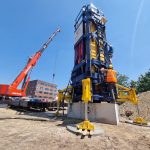



What is ASTM D1143 and how is it applied?
ASTM D1143 is the standard test method for deep foundations under static axial compressive load, published by ASTM International. It defines the procedures, equipment requirements, and acceptance criteria for conducting a static pile load test in compression. Engineers and project specifications reference it when they need a standardized, reproducible method for verifying that a pile or drilled shaft meets its design load requirements.
The standard applies to a wide range of deep foundation types, including driven piles, drilled shafts, and auger-cast piles, making it one of the most widely referenced documents in pile load testing practice across North America and internationally. The sections below unpack the key questions engineers and project teams typically ask when ASTM D1143 appears in a specification.
What does ASTM D1143 actually test for?
ASTM D1143 tests the axial compressive load-carrying capacity and load-displacement behavior of a single deep foundation element. The test measures how much a pile head moves under a series of applied compressive loads, producing a load-settlement curve that engineers use to confirm bearing capacity and assess stiffness under working conditions.
The test is not simply a pass-or-fail check. It generates a continuous record of pile head displacement at each load increment, which reveals how the pile mobilizes resistance as load increases. From this data, engineers can identify the relative contributions of shaft friction and toe resistance, assess whether the pile behaves elastically or begins to yield, and determine whether the pile has reached its ultimate capacity or is still within its elastic range at the maximum test load.
ASTM D1143 also captures time-dependent behavior. Under sustained loads, creep displacement is recorded, giving engineers insight into long-term settlement under constant load. This is particularly relevant in cohesive soils where time-dependent deformation is a real design concern. The standard’s scope covers both proof load tests, which verify performance up to a specified load, and tests taken to failure, which establish the ultimate geotechnical capacity of the pile.
What are the different loading procedures in ASTM D1143?
ASTM D1143 defines several loading procedures, and the choice between them depends on the test objective. The most commonly used are the Quick Load Test method and the Maintained Load method, but the standard also includes cyclic loading and other variants for specific project needs.
Maintained Load (ML) method
The Maintained Load method applies load in increments, typically 25% of the design load, and holds each increment until the rate of settlement slows to a defined threshold before the next increment is applied. This method captures time-dependent behavior at each load level and is well-suited when creep characteristics or long-term settlement data are needed. It is slower and more resource-intensive, often taking 24 to 72 hours to complete.
Quick Load Test (QLT) method
The Quick Load Test applies load increments at fixed time intervals, typically every 2.5 minutes, regardless of whether settlement has stabilized. This makes the test significantly faster, often completing in a few hours. It is widely used for production pile testing programs where schedule and cost efficiency matter, and where the primary objective is capacity verification rather than detailed creep analysis. The Quick Load Test is the most common procedure specified on construction projects today.
Beyond these two primary methods, ASTM D1143 includes procedures for cyclic loading, which applies repeated load-unload cycles to assess stiffness degradation, and loading to a specified settlement, which continues the test until a defined pile head displacement is reached rather than a defined load. Each procedure produces a different type of data, so the specification should clearly state which method is required and why, rather than simply citing the standard number alone.
How does ASTM D1143 differ from other pile testing standards?
ASTM D1143 specifically governs static axial compressive load testing and is distinct from standards covering other test types, other load directions, and other national frameworks. Understanding where it sits relative to related standards helps teams select the right specification for their project.
Within the ASTM family, ASTM D1143 addresses compression only. Lateral load testing is covered by ASTM D3966, and axial tension testing falls under ASTM D3689. These are separate documents with different procedures and instrumentation requirements, even though the physical test setup shares some common elements. A project requiring both compression and lateral testing must reference both standards.
Compared to dynamic load testing, which is governed by ASTM D4945, ASTM D1143 applies a slow, sustained load that directly measures pile response without requiring stress wave analysis or signal matching. This makes the results more straightforward to interpret and more directly comparable to the loads a pile experiences in service. Dynamic testing is faster and less expensive but introduces analytical complexity and uncertainty that static testing avoids.
Internationally, engineers may encounter ISO 22477-1 for static load testing or national standards such as BS EN ISO 22477 in Europe. These documents share the same underlying principles as ASTM D1143 but differ in load increment definitions, acceptance criteria, and reporting requirements. Projects with international stakeholders or regulatory oversight should confirm which standard governs, as specifying ASTM D1143 on a European project may create compliance questions if the local framework references ISO or EN standards instead.
What equipment and instrumentation does ASTM D1143 require?
ASTM D1143 requires a reaction system capable of applying the target test load, a hydraulic jack and pump to deliver that load, a calibrated load cell to measure applied force, and displacement measurement devices to record pile head movement. The accuracy and calibration of each component directly affect the reliability of the test results.
The reaction system is typically one of three configurations: a kentledge (dead weight) platform, a system of tension anchors or reaction piles, or a combination of both. The reaction system must be capable of delivering at least 110% of the maximum planned test load to provide a safety margin. Its design must also ensure that the reaction forces do not influence the test pile’s soil response, which means maintaining adequate spacing between the test pile and any reaction elements.
Load measurement requires a calibrated hydraulic jack with a pressure gauge or, preferably, a separate load cell placed between the jack and the pile head. Load cells provide more accurate readings than pressure gauges alone, particularly at high loads where hydraulic friction in the jack can introduce error. ASTM D1143 specifies calibration requirements for load-measuring devices to ensure traceability and accuracy.
Displacement is measured using dial gauges or electronic displacement transducers mounted on a reference beam that is independent of both the test pile and the reaction system. The reference beam must be stable and shielded from temperature changes, vibration, and accidental disturbance during the test. ASTM D1143 specifies minimum distances between the reference beam supports and the test pile to prevent the beam itself from being affected by pile movement or soil displacement.
For more detailed analysis, engineers often supplement the basic instrumentation with tell-tales (rod extensometers) or strain gauges embedded along the pile shaft. These allow the load distribution between shaft friction and toe resistance to be separated, providing data that the surface instrumentation alone cannot deliver. While not always required by the standard, embedded instrumentation is increasingly specified on complex projects where understanding load transfer mechanisms is as important as confirming total capacity.
How is pile capacity determined from ASTM D1143 results?
Pile capacity from an ASTM D1143 test is determined by analyzing the load-settlement curve produced during the test. Several interpretation methods exist, and the standard does not mandate a single approach. The method used should be defined in the project specification before testing begins, because different methods can produce meaningfully different capacity values from the same test data.
The most widely used interpretation methods include:
- Davisson Offset Limit: Defines failure as the load at which settlement exceeds a specified offset from the elastic compression line of the pile. It is commonly used for driven piles and produces a conservative, well-defined failure load.
- Chin-Kondner extrapolation: Fits a hyperbolic curve to the load-settlement data to extrapolate an ultimate load, useful when the test does not reach clear failure but needs a capacity estimate.
- De Beer method: Plots load and settlement on a log-log scale and identifies the failure load at the break in slope, often used in European practice.
- Settlement-based criteria: Some specifications define failure simply as the load at which pile head settlement reaches a defined value, such as 10% of the pile diameter.
When the test is taken to clear plunging failure, the ultimate capacity is more directly observable from the curve. When the test is a proof load test that stops at a specified load without reaching failure, the result confirms that the pile can sustain that load within acceptable settlement limits, but does not establish the ultimate capacity. Engineers should be clear about which objective the test is designed to meet, as this affects both the test procedure and how the results are used in design.
When should ASTM D1143 be specified on a project?
ASTM D1143 should be specified when a project requires direct, unambiguous verification of pile compressive capacity and load-settlement behavior under sustained loading. It is the right choice when regulatory requirements demand static testing, when the pile type or soil conditions make dynamic testing unreliable, or when the design depends on understanding long-term settlement and creep behavior.
Static load testing under ASTM D1143 is particularly relevant in the following situations:
- Cast-in-situ concrete piles and bored piles: Variable cross-sections and uncertain material properties make dynamic testing less accurate for these pile types. Static testing produces direct, reliable results without the analytical uncertainty that dynamic signal matching introduces.
- Cohesive soils: In clay-dominated profiles, time-dependent behavior and pore water pressure effects are significant. Static testing captures these effects directly; dynamic testing cannot replicate them.
- Design validation on trial piles: Before a production pile program begins, testing a small number of trial piles to failure under ASTM D1143 establishes the actual capacity and load-settlement response, allowing design assumptions to be confirmed or refined.
- Projects with strict regulatory or contractual requirements: Some infrastructure owners, public authorities, and building codes specifically require static load testing as the primary verification method, particularly for high-consequence structures.
- Situations where load-settlement behavior governs design: When allowable settlement is the controlling design criterion rather than ultimate capacity, the detailed load-displacement data from a static test is more useful than a capacity estimate from dynamic testing.
On large production pile programs, ASTM D1143 testing is often combined with dynamic load testing. Static tests on a small number of trial or indicator piles establish the reference capacity and load-settlement behavior, while dynamic testing provides efficient quality control across the broader pile program. This combined approach balances the accuracy of static testing with the speed and cost-effectiveness of dynamic methods.
How Allnamics Supports Static Pile Load Testing
We design, plan, and execute static pile load testing programs that comply with ASTM D1143 and equivalent international standards, delivering accurate, defensible results for projects of any scale and complexity. Our team brings decades of experience in static load testing across a wide range of pile types, soil conditions, and project environments, onshore and offshore.
When you work with us on a static load test program, we provide:
- Test program design: We define the appropriate loading procedure, instrumentation layout, and interpretation method based on your pile type, soil profile, and design objectives, so the test delivers the data your project actually needs.
- Dedicated testing equipment: We use purpose-built equipment designed for high-quality load and settlement measurement, including calibrated load cells and precision displacement systems that meet ASTM D1143 requirements.
- Embedded instrumentation: Where load transfer analysis is needed, we install tell-tales or strain gauges along the pile shaft to separate shaft friction from toe resistance, giving your design team a complete picture of pile behavior.
- Expert interpretation: Our engineers analyze the load-settlement data using the interpretation method specified for your project, and we provide clear, well-documented reporting that supports design decisions and regulatory submissions.
- Combined testing strategies: When your program calls for both static and dynamic testing, we integrate both methods into a coherent testing strategy, using dynamic load testing for production pile quality control and static testing for trial pile verification.
If you are specifying pile load testing for an upcoming project or need independent technical advice on which testing approach fits your foundation design, contact our team directly. We will help you define a testing program that gives your project the confidence it needs.
Artículos relacionados
- Why is hookload so important in a Vibratory Driving Prediction?
- Why is AllWave-VDP the most used prediction program for offshore installation predictions?
- Is there a comparison of a static load test to a Rapid Load Test?
- Can Rapid Load Testing load a pile up to soil failure?
- How do residual stresses affect dynamic pile test results?