

Why should pile stresses be checked before pile installation?
Pile stresses should be checked before installation because driving a pile into the ground generates powerful compressive and tensile stress waves that can crack, split, or permanently damage the pile before it ever carries a load. Without a pre-installation stress check, you have no way to confirm that your chosen hammer and soil conditions stay within the structural limits of the pile. The sections below walk through the mechanics of pile driving stress, the types of damage it causes, how drivability studies predict it, and what happens when the check is skipped.
What happens to a pile when it is driven into the ground?
When a hammer strikes the top of a pile, it does not simply push the pile downward as a rigid body. The impact generates a compressive stress wave that travels down the pile at a speed determined by the pile material and cross-section. This wave interacts with shaft friction along the pile’s length and with soil resistance at the toe, producing reflected waves that travel back up toward the pile head.
The core sequence is: hammer impact generates a stress wave, the wave propagates through the pile, the pile and soil interact, the pile achieves a small permanent penetration, and reflected waves return to influence the next blow. This cycle repeats with every hammer strike throughout the entire installation process.
Because the pile is treated as an elastic rod rather than a rigid body, forces, velocities, displacements, and stresses all vary as a function of both time and depth. A pile that looks intact at the surface can be experiencing very high tension or compression at a point several metres below ground at the same moment. This is why surface observation alone is never sufficient to confirm that a pile is being installed safely.
What types of pile stresses can cause damage during installation?
Two categories of stress govern pile integrity during driving: compressive stress and tensile stress. Both can exceed the structural capacity of the pile material if the hammer energy, pile geometry, or soil conditions are not properly matched.
Compressive stress occurs at the moment of impact and is highest near the pile head. In concrete piles, excessive compression can crush the concrete or damage prestressing strands. In steel piles, it can cause local buckling or permanent deformation at the pile tip when hard layers are encountered.
Tensile stress is often the less obvious but equally damaging risk. When the downward compressive wave reaches the pile toe and reflects back upward, it can return as a tensile wave under certain soil conditions, particularly when toe resistance is low relative to shaft friction. For concrete and prestressed concrete piles, tensile capacity is far lower than compressive capacity, meaning even moderate tensile stress can cause cracking. Once a crack forms, the cross-sectional impedance of the pile changes, which alters subsequent wave propagation and can accelerate further damage with every additional blow.
For concrete piles specifically, it is also worth tracking stresses in the reinforcement and the development of cracks over the course of installation, not just at a single moment. A pile may survive the first hundred blows and then crack when it encounters a stiffer layer deeper in the profile.
How does a drivability study predict pile stresses before installation?
A drivability study uses one-dimensional stress-wave analysis to simulate every hammer blow across the full depth of pile installation before a single pile is driven on site. The analysis models the coupled interaction between the hammer, the driving system, the pile, and the soil resistance at each penetration level, producing predicted stresses, blow counts, energy transfer, and pile movement as continuous functions of depth.
The key outputs relevant to pile stress include:
- Maximum compressive stress as a function of depth and penetration
- Maximum tensile stress as a function of depth and penetration
- Energy transferred into the pile per blow
- Blow count or penetration rate throughout installation
- Refusal risk at specific depth intervals
- For concrete piles: crack initiation depth and interaction between concrete and reinforcement
The analysis does not answer only whether the pile can reach the target depth. It answers whether the pile can reach that depth without being structurally compromised in the process. These are two separate questions, and a drivability study must address both simultaneously.
Hammer selection is a direct output of this process. A heavier or more energetic hammer may improve penetration through a dense sand layer but simultaneously generate compressive stresses that exceed the pile’s structural limits at shallower depths. The goal is to identify an operational window: enough energy to overcome soil resistance at every relevant depth, but not so much that structural limits are breached at any point along the installation profile. You can explore how AllWave software supports this type of simulation in detail.
The quality of the prediction depends directly on the quality of the input: the soil model, the uncertainty range around that model, hammer performance data, pile geometry, and friction fatigue behaviour all feed into the result. A drivability study is only as reliable as the ground investigation and the systematic comparison of previous predictions with measured installations.
What are the consequences of skipping a pre-installation stress check?
Skipping a pre-installation stress check means driving piles without knowing whether the hammer energy stays within the structural limits of the pile at every depth. The consequences range from hidden pile damage to complete installation failure, and the costs of remediation are almost always far higher than the cost of the analysis that was skipped.
The most common consequences include:
- Cracked or fractured concrete piles caused by tensile stress during driving, which may not be visible from the surface and can only be detected through integrity testing after the fact
- Early refusal, where the pile stops penetrating before reaching the required depth, requiring a larger hammer, soil removal, or a revised installation strategy
- Pile damage from oversized hammers, where a contractor selects a larger hammer to overcome refusal risk without realising that the increased energy generates compressive stresses beyond the pile’s capacity
- Bearing capacity uncertainty, because a damaged pile does not perform as designed and may require load testing, replacement, or structural remediation
- Programme delays and cost overruns from unplanned remedial actions mid-installation
Some remedial actions, such as switching to a larger hammer or applying soil removal techniques, can themselves introduce additional stress risks or alter the final bearing capacity of the pile. Addressing these problems after installation has begun is significantly more disruptive and expensive than resolving them at the design stage through a proper drivability analysis.
How are pile stresses monitored in real time during driving?
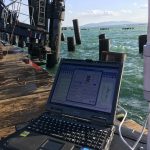
Real-time pile stress monitoring during installation is carried out using Pile Driving Analysis (PDA), which involves attaching strain gauges and accelerometers to the pile near the head. These sensors record force and velocity signals for every hammer blow, allowing engineers to calculate transferred energy, compressive stress, tensile stress, and an estimate of soil resistance in near real time.
PDA monitoring serves as the field verification of the pre-installation drivability study. Where the study predicts stress levels, PDA confirms whether those predictions hold under actual site conditions. If measured stresses approach or exceed allowable limits, the installation can be paused and the hammer energy adjusted before damage occurs.
For offshore installations or situations where access to the pile head is limited, specialised monitoring systems can be deployed that transmit data continuously throughout driving. The combination of a pre-installation drivability study and real-time PDA monitoring gives your team the most complete picture of pile behaviour: predicted performance before driving starts and measured performance as it happens.
When should a pile stress check be repeated or updated?
A pre-installation pile stress check should be updated whenever the conditions that informed the original analysis change in a meaningful way. A single drivability study produced at the design stage is not automatically valid for the entire project if key parameters shift between design and construction.
Specific situations that warrant a repeat or updated analysis include:
- A different hammer is selected than the one used in the original analysis, particularly if it has a different energy rating or drop height range
- Revised ground investigation data becomes available, such as additional CPT profiles or laboratory test results that change the soil model
- Pile geometry or material changes, including a different pile cross-section, wall thickness, or concrete grade
- Unexpected field behaviour during the first piles driven, such as blow counts significantly higher or lower than predicted, or PDA measurements showing stress levels outside the predicted range
- A change in target penetration depth driven by revised design requirements or foundation layout changes
- Vibratory pre-installation followed by impact driving, where the soil state after vibratory driving may differ substantially from the original soil model
Treating the drivability study as a living document rather than a one-time deliverable is good practice on any project where ground conditions are variable or where the installation programme extends over a long period. Systematic comparison of predicted blow counts and stresses with measured PDA data from early piles also improves the reliability of predictions for the remaining installation programme.
How We Help You Manage Pile Stress Risks
We provide drivability studies and pile stress analysis for impact-driven and vibratory-driven piles, onshore and offshore, using our in-house-developed AllWave software suite. Our approach covers the full installation process, not just the question of whether a pile can reach target depth.
Here is what we deliver as part of a drivability and pile stress assessment:
- AllWave-PDP analysis for impact driving: blow count versus penetration, maximum compressive and tensile stresses at every depth, energy transfer, refusal risk assessment, and hammer selection guidance
- AllWave-VDP analysis for vibratory driving: penetration rate prediction, soil fatigue modelling including depth-dependent loading history, and stress assessment throughout vibratory installation
- Soil modelling from CPT, SPT, and laboratory data: we build the ground model from your site investigation data and apply uncertainty bandwidths to capture the range of realistic installation conditions
- Hammer selection review: we identify the operational window where your hammer delivers sufficient energy to overcome soil resistance without exceeding the structural limits of the pile at any depth
- PDA monitoring during installation: real-time field verification of predicted stresses, with the ability to adjust hammer settings if measured values approach allowable limits
- Post-installation comparison: systematic review of predicted versus measured performance to improve reliability for the remainder of your installation programme
Whether you are planning a new offshore wind foundation programme, a land-based infrastructure project, or a marine structure, a proper pile stress check before installation protects your piles, your programme, and your budget. Contact our team to discuss your project and find out how we can support your drivability assessment.
Artículos relacionados
- What is friction fatigue during pile driving?
- How can the Allnamics Learning Loop improve future Drivability Predictions?
- Why should lower, best-estimate and upper-bound soil resistance be analysed?
- How does a pile driving analyser measure force and velocity?
- How does pile load testing work on large infrastructure projects?